CBD does nothing for you? 6 reasons you can check
Feeling nothing from CBD is common, and it usually comes down to six factors: a product that does not contain what its label says, a dose far below those used in studies, the route of intake, timing, expectations shaped by THC, and your own body. CBD does not get you high, so the absence of a sensation is not in itself a sign of a bad product. It is also a legitimate result.
Contents
- 011. The product does not contain what the label says
- 022. The dose is far from those used in studies
- 033. The route of intake changes what reaches the blood
- 044. Timing: a peak in hours, a steady level in days
- 055. You expect an effect CBD does not produce
- 066. Your body and the context
- 07Running an honest trial: five rules
- 08Frequently asked questions
> Key takeaways > > - In 2023, 8 CBD products in 10 analysed by three French addiction monitoring centres did not match their labelled content. > - EFSA's provisional safe level is about 2 mg a day for 70 kg; the 2019 trial that measured an effect used 300 mg in one dose. > - Swallowed on an empty stomach or with a fatty meal, CBD does not reach the blood in the same amounts: up to 5 times more with the meal. > - In a 2021 study, a CBD-free oil presented as "CBD oil" was enough to change what people reported feeling. > - CBD is not a medicine, except Epidyolex, prescribed for rare forms of epilepsy.
1. The product does not contain what the label says
This is the first lead, and the easiest to check. In a press release of 19 June 2025, the French agencies ANSES and ANSM cite a study carried out in 2023 by the addiction monitoring centres of Lyon, Paris and Montpellier: 8 CBD products in 10 had a CBD content different from the one stated. In the United States, a study published in JAMA in 2017 analysed 84 products sold online: only 31% were accurately labelled, and 26% contained less CBD than stated.
The same press release reports the opposite, more serious problem: products sold as CBD that contained THC above 0.3% or synthetic cannabinoids. If a "CBD" product gives you a strong effect, treat it as a warning sign, not as proof of quality.
What you can check: the certificate of analysis must carry the number of the batch in your hand, the measured CBD content, and Δ⁹-THC no higher than 0.30%. Our guide on how to read a certificate of analysis explains each line.
2. The dose is far from those used in studies
On 9 February 2026, EFSA set a provisional safe intake of 0.0275 mg of CBD per kilo per day, about 2 mg for a 70 kg adult. It applies to CBD at least 98% pure and does not cover people under 25, pregnancy, breastfeeding or people on medication.
Do the maths on a bottle. A 5% oil contains 50 mg of CBD per millilitre. With a dropper that delivers about 20 drops per millilitre, one drop provides 2.5 mg. Check the number of drops per millilitre on the leaflet: it varies from one bottle to another.
Studies that measured an effect used amounts of another order. A Brazilian trial published in 2019 gave 150, 300 or 600 mg of CBD, or a placebo, to 57 healthy men before a public speaking test. Only the 300 mg group reported less anxiety than the placebo group; the 150 and 600 mg groups did not differ.
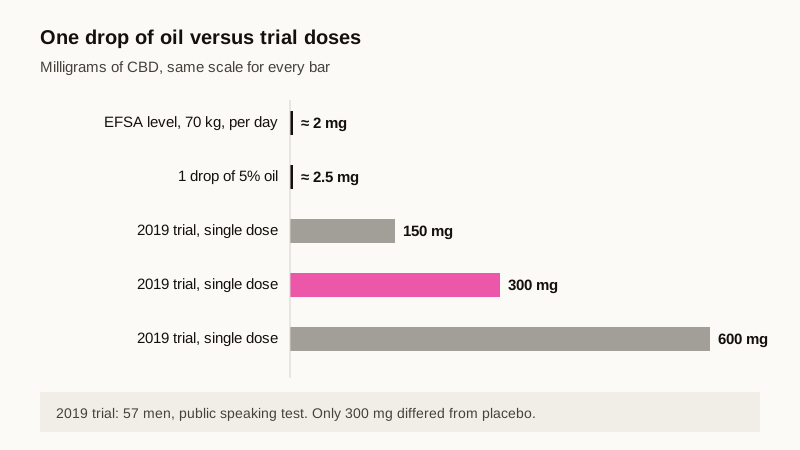
This chart is not a dosage guide. It shows why you cannot expect from one drop what a trial observed with 120 times more, and why the relationship is not linear: more is not better, as our article on CBD's biphasic effect describes. Above EFSA's level, talk to a doctor. The only authorised CBD-based medicine, Epidyolex, is prescribed under medical supervision, with doses calculated by body weight.
3. The route of intake changes what reaches the blood
A 2018 systematic review of CBD pharmacokinetics in humans gives the orders of magnitude:
| Route | Blood peak (Tmax) | What the review reports |
|---|---|---|
| Inhaled (smoked) | About 15 minutes in one study | Average bioavailability of 31% in the study that measured it |
| Spray on the lining of the mouth | 1.64 to 4.2 hours | No absolute bioavailability measured |
| Swallowed | Mostly 1 to 4 hours | Area under the curve 5 times higher and peak 3 times higher after a meal than fasting, in the study cited |
Two practical consequences. An oil swallowed on an empty stomach may barely reach the blood. And comparing two tries done in two different ways tells you nothing about the product. A reminder of the French framework: on 20 May 2026 the Ministry of Agriculture stated that foods containing CBD are illegal and must be withdrawn from the market. Our article on the sublingual route describes the technique without recommending any food use.
4. Timing: a peak in hours, a steady level in days
Many people draw conclusions after a single dose. Yet the blood peak of a swallowed dose comes one to four hours later, and the blood level only stabilises after several days of regular intake. Our article on how long CBD takes to work details these delays. The four-to-six-week window often quoted for judging a product is a usage convention, not a scientific standard.
5. You expect an effect CBD does not produce
CBD causes no intoxication, no euphoria and no change in perception. France's interministerial drug agency, MILDECA, points out that it does not cause dependence, unlike THC, and that no CBD product may claim a therapeutic effect without a medicine authorisation. Someone expecting the feeling of a joint will always conclude that "it does not work". Our article does CBD get you high explains why.
Expectations also work the other way. In a Canadian study from 2021, 43 adults twice received a CBD-free hempseed oil. Once, they were told it contained CBD. That day they reported feeling more sedated, and those who most believed CBD helps with anxiety reported less anxiety. What you feel also measures what you expect.
6. Your body and the context
CBD is broken down by the liver, by the same enzymes as many medicines, hence possible interactions described in our article on the grapefruit effect. Body weight, meals, sleep, alcohol and fatigue all weigh on what you perceive. The 2025 ANSES and ANSM press release advises drivers and workers exposed to risks against CBD, because of possible drowsiness, and warns that it can alter the effect of some medicines. If you take any treatment, ask your doctor or pharmacist.
Running an honest trial: five rules
If you want to know whether a product does anything for you, change only one thing at a time.
| Rule | Why |
|---|---|
| One product, one batch | The next batch may have a different content |
| Same amount, same time, same timing relative to meals | Meals change how much reaches the blood |
| A dated log: amount in mg, sleep, coffee, alcohol | Without a written record, memory rebuilds the story |
| At least two weeks before concluding | The blood level takes several days to stabilise |
| Stay below EFSA's level without medical advice | Safety above it is not established |
If nothing changes, three conclusions are possible: switch format, for example a CBD flower rather than an oil, check another analysed batch, or conclude that CBD does nothing for you. All three are valid answers.
Frequently asked questions
Why does CBD do nothing for me?
Most often for one of these reasons: actual content lower than the label, a dose of a few milligrams, intake on an empty stomach, a conclusion drawn too early, or expecting a THC-type effect. CBD has no psychoactive high: feeling nothing is not abnormal.
Should I increase the dose if I feel nothing?
Not beyond EFSA's level, about 2 mg a day for 70 kg, without medical advice. Doses in studies run to hundreds of milligrams and belong to a research setting, not everyday use. A 2019 trial in fact observed no effect at 600 mg while it did at 300 mg.
Is a CBD product with a strong effect a good product?
Not necessarily. ANSES and ANSM have reported poisonings linked to products sold as CBD that contained THC above 0.3% or synthetic cannabinoids. A marked effect is a reason to check the batch certificate.
Is a full spectrum product felt more than an isolate?
No study allows that claim. The hypothesis of an entourage effect between cannabinoids and terpenes is still debated, as our article on the entourage effect explains.
Written by the Phytogrammes team
Every article in this journal draws on primary sources (ANSM, EFSA, EUR-Lex, peer-reviewed publications) and on the lab's own practice: batch-by-batch HPLC analyses, measured cannabinoid profiles. Our approach.
Article published on . CBD is not a medicine.