CBD for athletes: 4 recovery trials and anti-doping rules
CBD has not been banned for athletes since 1 January 2018, but every other cannabinoid still is in competition, including the THC, CBG and CBDV found in full- and broad-spectrum products. On recovery, four controlled trials published between 2021 and 2026, taken by mouth or as a cream, measured no clear reduction in muscle soreness and no faster return of strength. For a tested athlete, only a CBD isolate whose analysis detects no other cannabinoid keeps the risk low.
Contents
> Key takeaways > > - The 2026 list of the World Anti-Doping Agency (WADA) bans all cannabinoids in competition, "except cannabidiol". > - In a 2026 study, a broad-spectrum CBD with no detectable THC still left CBG, which is prohibited, in 74% of urine samples after exercise. > - Four controlled trials, with 13 to 28 participants, showed no clear effect of CBD on soreness or strength. > - No recovery, performance or anti-inflammatory claim is authorised for a CBD product. > - Sleep, protein intake and training planning remain the documented levers of recovery.
Why so many athletes are interested
Use is real, especially in contact sports. In 2020, a survey of 517 professional rugby players from 25 teams found that 26% had used CBD or were still using it. The share reached 41% among players aged 28 and over. The reasons given: recovery and pain for 80% of them, sleep for 78%. Only 16% had consulted a nutritionist; most had got their information online or from a teammate.
The authors concluded that players needed information on the anti-doping risks. That is also the starting point of this article: enthusiasm came before evidence.
What controlled trials measured
Since 2021, several teams have tested CBD against placebo after exercise designed to cause micro-damage to muscle, the kind behind soreness in the following days. The results point the same way.
| Study | Participants | Product and dose | Main result |
|---|---|---|---|
| Cochrane-Snyman et al., 2021 | 13 untrained men | Oil, 150 mg three times | No effect on soreness, strength or swelling |
| Isenmann et al., 2024 | 17 trained athletes | Oil or soluble form, 60 mg after each session, 6 days | No clear effect on performance or inflammation |
| Pastina et al., 2025 | 28 adults | Cream, about 100 mg on the thighs | No effect on pain, jump or strength |
| Mendes et al., 2026 | 15 active students | Gel, 2 g on the thighs over 72 h | No effect on soreness or muscle marker |
Two nuances. Isenmann saw a fall in myoglobin, a marker of muscle damage, with the oil in the less elite group of athletes, with no effect on performance. Mendes noted a slight advantage in isometric strength, but not in soreness. The authors of both studies conclude there is no clear effect.
A 2024 systematic review kept seven studies out of 901 publications. It describes "limited" data on strength and recovery. In 2025, the Permanent Senate Commission on Food Safety of the German Research Foundation (SKLM) reviewed the CBD doses found in food products: it found no evidence that would support a health claim on physical performance, sleep or pain. It also noted that liver enzymes rose in healthy volunteers from 4.3 mg/kg a day taken for three to four weeks.
The practical consequence in France: a seller who promises faster recovery, less soreness or an anti-inflammatory effect is making an unauthorised health claim. Our article on what clinical studies really say extends this beyond sport.
Anti-doping: CBD allowed, the rest of the spectrum not
The prohibited list is published every year in France's Official Journal. For 2026, it is decree no. 2025-1226 of 15 December 2025. Its section S8 bans all natural and synthetic cannabinoids in competition, with a single exception: "cannabidiol". The change dates from 2018: the US Anti-Doping Agency summed it up as CBD no longer prohibited under the S8 category, adding that CBD extracted from the plant can contain THC.
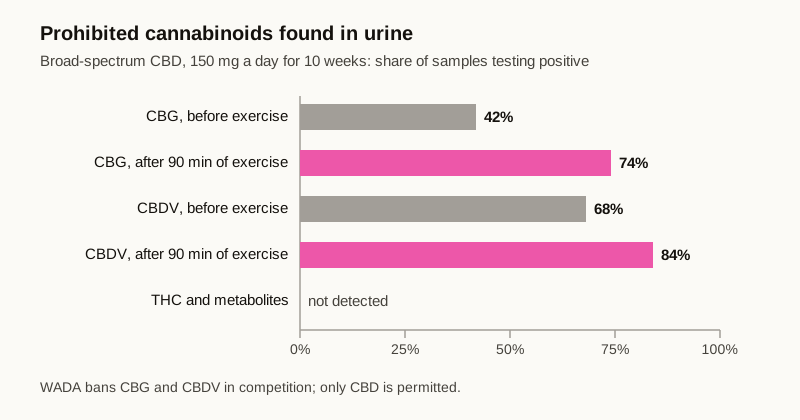
The trap is not limited to THC. CBG and CBDV, two cannabinoids found in "broad-spectrum" products, are also prohibited. A study published in 2026 in Medicine & Science in Sports & Exercise measured it. Thirty-six volunteers took a broad-spectrum CBD, 150 mg a day, or a placebo for ten weeks. No THC was detected. But CBG was present in 42% of urine samples before a 90-minute exercise session and in 74% after; CBDV in 68%, then 84%. Exercise raised the concentrations.
France's anti-doping agency, AFLD, takes the same line: some CBD oils or extracts "could contain other cannabinoids" that are banned, and what counts is the presence of the substance in the body, not when it was taken. The urinary THC threshold, the decision limit and the sanctions are covered in our article on CBD and the 2026 WADA list.
Choosing a product if you are tested
The deciding question: do you take part in competitions organised or authorised by a sports federation? If so, the format matters more than the brand.
| Format | What it contains | Anti-doping risk |
|---|---|---|
| Isolate | Purified CBD, in principle with no other cannabinoid | Lowest, if the analysis confirms it |
| Broad spectrum | CBD and other cannabinoids, THC removed | Real: CBG and CBDV are prohibited |
| Full spectrum | The plant's whole profile, THC included under 0.3% | Highest |
| Flower, resin | THC and THCA always present | High, avoid |
An isolate is not enough on the strength of its label. The certificate of analysis must cover the batch bought and show "not detected" for Δ⁹-THC, and also for CBG, CBDV and CBN where the laboratory tested for them. Our article on 99% isolate shows what that figure guarantees and what it does not, and the guide to reading a certificate of analysis goes through each line. To compare formats, see full spectrum or isolate.
Two other rules apply to everyone, competitive or not. Semi-synthetic cannabinoids are controlled drugs in France: HHC since June 2023, then H4CBD and THCP since June 2024, as our article on the H4CBD ban explains. And since May 2026, CBD oils, capsules and supplements meant to be swallowed have been withdrawn from sale under the Novel Food regulation, as our overview of CBD regulation in 2026 details. That leaves cosmetics, balms or massage oils, which go on the skin and fall under a different framework.
Someone who takes part in no official competition, in the gym or in recreational CrossFit, is not subject to these tests. All three formats are then legal, under the 0.3% THC threshold, but the trials described above apply to them too: nothing shows that CBD speeds up their recovery.
What remains documented for recovery
The levers with a measured effect are not new. Sleep first: the American Academy of Sleep Medicine and the Sleep Research Society recommend at least seven hours a night for adults. Our article on CBD and sleep sets out what research does, and does not, say about CBD there.
Then nutrition. The International Society of Sports Nutrition's position puts most athletes' needs at 1.4 to 2.0 g of protein per kilo per day, split into servings of 20 to 40 g every 3 to 4 hours. Finally come load planning, with lighter weeks, and hydration.
If you want a CBD ritual after exercise, the consistent format in France is a cosmetic applied during a massage. Massage is a common part of many routines; the added CBD showed no measurable effect in the two cream and gel trials. Our guide to assessing a CBD cream or balm explains what to read on the label. Persistent pain is a matter for a sports doctor or a physiotherapist.
Frequently asked questions
Can a licensed athlete take CBD?
Yes, WADA has allowed cannabidiol since 2018, including in competition. But every other cannabinoid remains prohibited, including THC, CBG and CBDV. Only an isolate whose batch analysis detects no other cannabinoid keeps the risk of a positive test low.
Is a "THC-free" broad-spectrum CBD safe for a competitor?
No. In the 2026 study described above, a broad spectrum with no detectable THC left CBG in 74% of urine samples after exercise and CBDV in 84%. Both cannabinoids are prohibited in competition.
Does CBD improve performance or recovery?
The controlled trials published between 2021 and 2026 measured no clear effect on soreness, strength or performance. No claim of this kind is authorised for a CBD product.
Is a CBD oil suited to CrossFit or weight training?
Since May 2026, CBD oils meant to be swallowed can no longer be sold as food in France. For a recreational athlete, nothing indicates that they speed up recovery. For a competitor, the anti-doping risk adds to this if the product is not a verified isolate.
Can a CBD balm cause a positive test?
None of the studies cited here measured that risk for a balm, and AFLD says it cannot guarantee the composition of any cosmetic. A careful competitor chooses a balm made with an isolate and checks the batch analysis.
Written by the Phytogrammes team
Every article in this journal draws on primary sources (ANSM, EFSA, EUR-Lex, peer-reviewed publications) and on the lab's own practice: batch-by-batch HPLC analyses, measured cannabinoid profiles. Our approach.
Article published on . CBD is not a medicine.