CBD gummies in France: why they were pulled from shelves
CBD gummies can no longer be sold in France. They are foods containing a hemp extract, and no CBD extract has received the EU authorisation required for a "novel food". French authorities have been checking this since 15 May 2026 and require these products to be taken off the market. CBD flowers, resins and cosmetics are not affected.
Contents
> Key takeaways > > - A CBD gummy is a food: it falls under Regulation (EU) 2015/2283 on novel foods, which requires prior authorisation. > - No CBD extract is authorised as a food in the EU. The DGAL, France's food authority, has been extending checks since 15 May 2026. > - In February 2026 EFSA set a provisional level of about 2 mg of CBD a day for a 70 kg adult. A 10 mg gummy exceeds it five times over. > - The French Ministry of Agriculture advises consumers not to buy or eat these products, wherever they are sold. > - CBD flowers, resins, cosmetics and e-liquids remain on sale under their own rules.
What changed in spring 2026
The change did not come from a new law but from systematic enforcement. On 15 April 2026, the Directorate-General for Food (DGAL) presented to industry unions a national plan targeting every food product that contains or advertises CBD, THC or another cannabinoid, with enforcement from 15 May 2026, according to the Provence-Alpes-Côte d'Azur Chamber of Agriculture. On 20 May 2026 the Ministry of Agriculture confirmed it publicly: these foods are illegal and must be withdrawn from the market, and checks now cover specialist shops, supermarkets, online sellers and vending machines.
The text being applied is Regulation (EU) 2015/2283. It defines as a "novel food" any food that was not consumed to a significant degree in the EU before 15 May 1997, and allows its sale only after a safety assessment. CBD extracts fall into this category. Applications have been filed for several years, but none has been approved.
The measure targets the product's status as a food, not the molecule. CBD is not a narcotic, and a compliant flower is still sold. The problem is putting it into a food without authorisation.
| Product | Status in France since May 2026 | Reason |
|---|---|---|
| CBD gummies, sweets, chewing gum | Withdrawn from sale | Food containing an unauthorised novel food |
| Oils sold as "food supplements", capsules, softgels | Withdrawn from sale | Same reason |
| Chocolates, drinks, infusions of flowering tops | Withdrawn from sale | Same reason |
| Hemp seeds, seed oil and seed flour | Authorised | Eaten before 1997, not a novel food |
| Hemp leaves for water infusion | Authorised | Excluded from novel food status, no added extract |
| Hemp flowers and resins | On sale | Not foods |
| CBD cosmetics | On sale | Cosmetics regulation, applied to skin |
Why a gummy fails: EFSA's provisional level
On 9 February 2026, the European Food Safety Authority set a provisional safe intake of 0.0275 mg of CBD per kilo of body weight per day, or about 2 mg a day for a 70 kg adult. The figure includes a safety factor, because data are still incomplete on the liver and on the endocrine, nervous and reproductive systems. EFSA had already flagged these gaps in a first statement in June 2022.
The level is narrow in several ways. It only applies to supplements containing CBD at least 98% pure, without nanoparticles, made by a process judged safe. For people under 25, pregnant or breastfeeding women and people on medication, EFSA concludes that the safety of CBD cannot be established.
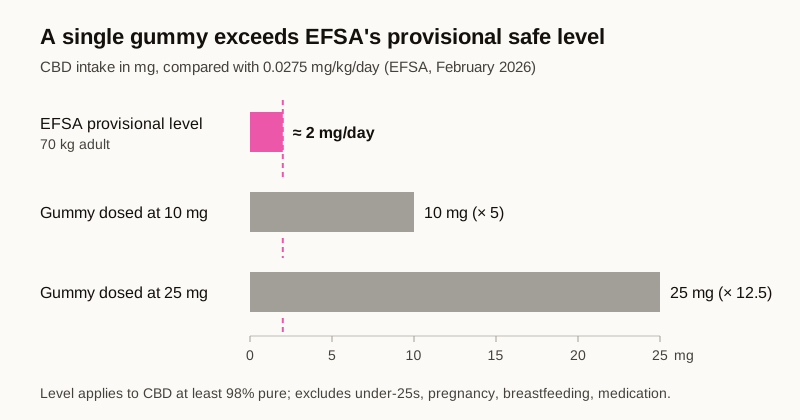
The calculation depends on your weight: 0.0275 × weight in kilos. It gives 1.4 mg for 50 kg, 1.9 mg for 70 kg and 2.5 mg for 90 kg. A gummy dosed at 10 mg is therefore four to seven times that level, depending on the person. "Fast-acting" gummies, which use nanoemulsions to speed up absorption, fall outside this level altogether, since it excludes nanoparticles. Our article on EFSA's reference dose walks through the calculation.
What the authorities found on the ground
The withdrawal also rests on case reports. In June 2025 the ANSM, France's medicines agency, issued an alert on several hundred poisonings recorded since early 2024 by poison and addiction-monitoring centres. In most cases the product contained, without the buyer knowing, a synthetic cannabinoid or a THC level above 0.3%. The formats listed include gummies, sweets, chocolates and syrups. The agency stresses the risk of accidental ingestion by children, who are drawn to how these sweets look.
The same alert notes that 8 CBD products out of 10 have a CBD content different from the one on the label. With a gummy the gap is hard to spot: you see neither the colour of the extract nor its quantity, only a sweet.
Another file is open. In March 2025, ANSES, France's food and health safety agency, proposed at EU level to classify CBD as "presumed toxic to human reproduction", category 1B under the CLP regulation. This is a proposal to classify the hazard of the substance, put out to consultation, not a decision on products.
Sleep, immunity, THC-free: what the label is worth
Before the withdrawal, gummies were often sold by use: evening, daytime, immunity, sport. These segments were marketing, not a legal status. Regulation (EC) No 1924/2006 only allows health claims on food that appear in the EU register, and none concerns CBD.
"Immunity" ranges often combined CBD with vitamin C or D, sometimes zinc. These nutrients have an authorised claim, "contributes to the normal function of the immune system", provided they are present in a sufficient amount. The claim then related to the vitamin, never to CBD or to added plants such as astragalus.
The words "THC-free" meant nothing without an analysis. A gummy made from isolate, CBD purified to 98 or 99%, lowers the risk of THC traces without removing it. A full-spectrum gummy may contain some. The same goes for "product of the year" medals: they reflect a panel vote on taste or packaging, not compliance. Only a certificate of analysis for the batch, linked to the product sold, shows what it contains; our guide to reading a certificate of analysis explains each line.
You still have gummies at home: what now?
No rule penalises simply owning a CBD gummy bought before May 2026. The official advice is clear all the same: the Ministry of Agriculture asks consumers not to buy or eat these products, wherever they are sold.
If you have felt an unexpected effect, the ANSM recommends stopping the product and keeping the packaging for possible analysis. In France, call 15 for serious symptoms, or a poison control centre for advice. A product still on sale in a shop or online can be reported on SignalConso, the DGCCRF consumer service.
Think about driving too. A full-spectrum gummy may contain THC, and France's Court of Cassation ruled on 21 June 2023 that the offence of driving after drug use is established as soon as a test detects use, whatever the dose. Our guide to CBD and saliva tests covers detection windows.
What is still legal in France
CBD products that are not eaten remain on sale. Hemp flowers and resins whose finished product contains no more than 0.30% Δ⁹-THC fall under hemp law, since the Conseil d'État struck down on 29 December 2022 the ban on selling flowers and leaves. You will find them in our CBD flowers and resins, hash and pollens categories. CBD cosmetics, applied to the skin, follow the cosmetics regulation, and e-liquids the tobacco and vaping rules.
None of these formats is a medicine. The only authorised cannabidiol medicine is Epidyolex, prescribed for certain rare epilepsies. For the full picture of what is allowed and banned in 2026, see our overview of CBD regulation and Novel Food. THC gummies are banned for a different reason, THC's status as a narcotic, which our article on THC gummies explains.
Frequently asked questions
Are CBD gummies banned in France?
Selling them is, like any food containing a CBD extract, because there is no authorisation under Regulation (EU) 2015/2283. The DGAL has been checking this since 15 May 2026. CBD itself remains legal in other forms: flowers, resins, cosmetics.
Why are CBD gummies still on sale in some places?
Some sellers have not cleared their stock, in shops or online. The Ministry of Agriculture states that these products are illegal wherever they are sold. You can report a seller on SignalConso.
Is a gummy bought in another EU country legal?
No. The novel food regulation applies across the whole EU, and no CBD extract is authorised as a food anywhere in it. The country of sale does not change the product's status.
How much CBD a day does EFSA consider safe?
Provisionally, 0.0275 mg per kilo per day, or about 2 mg for a 70 kg adult. This level does not apply to people under 25, pregnant or breastfeeding women or people on medication.
Is CBD chewing gum treated like a gummy?
Yes. It is chewed and partly swallowed with saliva, so it is a food. It falls under the same regulation and the same withdrawal as gummies and sweets.
Written by the Phytogrammes team
Every article in this journal draws on primary sources (ANSM, EFSA, EUR-Lex, peer-reviewed publications) and on the lab's own practice: batch-by-batch HPLC analyses, measured cannabinoid profiles. Our approach.
Article published on . CBD is not a medicine.