Fast-acting THC gummies: legal in the US, banned in France
In France, a THC gummy is a narcotic, fast-acting or not: making, selling, possessing or importing one is an offence. The so-called fast-acting technology brings the THC peak in the blood forward by about 30 minutes, without changing the amount absorbed or how long the effects last. In the United States, where these gummies boomed, the federal definition of hemp that made them legal is due to change on 11 December 2026.
Contents
> Key takeaways > > - In a trial published in 2026 on 20 adults, the fast-acting gummy reached its blood peak 30 minutes after intake, 30 minutes earlier than the standard gummy. > - Peak level, half-life and total THC exposure did not differ between the two gummies. > - In France, the Public Health Code bans tetrahydrocannabinols "natural or synthetic"; the 0.30% threshold does not cover added THC. > - Importing narcotics carries up to 10 years in prison and a €7,500,000 fine. > - In the United States, a law of 12 November 2025 caps THC at 0.4 mg per container; its entry into force has been pushed back to 11 December 2026.
What "fast-acting" changes, with measurements
A standard gummy acts slowly. Swallowed THC passes through the gut and then the liver before reaching the brain. A 2003 clinical pharmacology review puts the onset of effects 30 to 90 minutes after ingestion, with a peak after 2 to 3 hours and a duration of 4 to 12 hours depending on the dose. Smoked, THC acts within minutes and its effects fade within 2 to 3 hours.
Fast-acting gummies wrap THC in microscopic particles that disperse in water, so that it reaches the blood sooner. A Colorado State University trial, published in 2026 in Cannabis and Cannabinoid Research, compared a fast-acting gummy, a standard gummy and a placebo in 20 participants. THC from the fast-acting gummy peaked in plasma 30 minutes after intake, on average 30 minutes before THC from the standard gummy.
Nothing else moved. Peak concentration, half-life and total THC exposure were statistically the same for both gummies. Two co-authors work for manufacturers, the technology supplier and a gummy brand, which the paper discloses. The technology therefore brings the peak forward. It reduces neither the dose absorbed nor the time THC stays in the body.
| Measure | Standard gummy | Fast-acting gummy | Source |
|---|---|---|---|
| THC peak in the blood | About 30 minutes later | 30 minutes after intake | Conner et al., 2026 |
| Peak level, total exposure, half-life | No difference | No difference | Conner et al., 2026 |
| Duration of effects of swallowed THC | 4 to 12 hours | Not measured separately | Grotenhermen, 2003 |
| Status in France | Narcotic | Narcotic | Public Health Code |
Why these gummies were legal in the United States
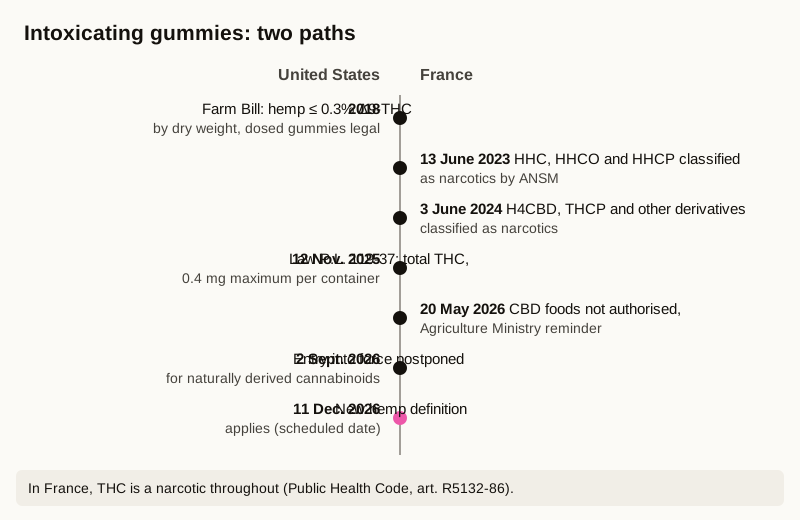
The 2018 Farm Bill defined hemp as a Cannabis sativa L. plant containing no more than 0.3% delta-9-THC on a dry weight basis. The threshold is a percentage of weight, not a dose. A 4-gram gummy containing 10 mg of THC comes to 0.25%: it remains "hemp" under federal law while delivering an active dose. The Congressional Research Service calls it the "farm bill loophole".
Congress has closed it. The agriculture appropriations act of 12 November 2025 (P.L. 119-37) now counts total THC and excludes from hemp any final product with more than 0.4 mg of THC per container, as well as cannabinoids synthesised outside the plant. This definition was due to apply on 12 November 2026. A stopgap funding law signed on 2 September 2026 pushes the deadline back to 11 December 2026 for naturally derived cannabinoids, not for synthetic ones. A 10 mg gummy exceeds the new cap 25 times over.
Why French law leaves no loophole
France does not reason in percentages of a gummy's weight. Article R5132-86 of the Public Health Code bans the production, sale, possession and use of cannabis and of tetrahydrocannabinols, "natural or synthetic". Delta-9-THC and its isomers, including delta-8, fall under this ban: our article on delta-8 THC covers this point.
The only exemption is for hemp. The order of 30 December 2021 authorises varieties whose Δ⁹-THC content does not exceed 0.30%, and caps extracts and the products containing them at the same level. A concentrated THC distillate added to a gummy exceeds that threshold well before it goes into the recipe. The exemption covers a residual trace, not a dose. Our article on the legal THC level explains where the figure comes from.
A second lock applies to anything edible. On 20 May 2026, the Ministry of Agriculture reminded businesses that foods containing CBD are not authorised under the novel food regulation. Only hemp seeds, their oil and leaves for infusion remain permitted. CBD gummies are therefore off the shelves too, for a food-law reason: our article on CBD gummies and Novel Food gives the details.
The "alternatives" sold in France are already classified
Before the American gummies, the French market saw gummies and sweets containing HHC, a semi-synthetic cannabinoid. ANSM, the French medicines agency, classified HHC, HHCO and HHCP as narcotics from 13 June 2023. It noted products containing up to 99% HHC, sold online and in shops as oils, edibles or vapes. Our HHC timeline traces this classification.
A year later, ANSM added H4CBD, THCP and other derivatives to the same list, from 3 June 2024. A decision of the same day excludes THCA present in hemp that complies with the 0.30% threshold. THCA as such is therefore not banned.
The risk is not theoretical. In June 2025, ANSES, the French food and health safety agency, reported several hundred poisonings since 2024 among people who thought they were taking CBD. Tests found THC above 0.3%, HHC, H4CBD or a synthetic cannabinoid, MDMB-PINACA. "Sleep" gummies that combine CBN and THC follow the same logic: our article on CBN and THC gummies describes the case.
What a buyer risks in France
Buying legally in a US state changes nothing on arrival. Crossing the border with a THC gummy, or having one delivered, means importing a narcotic.
| Situation | Law | Maximum penalty |
|---|---|---|
| Importing, including by parcel | Criminal Code, art. 222-36 | 10 years in prison, €7,500,000 fine |
| Using | Public Health Code, art. L3421-1 | 1 year, €3,750, or a €500 fixed fine since 20 August 2026 |
| Driving after use | Highway Code, art. L235-1 | 3 years, €9,000, no THC threshold |
How long the effects last matters most behind the wheel. A fast-acting gummy kicks in sooner, but swallowed THC stays in the body just as long: driving a few hours later is no safer. Our guide to saliva drug testing gives the detection windows. The full picture of edible THC products, drinks and oils included, is in our article on ingested THC in France.
What remains legally on sale are non-food hemp formats with no more than 0.30% Δ⁹-THC, such as CBD flowers. None of them is designed to produce the effect of a THC gummy.
Frequently asked questions
Is a gummy with less than 0.3% THC legal in France?
No, if it contains added THC. The 0.30% threshold covers the hemp plant and its extracts, for a residual trace. An added THC distillate exceeds that threshold, and a hemp gummy is in any case an unauthorised novel food.
Is a fast-acting THC gummy stronger?
Not in the 2026 trial: the peak amount of THC in the blood and the total exposure were the same as with a standard gummy. Only the timing of the peak changed, 30 minutes earlier.
Can I bring back THC gummies bought in the United States?
No. Buying them legally abroad changes nothing: bringing them into France is importing narcotics, punishable by up to 10 years in prison and a €7,500,000 fine.
Are THC gummies still legal in the United States?
Not for much longer at federal level. The law of 12 November 2025 excludes from hemp any product with more than 0.4 mg of THC per container, from 11 December 2026 after a postponement. Each state may also have its own rules.
Is delta-8 THC a legal alternative?
No. The Public Health Code bans tetrahydrocannabinols, natural or synthetic, and delta-8 is one of them, whether extracted or produced by chemical conversion.
Written by the Phytogrammes team
Every article in this journal draws on primary sources (ANSM, EFSA, EUR-Lex, peer-reviewed publications) and on the lab's own practice: batch-by-batch HPLC analyses, measured cannabinoid profiles. Our approach.
Article published on . CBD is not a medicine.