HHC banned in France: the 2022-2026 timeline
HHC (hexahydrocannabinol) has been a controlled drug in France since 13 June 2023, along with two derivatives, HHCO and HHCP. On 3 June 2024, the ANSM, France's medicines agency, added H4-CBD, THCP and other molecules that had appeared to replace it. Buying, possessing or using these products exposes you to the penalties for drug use, including a €500 fixed fine since 20 August 2026.
Contents
> Key takeaways > > - HHC is not extracted as such from hemp: it is made in a laboratory, most often from CBD. > - The ANSM classified it by a decision of 12 June 2023, in force on 13 June, together with HHCO and HHCP. > - A second decision, in force on 3 June 2024, covers H4-CBD, H2-CBD, THCP, HHCPO and their whole chemical family, with an exception for THCA from compliant hemp. > - Drug use carries up to one year in prison and a €3,750 fine; the fixed fine has been €500 since 20 August 2026. > - CBD is not affected, as long as the product stays under 0.3% THC and contains none of these molecules.
HHC, a cannabinoid made in the lab
HHC is a hydrogenated version of THC: hydrogen atoms are added to a THC-type molecule. It was first described in 1940 but only reached the market recently. According to a 2025 study in Pharmacology Research & Perspectives, it is most often made from cannabidiol, or by reducing THC or Δ⁸-THC. That is why it is called semi-synthetic: the starting material comes from hemp, the final molecule comes out of a reactor.
HHC exists in two forms, labelled 9R and 9S. The 9R form binds more strongly to the brain's cannabinoid receptors, the same ones THC activates. HHC therefore has a psychoactive effect close to that of cannabis. This is the basic difference from CBD, which has no such effect; our article does CBD get you high explains why.
It first benefited from a legal gap: no text named it. For a year, shops and websites sold it openly, often on the CBD shelf.
The timeline, from 1940 to 2026
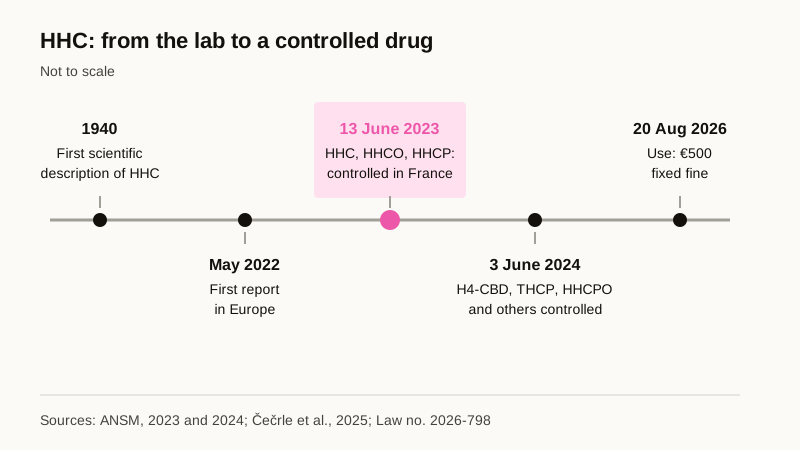
The HHC market was built in a few months, and the regulatory response followed each wave of replacement molecules.
| Date | What happened |
|---|---|
| 1940 | First scientific description of HHC |
| May 2022 | First report in Europe, after Danish police seized a product sold as a sleep aid |
| 12 June 2023 | ANSM decision classifying HHC, HHCO and HHCP as narcotics |
| 13 June 2023 | Entry into force: HHC products become illegal in France |
| 1 March 2024 | The Czech Republic bans the sale of HHC, THCP and HHC-O |
| 22 May 2024 | New ANSM decision against the replacement molecules |
| 3 June 2024 | Entry into force: H4-CBD, H2-CBD, THCP, HHCPO and their chemical family are classified |
| 20 August 2026 | The fixed fine for drug use rises to €500 |
The 2024 decision is not just a list of names. It covers the whole family of benzo[c]chromene derivatives, the chemical backbone shared by THC and HHC, plus several fully synthetic cannabinoids. The aim is to stop a variant with one atom changed from slipping through. THCA is on the list, but the ANSM specifies that it is not covered when it comes from hemp whose THC content meets the 0.3% threshold. Our page on THCA covers this often misunderstood point.
Why the ANSM classified HHC and its derivatives
The agency gives three reasons in its decision of 12 June 2023. HHC carries "a risk of abuse and dependence equivalent to that of cannabis". Its chemical structure is close to that of Δ⁹-THC. And it is sometimes consumed "without the knowledge of users who think they are consuming another product, such as CBD".
In 2024, the ANSM listed the serious effects reported by addiction monitoring centres after use of the replacement molecules: vomiting, loss of consciousness, seizures, anxiety, high blood pressure and a racing heart.
Czech data give a sense of scale. Between May 2022 and April 2024, the toxicology information centre in Prague counted 196 poisoning cases, 185 with HHC and 11 with HHCP. Symptoms were neurological in 74% of cases, mostly drowsiness, tremor and dizziness. Thirty-nine patients were under 15, or 19% of cases. Where the product was known, 38% of cases involved gummies and 35% cigarettes, joints or vapes. Cases fell after the Czech ban of 1 March 2024, while those linked to HHCP, still allowed at the time, rose slightly.
This pattern, a molecule that is legal by omission followed by ever less studied replacements, echoes the story of synthetic cannabinoids. We trace that history in our article on synthetic cannabinoids and harm reduction.
What a buyer risks in 2026
Classification makes HHC a controlled drug like any other. Production, sale, transport, possession, purchase and use are banned in France. Article L3421-1 of the French Public Health Code punishes use with one year in prison and a €3,750 fine. Since Law no. 2026-798 of 18 August 2026, in force on 20 August, prosecution can be settled with a €500 fixed fine, reduced to €400 for prompt payment and raised to €1,000 for late payment.
Selling falls under drug trafficking, which is punished far more heavily. And driving after using a controlled substance falls under article L235-1 of the French Highway Code, which provides for up to 3 years in prison and a €9,000 fine; our article on CBD and driving explains this regime.
Spotting a risky product
A product sold as CBD should never promise a high. If it does, either it exceeds the THC threshold or it contains a controlled cannabinoid. Four simple checks:
- The label: HHC, HHC-O, HHC-P, HHCPO, H4-CBD, THCP or any unfamiliar abbreviation is enough to rule the product out.
- The promise: "powerful effect", "legal alternative to THC" or a name that suggests intoxication has no place on a CBD product.
- The certificate of analysis: it must carry the batch number of the product sold and a Δ⁹-THC level of 0.3% at most. Ask whether the lab looked for semi-synthetic cannabinoids: a standard analysis does not always search for them.
- The format: in the poisonings recorded in the Czech Republic, gummies and products to smoke or vape dominated. Nothing visible distinguishes an HHC gummy from a CBD gummy.
Our guide explains how to read a certificate of analysis, and the laboratory page describes the measurement methods. The threshold itself is covered in our article on the legal THC level.
Frequently asked questions
Is HHC legal in France in 2026?
No. It has been a controlled drug since 13 June 2023, along with HHCO and HHCP. Buying, possessing and using it are banned, just as for cannabis.
Is HHC natural?
Not in the form sold. It is obtained in a laboratory by chemical conversion, most often from CBD extracted from hemp. That is what places it among semi-synthetic cannabinoids.
What is the difference between HHC and CBD?
HHC acts on the same receptors as THC and has a psychoactive effect; it is a controlled drug. CBD has no psychoactive effect and remains allowed in products whose Δ⁹-THC content does not exceed 0.3%.
Has THCA been banned since 2024?
Not THCA from compliant hemp. The ANSM decision in force on 3 June 2024 names THCA, but excludes THCA present in hemp whose THC content meets the 0.3% threshold.
What is the fine for using HHC?
Use carries up to one year in prison and a €3,750 fine. Since 20 August 2026, prosecution can be settled with a €500 fixed fine, or €400 for prompt payment.
Written by the Phytogrammes team
Every article in this journal draws on primary sources (ANSM, EFSA, EUR-Lex, peer-reviewed publications) and on the lab's own practice: batch-by-batch HPLC analyses, measured cannabinoid profiles. Our approach.
Article published on . CBD is not a medicine.