Is cannabis legal in France? The law in 7 figures
No, cannabis is not legal in France. Using it is a criminal offence punishable by one year in prison and a €3,750 fine, and since 20 August 2026 it is usually dealt with by a €500 fixed fine. Hemp is allowed on one measurable condition: no more than 0.3% Δ⁹-THC, in the plant as well as in its extracts and the products that contain them. That threshold separates two legal regimes; it is not a tolerance margin.
Contents
> Key takeaways > > - 0.3% Δ⁹-THC is the limit for authorised hemp, set by the order of 30 December 2021. > - Cannabis use has cost a €500 fixed fine since 20 August 2026, up from €200. > - Driving after using cannabis carries 3 years in prison and a €9,000 fine, whatever the dose. > - Legally sold CBD does not protect you behind the wheel: the Cour de cassation ruled so in June 2023. > - Resin seized in 2023 averaged 29% THC, nearly 100 times the hemp threshold.
French cannabis law in 7 figures
Most misconceptions about cannabis in France come down to a misread number. Here are the seven that matter, each with its legal text or source.
| Figure | What it refers to | Text or source |
|---|---|---|
| 0.3% | Maximum Δ⁹-THC content of hemp, its extracts and the products that contain them | Order of 30 December 2021 |
| €500 | Fixed fine for drug use (€400 if paid early, €1,000 if paid late) | Art. L3421-1, Public Health Code, since 20 August 2026 |
| 1 year and €3,750 | Maximum penalty for use if the case goes to court | Art. L3421-1, Public Health Code |
| 10 years and €7,500,000 | Penalty for transporting, possessing, offering or supplying | Art. 222-37, Criminal Code |
| 3 years and €9,000 | Driving after drug use, whatever the dose | Art. L235-1, Highway Code |
| 29% | Average THC content of resin seized in 2023 (12% in 2011) | OFDT, key figures 2025 |
| 10.8% | Share of 18-64 year olds who used cannabis in the past year (2023) | OFDT, key figures 2025 |
Cannabis and hemp: two regimes, one criterion
French law does not distinguish two plants, it distinguishes two concentrations. Cannabis sativa L. is a narcotic, except for authorised varieties whose content of Δ⁹-THC, the main psychoactive compound, does not exceed 0.3%. The order of 30 December 2021 sets that threshold for growing and industrial use of the varieties. It extends it, in the same words, to "hemp extracts, as well as the products that incorporate them".
So the threshold does not apply only to the plant in the field. A flower, a resin, an oil or an e-liquid sold in a shop must each stay at or below 0.3% Δ⁹-THC. Our article on the legal THC limit explains how it is measured and the margins of analysis.
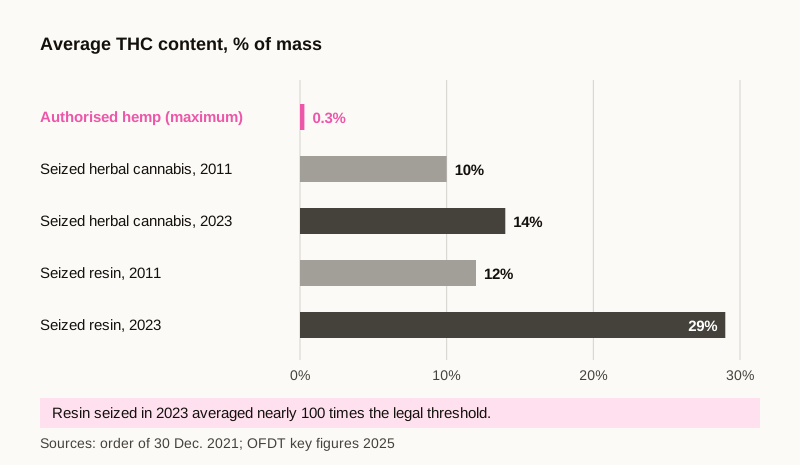
The gap is huge. According to the OFDT, the French drug observatory, average THC in seized herbal cannabis rose from 10% in 2011 to 14% in 2023, and in resin from 12% to 29%. A "CBD" product that produces the effects of cannabis is therefore not a strong CBD: it is either outside the legal framework or spiked with another molecule.
What a cannabis user risks in 2026
Using cannabis is an offence. Article L3421-1 of the Public Health Code punishes it with one year in prison and a €3,750 fine. In practice, police usually issue a fixed criminal fine, which ends the prosecution once paid. Law No. 2026-798 of 18 August 2026 raised it to €500 for offences committed from 20 August 2026. It drops to €400 if paid quickly and rises to €1,000 if paid late. The text states that it applies "including for repeat offences".
The OFDT counted 143,200 such fines for drug use in 2022, when the amount was €200.
Transporting, possessing, offering or supplying cannabis falls under a different text. Article 222-37 of the Criminal Code provides for ten years in prison and a €7,500,000 fine. That is the maximum penalty, not the usual one: courts adjust it to the quantities and the circumstances.
Behind the wheel, the 0.3% threshold plays no part. Article L235-1 of the Highway Code punishes with three years in prison and a €9,000 fine anyone who drives while a blood or saliva test shows use of a narcotic. The Cour de cassation confirmed this on 21 June 2023 (No. 22-85.530): the offence is made out "regardless of the dose absorbed", and the authorisation to sell some hemp derivatives below 0.3% "has no bearing" on it. A CBD product can contain detectable traces of THC. Our article on CBD and driving covers the tests and penalties.
How the CBD framework was built, ruling by ruling
The current hemp regime does not come from a single statute. It is the result of a series of court rulings and regulations.
| Date | Ruling or text | Effect |
|---|---|---|
| 19 November 2020 | CJEU, Kanavape judgment (C-663/18) | France cannot ban CBD lawfully produced in another Member State from the whole plant |
| 30 December 2021 | Interministerial order | 0.3% Δ⁹-THC threshold, but sale of raw flowers and leaves banned |
| 24 January 2022 | Conseil d'État, interim ruling (No. 460055) | Flower ban suspended |
| 29 December 2022 | Conseil d'État (No. 444887) | Flower ban annulled for good |
| 13 June 2023 | ANSM | HHC, HHCO and HHCP classified as narcotics |
| 3 June 2024 | ANSM | H4CBD, THCP and other derivatives classified as narcotics |
The Kanavape judgment opened the door. The EU Court of Justice held that free movement of goods precludes a ban on CBD extracted from the whole plant and lawfully produced in another Member State. It noted that, on current knowledge, CBD does not appear to have a psychoactive effect. Our article on the Kanavape ruling goes back over the case.
France then set the 0.3% threshold while banning the sale of raw flowers. The Conseil d'État, France's highest administrative court, first suspended that ban in interim proceedings on 24 January 2022, finding it disproportionate, then annulled it on 29 December 2022. It noted that quick, inexpensive tests can tell hemp from cannabis.
Semi-synthetic molecules never benefited from this framework. The ANSM, the French medicines agency, classified HHC, HHCO and HHCP as narcotics from 13 June 2023, then H4CBD, THCP and other derivatives from 3 June 2024. Their THC content makes no difference. Our feature on HHC explains why.
Three misconceptions the legal texts contradict
"0.3% is a tolerance." No. It is not a margin granted to cannabis users; it is the definition of authorised hemp. A product at 0.4% Δ⁹-THC gets no leniency: it falls outside the hemp regime.
"With legal CBD, I am fine behind the wheel." Not necessarily. The sale is legal, but driving is judged on the saliva or blood test, not on the product label.
"CBD is a narcotic that is tolerated." No again. In December 2022 the Conseil d'État noted that CBD has no psychoactive effect and found the ban on flowers below 0.3% disproportionate. Products you swallow, however, fall under a separate framework, the novel food rules, described in our article on CBD regulation in 2026.
Frequently asked questions
Is cannabis legal in France?
No. Using it is an offence punishable by one year in prison and a €3,750 fine, usually settled with a €500 fixed fine since 20 August 2026. Only hemp with no more than 0.3% Δ⁹-THC is allowed.
What is the legal THC level in France?
At most 0.3% Δ⁹-THC. The threshold applies to cultivated varieties, to hemp extracts and to the products that contain them, including flowers and resins.
How much is the fine for cannabis use in France?
€500 since 20 August 2026, €400 if paid quickly and €1,000 if paid late. Before that date it was €200. The prosecutor can also choose to take the case to court.
Can you drive after using CBD in France?
It is risky. If a saliva or blood test detects THC, the offence is made out whatever the dose, and the fact that the product was sold legally changes nothing, according to the Cour de cassation.
Written by the Phytogrammes team
Every article in this journal draws on primary sources (ANSM, EFSA, EUR-Lex, peer-reviewed publications) and on the lab's own practice: batch-by-batch HPLC analyses, measured cannabinoid profiles. Our approach.
Article published on . CBD is not a medicine.