THCP: 33 times THC's affinity, banned in France since 2024
THCP, or Δ⁹-tetrahydrocannabiphorol, is a cannabinoid first described in 2019 that binds the CB1 receptor about 33 times more tightly than THC in laboratory tests. The plant contains only traces of it: the THCP sold in shops is made by synthesis. In France it has been classified as a narcotic since 3 June 2024, whatever form the product takes.
Contents
> Key takeaways > > - THCP differs from THC by a side chain of 7 carbons instead of 5. > - In vitro, its affinity for the CB1 receptor is about 33 times that of THC; no trial has measured its effect in humans. > - In the cannabis flowers analysed, it never exceeded 0.014%; it was not detected in a CBD-dominant variety. > - The ANSM decision of 22 May 2024 classified it as a narcotic from 3 June 2024. > - A "THCP" product is therefore not a CBD product: possessing it falls under the Criminal Code.
What is THCP?
THCP is a phytocannabinoid, meaning a molecule the cannabis plant makes itself. An Italian team led by Cinzia Citti and Giuseppe Cannazza (University of Modena and Reggio Emilia, CNR Nanotec in Lecce) isolated and described it in Scientific Reports on 30 December 2019. They were working on FM2, a medical cannabis variety grown in Italy. The same paper also describes CBDP, the long-chain counterpart of CBD.
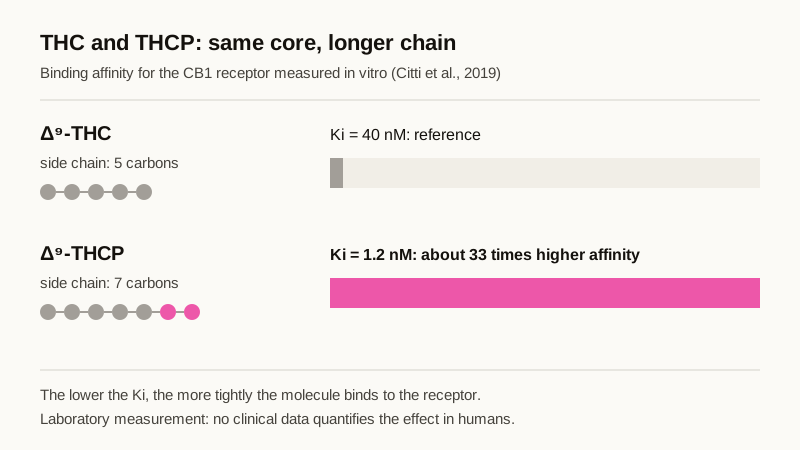
THCP has the same core as Δ⁹-THC. The only difference is its side chain, a tail of carbon atoms attached to the core: 7 carbons (a heptyl group) instead of 5 (a pentyl group). The suffix "phorol" comes from sphaerophorol, the common name of the heptyl resorcinol that forms this part of the molecule.
Do not confuse it with THCPO, which is THCP turned into an ester by synthesis, or with HHCP, its hydrogenated version.
Affinity measured in the lab, not an effect measured in humans
The 2019 team measured how THCP binds cannabinoid receptors using a constant called Ki: the lower it is, the more tightly the molecule holds on to the receptor. THCP shows a Ki of 1.2 nM at CB1 and 6.2 nM at CB2, against 40 nM for THC at CB1. The authors conclude its affinity is about 33 times stronger.
In mice, injections of 2.5 to 10 mg/kg produced the four classic signs of THC-like activity: reduced movement, immobility, lower body temperature and a weaker response to pain. These results come from animals given injected doses.
In humans there is no controlled trial. The literature holds only isolated reports. In 2025 a team in New Jersey published the case of a man admitted to hospital after taking 8 mg of THCP: a regular THC user with no history of psychosis, he had 48 hours of psychotic symptoms and injured himself. One case cannot establish an average risk, but it shows that a high laboratory affinity is not a trivial matter.
Traces in the plant, synthesis in the shop
A 2021 American study measured THCP in 14 plants from six chemotypes (chemical profiles). It was present in all 13 flower samples from THC-dominant varieties, at 0.0023% to 0.0136% by weight. It was not detected in the CBD-dominant variety. To obtain 1 g of THCP at 0.01%, you would need to extract 10 kg of flowers.
So the THCP sold between 2021 and 2024 did not come from extraction. A German police laboratory analysed 79 samples seized in Rhineland-Palatinate between December 2021 and December 2023: flowers and resins containing semi-synthetic cannabinoids. Δ⁹-THCP was present in 47.5% of them, almost always alongside its Δ⁸ isomer. For the authors, that pairing points to chemical synthesis: acid-catalysed cyclisation of a long-chain CBD analogue.
In other words, a hemp flower with a measurable amount of THCP has very probably had a synthetic product added to it. HHC is made the same way, as our timeline of the HHC ban shows.
The legal framework in France since 3 June 2024
The ANSM added new cannabinoids to the list of narcotics through a decision of 22 May 2024 that took effect on 3 June 2024. The text covers any substance derived from the benzo[c]chromene core that carries certain substitutions, including an alkyl chain at position 3. The ANSM names THCP among the molecules covered. A year earlier it had classified HHC, HHCO and HHCP from 13 June 2023.
| Molecule | Status in France | Since |
|---|---|---|
| HHC, HHCO, HHCP | Narcotics | 13 June 2023 |
| THCP, HHCPO, H4CBD, H2CBD, and derivatives covered by the generic definition such as THCPO | Narcotics | 3 June 2024 |
| CBN | Excluded from the generic classification | 3 June 2024 |
| THCA in hemp whose THC does not exceed 0.30% | Excluded from the classification | 3 June 2024 |
| CBD, CBG | Not classified; finished product at no more than 0.30% Δ⁹-THC | Order of 30 December 2021 |
Classification changes the penalties. Using a narcotic is punishable by one year in prison and a €3,750 fine under article L3421-1 of the Public Health Code, with a fixed fine of €500. Transport, possession, supply, transfer and purchase fall under article 222-37 of the Criminal Code: up to 10 years in prison and a €7,500,000 fine.
THCA needs a clarification, because the previous version of this article listed it among the banned molecules. That is wrong for compliant hemp: the 3 June 2024 amendment excludes it when the THC content respects the 0.30% threshold. Details are in our article on THCA.
Spotting THCP on a label or a certificate
On the packaging, the names to watch for are THCP, THC-P, Δ⁹-THCP, Δ⁸-THCP, THCPO and HHCP. Phrases such as "enhanced effect", "new generation" or "stronger than CBD" on a so-called "hemp" product should also raise a flag.
On a certificate of analysis, check three points:
- the batch number, which must match the product sold;
- the list of cannabinoids tested: a laboratory that did not look for THCP cannot conclude it is absent;
- the result "not detected" (or "< LOQ", below the limit of quantification) for THCP and HHC, and Δ⁹-THC at no more than 0.30%.
Our guide to reading a certificate of analysis goes through each line, and the laboratory page describes the measurement methods. The risk is not theoretical: in June 2025 the ANSM and Anses reported several hundred poisonings since early 2024 among people using products sold as containing CBD, most often linked to undeclared THC or synthetic cannabinoids. Our advice on avoiding synthetic cannabinoids lists the warning signs.
Frequently asked questions
Is THCP legal in France?
No. It has been classified as a narcotic since 3 June 2024 by an ANSM decision of 22 May 2024. Selling, possessing and using it are prohibited, whether the product is presented as a flower, a resin, a liquid or a gummy.
Is THCP naturally present in hemp?
Only as traces. A 2021 study measured it at 0.0023% to 0.0136% in THC-dominant flowers and did not detect it in a CBD-dominant variety. Commercial THCP is synthetic.
Is THCP stronger than THC?
Its affinity for the CB1 receptor is about 33 times higher in vitro, and it acts at low doses in mice. No human trial has quantified its effect. A case published in 2025 describes a 48-hour psychotic episode after 8 mg.
What is the difference between THCP and THCPO?
THCPO is the acetate ester of THCP: a second chemical transformation that does not occur in the plant. Both are covered by the 2024 ANSM decision.
What are the penalties for a THCP product?
For use, one year in prison and a €3,750 fine, or a fixed fine of €500. For possession, transport or sale, up to 10 years in prison and a €7,500,000 fine.
Written by the Phytogrammes team
Every article in this journal draws on primary sources (ANSM, EFSA, EUR-Lex, peer-reviewed publications) and on the lab's own practice: batch-by-batch HPLC analyses, measured cannabinoid profiles. Our approach.
Article published on . CBD is not a medicine.