THCPO: the THCP ester, a narcotic in France since 2024
THCPO, or THCP-O-acetate, is THCP whose alcohol group has been turned into an acetate ester by chemical synthesis. It does not exist in hemp, and no study has described its effects in humans. In France, since 3 June 2024, it falls under the ANSM decision that classifies as narcotics the THC derivatives in which this group is "esterified or not".
Contents
> Key takeaways > > - The "O" in THCPO, THC-O or HHC-O stands for an acetate ester, made by a chemical reaction in a laboratory. > - THCPO combines two changes to THC: a chain lengthened to 7 carbons, then acetylation. > - When heated in a vape device, the cannabinoid acetates tested release ketene, a gas that is toxic to the lungs. > - THCPO is not named in the ANSM decision, but its generic definition covers it. > - No product sold as "THCPO" is a legal CBD product in France.
What the "O" in THCPO means
In the trade, the "O" suffix signals an acetate ester. The manufacturer starts from a cannabinoid that carries a hydroxyl group (an OH, or alcohol group) and reacts it to replace that group with an acetate. THC becomes THC-O, HHC becomes HHC-O, HHCP becomes HHCPO, and THCP becomes THCPO.
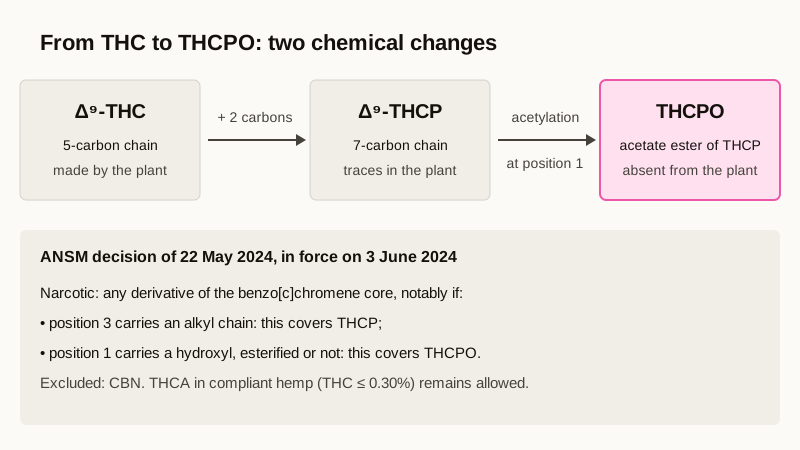
THCPO therefore combines two transformations. The first, lengthening the side chain from 5 to 7 carbons, gives THCP, which the plant makes only in trace amounts. The second, acetylation at position 1 of the core, does not happen in the plant.
THCPO is not a forum legend. In 2025 a Japanese public institute identified it by nuclear magnetic resonance in oils sold online, along with other esters such as THC-O-propionate and THCP-O-butanoate. In Germany, traces of THCPO were detected in 7 of 79 samples seized in Rhineland-Palatinate between 2021 and 2023, all of them flowers.
No data in humans
A PubMed search in September 2026 returns only analytical work on seized or purchased products for THCPO. No study describes its pharmacology, its toxicity or what happens to it in the human body.
Even for THC-O, which is older and more widespread, the data are thin. A consumer survey published in 2023 tested the idea, spread by sellers, that THC-O has psychedelic effects. Among respondents, 79% rated the experience "not at all" or "a little" psychedelic. Online reviews of THCPO are no substitute for a measurement: they say neither what the product contained nor at what dose.
Heating an acetate: the ketene problem
The best-documented risk does not come from the cannabinoid itself but from its acetate group. The phenomenon was first described with vitamin E acetate, an additive found in some vaping liquids: when heated, this group releases ketene, a gas that is toxic to the lungs.
In 2022, chemists at Portland State University vaped three cannabinoid acetates (Δ⁸-THC-O, CBN-O and CBD-O) and found ketene in every condensate, including one from a commercial product. A study from the University of California, Davis, published in 2026, quantified the effect: in a commercial vape device, the acetate group broke down into ketene with more than 99% efficiency, for a yield of 1 to 4% ketene relative to the cannabinoid mass. The same cannabinoids without an acetate produced no ketene.
THCPO was not among the compounds tested. It does, however, carry the same acetate group, at the same position as THC-O. Nothing suggests it would behave differently when heated.
The legal status of THCPO in France
The ANSM decision of 22 May 2024, in force since 3 June 2024, does not name THCPO. It works through a generic definition: any derivative of the benzo[c]chromene core, the chemical skeleton of THC, that carries certain substitutions is a narcotic. Two of them describe THCPO exactly:
| Position on the core | Substitution covered by the decision | What it covers |
|---|---|---|
| Position 1 | Hydroxyl, esterified or not | The acetate ester of THCPO, like that of THC-O |
| Position 3 | Alkyl chain | The 7-carbon chain of THCP |
The ANSM names THCP and HHCPO, the ester of HHCP. HHC-O had been classified earlier, together with HHC and HHCP, from 13 June 2023. Our timeline of the HHC ban traces these steps.
The penalties are those for narcotics. Use is punishable by one year in prison and a €3,750 fine under article L3421-1 of the Public Health Code, with a fixed fine of €500. Possession, transport and sale fall under article 222-37 of the Criminal Code, which provides for up to 10 years in prison.
The trade name changes nothing: a resin, a flower or a cartridge sold under the THCPO label is still a narcotic if it contains the molecule.
How to avoid buying THCPO without knowing it
THCPO is not always on the label. In the German study, esters mostly appeared as traces, mixed with other synthetic cannabinoids. In June 2025 the ANSM and Anses reported several hundred poisonings since early 2024 among people using products sold as containing CBD, most often caused by undeclared THC or synthetic cannabinoids.
Three checks reduce this risk:
- The certificate of analysis carries the batch number of the product sold and lists the cannabinoids tested. Our guide to reading a certificate of analysis explains each line.
- The laboratory looked for semi-synthetics (HHC, THCP, "O" esters) and reports them as "not detected".
- The price and the sales pitch are consistent with CBD: a "stronger" effect promised on a "hemp" product is a warning sign.
Our advice on spotting synthetic cannabinoids and our article on PTC complete this section.
Frequently asked questions
Is THCPO legal in France?
No. It is not named in the ANSM decision of 22 May 2024, but the generic definition covers THC derivatives whose hydroxyl at position 1 is "esterified or not" and whose chain is an alkyl. THCPO meets both criteria, so it has been a narcotic since 3 June 2024.
Does THCPO occur naturally in hemp?
No. The THCP it is made from is present only as traces in some THC-dominant flowers, and acetylation is a laboratory reaction.
What is the difference between THCPO and HHCPO?
Both are acetate esters. THCPO derives from THCP; HHCPO derives from HHCP, the hydrogenated version of THCP. The ANSM named HHCPO in its 2024 decision; THCPO is covered by the same generic definition.
What are THCPO reviews worth?
There is no study in humans. Online testimonials do not state the real composition of the product or the dose, and several analyses of seized products show mixtures of synthetic molecules.
Is vaping a THCPO product riskier?
Cannabinoid acetates that have been tested release ketene when vaped, a gas that is toxic to the lungs. THCPO has not been tested, but it carries the same acetate group.
Written by the Phytogrammes team
Every article in this journal draws on primary sources (ANSM, EFSA, EUR-Lex, peer-reviewed publications) and on the lab's own practice: batch-by-batch HPLC analyses, measured cannabinoid profiles. Our approach.
Article published on . CBD is not a medicine.