Kanavape ruling (C-663/18): what the CJEU decided on CBD
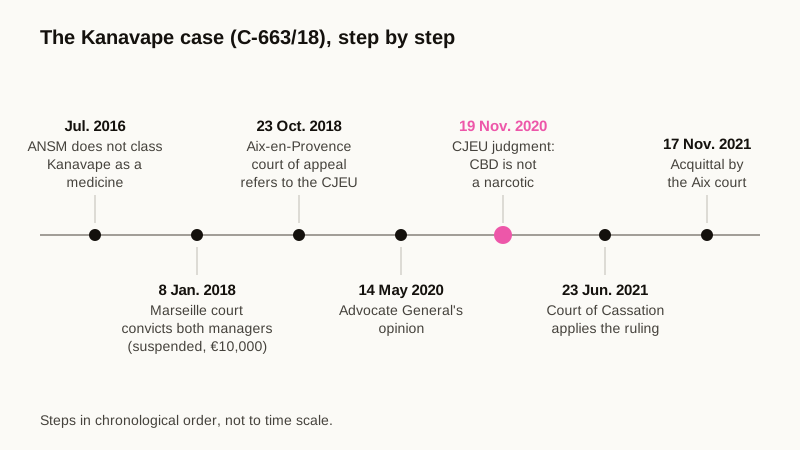
On 19 November 2020, the Court of Justice of the European Union (CJEU) held that CBD extracted from the whole hemp plant is not a narcotic drug within the meaning of the 1961 UN Single Convention. A member state therefore cannot ban the sale of CBD lawfully produced in another member state, unless the ban genuinely protects public health and is proportionate. This judgment, handed down in the Kanavape case, forced France to rewrite its hemp rules.
Contents
> Key takeaways > > - The case concerned an e-cigarette filled with CBD made in the Czech Republic from whole hemp plants. > - The question was referred to the CJEU in 2018 by the Aix-en-Provence court of appeal, not by the Marseille court. > - The Court found CBD was not a narcotic "in the light of current scientific knowledge", not that it carries no health risk. > - On 17 November 2021, the Aix-en-Provence court of appeal acquitted one of the managers on all charges. > - The ruling covers neither THC above the legal limit nor CBD foods, which fall under other laws.
The case: a CBD e-cigarette from the Czech Republic
Two former managers of a French company sold Kanavape, an e-cigarette using CBD oil. The CBD was produced in the Czech Republic from legally grown hemp plants used whole, flowers and leaves included. It was then imported into France and put into cartridges.
French law at the time only allowed hemp fibre and seeds to be used. The rule came from the order of 22 August 1990, as read by a Ministry of Justice circular of 23 July 2018. Any CBD taken from the flowers was therefore outside the rules, even with no narcotic effect.
The Court's judgment sets out the facts. The ANSM laboratory, France's medicines agency, had tested cartridges sold in France: the CBD content varied widely, but THC was always below the permitted limit. In July 2016, the ANSM said it did not regard the product as a medicine.
Even so, on 8 January 2018 the Marseille criminal court sentenced the two managers to 18 and 15 months' suspended imprisonment and a fine of €10,000 each. They appealed. On 23 October 2018, the Aix-en-Provence court of appeal referred a question to the CJEU: does EU law allow France to ban this CBD?
What the Court decided, point by point
The Court answered in three steps. Its press release No 141/20 summarises them.
| Question | The Court's answer |
|---|---|
| Do the Common Agricultural Policy regulations apply? | No. CBD extracted from the whole plant is not an "agricultural product", unlike raw hemp. |
| Is CBD a narcotic drug? | No. A literal reading of the 1961 Convention would allow it, but that would run against its purpose, protecting health. |
| Can France ban its sale? | It is a restriction on trade (Article 34 of the Treaty). It is only allowed if it protects public health and is proportionate (Article 36). |
On the second point, the Court relied on the state of science in 2020. Unlike THC, the CBD at issue "does not appear to have any psychotropic effect or any harmful effect on human health". The product came from plants whose THC did not exceed 0.2%, the EU limit for cultivated hemp at the time.
On the third point, the Court left the final word to the French judge, but gave two pointers. First, the French ban did not cover synthetic CBD, which has the same properties: a rule that lets the substitute through does a poor job of protecting health. Second, France does not have to prove that CBD is as dangerous as a narcotic. The alleged risk must still be "sufficiently established", not based on "purely hypothetical considerations".
What the ruling does not say
The judgment is often quoted more broadly than what it actually decides. Three limits are worth knowing.
It does not make every CBD product legal. THC remains a controlled drug, and the product the Court examined complied with the limit then in force. CBD above the legal THC limit is not covered, and neither is a product containing semi-synthetic molecules such as HHC or H4CBD, since classified as narcotics in France.
It does not say that CBD is harmless. The Court refers to what was known in 2020 and accepts that a state may restrict sales on the basis of a sufficiently established health risk. Since then, EFSA set on 9 February 2026 a provisional safe level of about 2 mg of CBD per day for a 70 kg adult, and a classification of CBD as toxic for reproduction is under review at EU level.
It does not settle the case of food. The product was an e-cigarette. CBD meant to be swallowed falls under the EU novel food regulation, which requires prior authorisation. None has been granted, and on 20 May 2026 the French Ministry of Agriculture reminded operators that foods containing CBD must be withdrawn from the market.
What followed in France, 2021 to 2022
French courts applied the ruling within a year. On 23 June 2021, the Court of Cassation quashed a conviction for drug offences. Before convicting, the judge must check whether the seized CBD was lawfully produced in another member state.
On 17 November 2021, the Aix-en-Provence court of appeal acquitted one of the two former managers on all charges. This comes from the press release of the law firm that defended him.
The government replaced the 1990 order with the order of 30 December 2021. The new text allows flowers and leaves to be used to produce extracts and sets the limit at 0.30% Δ⁹-THC. It did, however, ban the sale of raw flowers and leaves to consumers. The Conseil d'État, France's highest administrative court, suspended that ban on 24 January 2022 and annulled it on 29 December 2022, following the Court's reasoning on proportionality. Our article on the order banning CBD flowers covers that sequence.
What remains in 2026
The foundation laid in 2020 still holds. CBD from authorised hemp is not a narcotic, and a general ban must rest on a proven risk. That is why the question "is CBD a drug?" now has a clear legal answer.
The framework has tightened on other fronts, though. The THC limit is 0.30% in the plant and in finished products, as our page on the legal THC level explains. Semi-synthetic cannabinoids are banned. CBD foods left the shelves in 2026. Our overview of CBD regulation in 2026 lists what is still on sale.
Frequently asked questions
Written by the Phytogrammes team
Every article in this journal draws on primary sources (ANSM, EFSA, EUR-Lex, peer-reviewed publications) and on the lab's own practice: batch-by-batch HPLC analyses, measured cannabinoid profiles. Our approach.
Article published on . CBD is not a medicine.