Is CBD a drug? What French law and the WHO say
No, not in the legal sense: cannabidiol (CBD) is on no narcotics list in France, and the Court of Justice of the European Union ruled in 2020 that it cannot be treated as one. It does act on the brain, but it does not make you high, and in 2018 the WHO found no abuse potential. The legal risk of a CBD product comes from the THC it may contain.
Contents
> Key takeaways > > - The French Public Health Code bans cannabis, its resin and tetrahydrocannabinols (THC). Cannabidiol is not named. > - For the CJEU, CBD "does not appear to have any psychotropic effect or any harmful effect on human health" (Kanavape ruling, 19 November 2020). > - MILDECA, the French government's drug agency, calls it psychoactive because it acts on the brain, but states that it does not cause dependence. > - A flower above 0.30% THC becomes cannabis under criminal law, and the THC in a legal product is enough to fail a roadside test.
Three meanings of "drug", three different answers
The question "is CBD a drug?" hides several. The word can mean a narcotic banned by law, a substance that changes how the brain works, or a product that creates dependence. CBD does not get the same answer in each case.
| Question | Answer for CBD | What it rests on |
|---|---|---|
| Is it a narcotic under the law? | No | Public Health Code, 1990 list, 2020 CJEU ruling |
| Does it act on the brain (psychoactive)? | Yes | MILDECA, 2025 |
| Does it make you high (psychotropic)? | No | CJEU, 2020; human studies |
| Does it create dependence? | Not documented | WHO, 2018; MILDECA |
| Is there a CBD medicine? | Yes, only one: Epidyolex | European Medicines Agency, 2019 |
Keep the third row in mind: it is the high, produced by THC, that makes cannabis a narcotic. CBD, the plant's other major cannabinoid, does not produce one.
What French law says
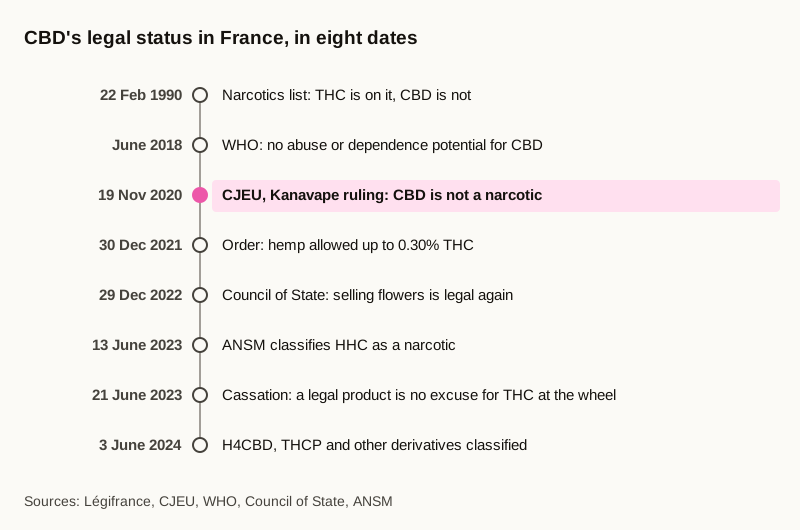
In France, a narcotic is a substance written onto an official list. Article R5132-86 of the Public Health Code bans the production, sale and use of cannabis, its plant, its resin and "tetrahydrocannabinols, natural or synthetic". Annex IV of the order of 22 February 1990, which sets the narcotics list, also covers tetrahydrocannabinols. Cannabidiol is not named in any of these texts.
The hemp that CBD comes from falls under another text. The order of 30 December 2021 allows the cultivation, import, export and industrial and commercial use of Cannabis sativa L. varieties listed in the official catalogues whose Δ⁹-THC content does not exceed 0.30%. On 29 December 2022, the Council of State struck down the ban on selling raw flowers and leaves that the same order contained. The origin of the threshold is covered in our article on the legal THC level.
The limit works both ways. A hemp flower at 0.25% THC is a legal product; the same flower at 0.50% is cannabis under criminal law. Using it is then punishable by one year in prison and a €3,750 fine, or by a €500 fixed fine since 20 August 2026. It is not the CBD that tips the product over, it is the THC level.
What the EU Court of Justice ruled
The Kanavape case concerned an electronic cigarette filled with CBD oil. The CBD was extracted in the Czech Republic from whole hemp plants, flowers included, then packaged in France. The company's two managers had been convicted in Marseille, because at the time only hemp fibre and seeds could be sold. The Aix-en-Provence court of appeal referred the question to the Court of Justice of the European Union.
In its ruling of 19 November 2020 (case C-663/18), the Court notes that CBD is not mentioned in the UN Convention on Psychotropic Substances. A literal reading of the Single Convention on Narcotic Drugs could bring it in, as a cannabis extract, but that reading would run against the purpose of the text, which is to protect health. On current knowledge, the Court concludes, CBD "does not appear to have any psychotropic effect or any harmful effect on human health". It therefore cannot be considered a narcotic.
The ruling leaves room for member states: a restriction is still possible on public health grounds, provided it is proportionate and backed by scientific data. What followed in France is traced in our article on Kanavape.
Dependence: what the WHO and trials measured
The WHO Expert Committee on Drug Dependence reviewed cannabidiol in June 2018. Its critical review concludes that in humans, CBD shows no effects indicative of any abuse or dependence potential. It found no published case of abuse of or dependence on pure CBD, and no associated public health problem. The committee therefore recommended not placing pure CBD under international control.
Two controlled trials point the same way. In 2017, a US team gave 200, 400 or 800 mg of oral CBD to 31 frequent cannabis smokers, compared with a placebo and cannabis at 5.3-5.8% THC. The cannabis produced the effects users look for; CBD looked like placebo on every measure. The Epidyolex summary of product characteristics cites a study in recreational drug users: compared with dronabinol (synthetic THC) and alprazolam, an anti-anxiety drug, cannabidiol has low abuse potential.
No dependence does not mean no effect. At the medicine's doses, 10 to 25 mg per kilo per day, the same document reports drowsiness in 23% of treated patients, reduced appetite in 21% and diarrhoea in 20%. CBD is broken down by liver enzymes that also process many medicines, hence interactions with some treatments. Our article on CBD side effects goes through this data dose by dose.
Psychoactive, but not intoxicating
MILDECA, the interministerial mission against drugs, sums up the nuance in two sentences: CBD "does not cause dependence, unlike THC", but it has "psychoactive effects, in that it acts on the brain". Psychoactive means acting on the central nervous system, which caffeine does too. Psychotropic, in everyday use, means a substance that alters perception, judgement or coordination: that is the cannabis high, which CBD does not produce.
The difference comes down to receptors. THC directly activates the brain's CB1 receptor, which triggers the high; CBD does not activate it in that way. The mechanisms are explained in does CBD get you high?.
Where CBD meets narcotics law: THC
A "CBD" product is not pure CBD. A full-spectrum flower, resin or oil also contains THC, up to 0.30%. That THC is a narcotic, even in small amounts, and it is what tests look for.
At the wheel, article L235-1 of the Highway Code punishes driving after drug use with 3 years in prison and a €9,000 fine, with no minimum threshold. The Court of Cassation ruled on 21 June 2023 that the legality of the product bought makes no difference to the offence. The guide CBD and saliva tests explains the thresholds and detection times.
Another trap: semi-synthetic cannabinoids sold alongside CBD. The ANSM classified HHC as a narcotic from 13 June 2023, then H4CBD, THCP and other derivatives from 3 June 2024. A product that contains them is a narcotic, whatever the "CBD" label says. Their story is traced in our HHC timeline.
Frequently asked questions
Is CBD legal in France?
Yes, if it comes from authorised hemp varieties and the finished product contains no more than 0.30% Δ⁹-THC. Raw flowers and leaves can be sold since the Council of State decision of 29 December 2022. Oils and products you swallow also fall under the novel food rules, covered in our overview of CBD regulation in 2026.
Do the police treat CBD as a drug?
CBD itself is not tested for: roadside tests look for THC. A positive test after a CBD product means that product contained THC. If a product is seized, it is the THC analysis that separates legal hemp from cannabis.
Can you become dependent on CBD?
No dependence has been documented. The WHO concluded so in 2018, and a 2017 trial in 31 regular cannabis users found no sign of abuse up to 800 mg. Side effects do exist, mainly at high doses and with certain medicines.
Is CBD oil a medicine?
No. The only CBD-based medicine authorised in the European Union is Epidyolex, since 19 September 2019, for rare childhood epilepsies. It is described in our article on Epidyolex. An oil sold in a shop does not have that status and cannot claim any therapeutic effect.
Written by the Phytogrammes team
Every article in this journal draws on primary sources (ANSM, EFSA, EUR-Lex, peer-reviewed publications) and on the lab's own practice: batch-by-batch HPLC analyses, measured cannabinoid profiles. Our approach.
Article published on . CBD is not a medicine.