CBD that gets you high: why it is a warning sign
No, CBD does not get you high. In a controlled trial, 600 mg of swallowed CBD produced neither intoxication nor euphoria, while 10 mg of THC was enough to do both. A product sold as CBD that gets you high therefore contains something else: THC above the legal 0.3% threshold, or a semi-synthetic cannabinoid classified as a controlled drug.
Contents
> Key takeaways > > - In a trial reported by the WHO, 600 mg of CBD did not differ from a placebo on felt intoxication; 10 mg of THC produced intoxication and euphoria. > - On the road, CBD-rich cannabis did not change driving compared with a placebo, unlike THC-rich cannabis. > - Legal hemp flower contains at most 3 mg of Δ⁹-THC per gram. Resin seized in France in 2024 contained 296 mg on average. > - The Court of Justice of the European Union in 2020 and France's Conseil d'État in 2022 found that CBD has no psychoactive effect. > - A high comes from excess THC or from a molecule such as HHC or H4-CBD, both banned in France.
Why CBD does not get you high
The "high" from cannabis comes from THC, which activates a brain receptor called CB1. CBD does not activate this receptor in the same way. In 2015, a study in the British Journal of Pharmacology showed in cells that CBD acts as a negative allosteric modulator of CB1. Put simply, it binds to another site on the receptor and dampens the effect of THC and of endocannabinoids, without taking their place.
These measurements were made in cell cultures. They shed light on the mechanism, but the proof that CBD does not get you high comes from human trials. The 2018 WHO critical review summarises one, run double-blind against a placebo. An oral dose of 600 mg of CBD did not differ from placebo on scales of intoxication, mood and psychotic symptoms. A 10 mg dose of THC produced intoxication and euphoria, and raised anxiety and heart rate.
The WHO concludes that in humans CBD shows no effects indicative of any potential for abuse or dependence. Our article THC and CBD: the differences compares the two molecules point by point.
Not getting you high does not mean doing nothing. CBD has documented adverse effects and interactions with some medicines, covered in our article on CBD side effects.
What a driving trial measured
Driving is a good test: it deteriorates quickly under a psychoactive substance. In 2020, a team at Maastricht University published in JAMA an on-road trial with 26 occasional cannabis users. Each one vaporised four types of cannabis in random order: CBD-rich, THC-rich, mixed and placebo. The doses were 13.75 mg of CBD, of THC, or of both.
The researchers measured how much the car weaved over 100 km, using the standard deviation of its position in the lane. The higher the figure, the more the car zigzags.
| Cannabis vaporised | Weaving, 40 to 100 min after |
|---|---|
| Placebo | 18.28 cm |
| CBD-rich | 18.21 cm |
| THC-rich | 20.59 cm |
| Mixed THC and CBD | 21.09 cm |
CBD-rich cannabis did not differ from placebo. THC, alone or with CBD, impaired driving between 40 and 100 minutes after use, but no longer after four hours. As a reference point, the authors state that a blood alcohol level of 0.5 g/L (0.05%) increases this weaving by 2.4 cm. They note two limits themselves: the difference measured with CBD does not rule out a small effect, and the doses tested may not reflect common use. CBD did not reduce the effect of THC either.
How much THC a CBD product contains
The legal threshold is easier to grasp in milligrams. The French order of 30 December 2021 caps the Δ⁹-THC content of hemp varieties, extracts and products containing them at 0.30%. One gram of compliant flower therefore contains no more than 3 mg of Δ⁹-THC. According to the OFDT, France's drug observatory, herbal cannabis seized in France in 2024 averaged 14.3% THC, or 143 mg per gram, and resin 29.6%, or 296 mg.
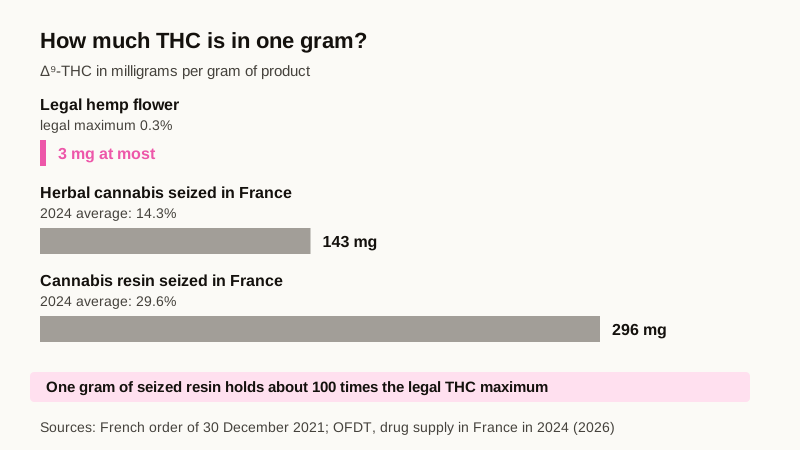
To reach the THC dose of the Maastricht trial, 13.75 mg, you would need more than 4.5 g of flower at the legal maximum, with all of its THC passing into the vapour, which never happens. Full analyses also list THCA, the acid form of THC found in the plant, which partly turns into THC when heated. These traces do not get you high, but they can matter in a drug test: our guide on saliva tests and CBD explains why. The threshold itself is covered in our article on the legal THC level.
What the courts say
On 19 November 2020, in case C-663/18, known as Kanavape, the Court of Justice of the European Union noted that, on current scientific knowledge, the CBD at issue "does not appear to have any psychotropic effect". It concluded that CBD cannot be regarded as a narcotic under the United Nations conventions, as its press release summarises.
On 29 December 2022, the Conseil d'État, France's highest administrative court, took up the same finding: CBD "has no psychotropic effect and does not cause dependence" and "cannot be considered a narcotic product". It struck down the ban on selling flowers and leaves, noting that their THC level can be checked with quick, cheap tests. Our article is CBD a drug details both rulings.
The withdrawal of CBD foods, called for in the French agriculture ministry's notice of 20 May 2026, does not change this status. It rests on the EU novel food regulation, because the safety of CBD as a food has not been demonstrated, not on any psychoactive effect. Our update on CBD regulation in 2026 sorts out the two issues.
"CBD that gets you high": what it hides
A product sold as CBD that gets you high is not a stronger CBD. There are two possible explanations, and both are illegal in France.
A THC level above 0.3%. The product is then cannabis, and therefore a controlled drug, whatever its packaging.
A semi-synthetic cannabinoid. HHC has been a controlled drug since 13 June 2023. H4-CBD, THCP and other derivatives have been since 3 June 2024, under an ANSM decision that cites serious reported effects: vomiting, loss of consciousness, seizures, a racing heart. Our articles on HHC and H4-CBD tell how these molecules were sold on the CBD shelf.
To rule out both cases before buying, read the batch's certificate of analysis: the dominant cannabinoid, Δ⁹-THC at 0.3% at most, a batch number matching the product. Our guide explains how to read a certificate of analysis, and the laboratory page describes the measurement methods. If a product gets you high, stop using it and do not drive.
Frequently asked questions
Does CBD get you high?
No. CBD has no psychoactive effect. In a controlled trial, 600 mg of CBD did not differ from a placebo on felt intoxication, and CBD-rich cannabis did not change on-road driving.
Is there a legal CBD that gets you high?
No. A compliant CBD product contains no more than 0.3% Δ⁹-THC, or 3 mg per gram at most. If it gets you high, it contains too much THC or a controlled cannabinoid such as HHC or H4-CBD.
Can I drive after taking CBD?
CBD alone did not impair driving in the Maastricht trial. But CBD products can contain traces of THC, and driving after drug use is punished as soon as a test establishes the presence of THC. Our article on CBD and driving sets out the risks.
Is CBD psychoactive?
It acts on the brain, since it binds to several receptors, but it produces neither intoxication nor euphoria. That is the distinction the WHO and the courts draw: CBD has no psychotropic effect in the sense of altering perception.
Is CBD considered a drug in France?
No. The Court of Justice of the European Union in 2020 and the Conseil d'État in 2022 ruled that it is not a narcotic. The 2026 withdrawal of CBD foods falls under food law, not drug law.
Written by the Phytogrammes team
Every article in this journal draws on primary sources (ANSM, EFSA, EUR-Lex, peer-reviewed publications) and on the lab's own practice: batch-by-batch HPLC analyses, measured cannabinoid profiles. Our approach.
Article published on . CBD is not a medicine.