H4CBD ban in France: a narcotic since 3 June 2024
H4CBD has been banned in France since 3 June 2024. A decision by the ANSM, the French medicines agency, dated 22 May 2024 added it to the list of narcotics, together with H2CBD and a whole family of derivatives: producing, selling, possessing or using it is now punished like any other narcotic. H4CBD is not an "enhanced" CBD. It is a different molecule, made in a laboratory from CBD.
Contents
> Key takeaways > > - ANSM decision of 22 May 2024, in force on 3 June 2024: H4CBD and H2CBD become narcotics. > - H4CBD is made by adding hydrogen to CBD: it is manufactured, not extracted from the plant. > - Addiction monitoring centres reported vomiting, loss of consciousness, seizures and a racing heart. > - CBD, CBG and CBN stay off the list, as does the THCA in compliant hemp. > - A product labelled "H4CBD", "tetrahydrocannabidiol" or "hydrogenated CBD" is illegal, whatever its THC level.
What the ANSM decided, and when
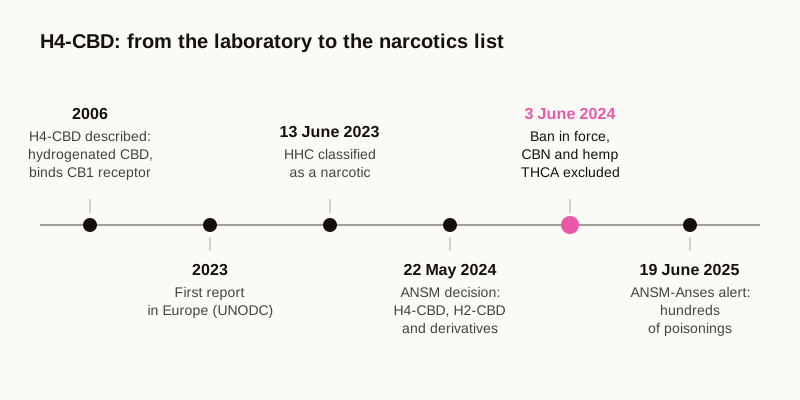
The Agence nationale de sécurité du médicament (ANSM) keeps France's list of narcotics. On 22 May 2024 it added new cannabinoids to that list, with the ban taking effect on 3 June 2024. The decision of 22 May 2024 names two CBD derivatives, H2CBD (dihydrocannabidiol) and H4CBD (tetrahydrocannabidiol), plus eight synthetic cannabinoids.
It also covers, more broadly, "any substance derived from the benzo[c]chromene nucleus". That chemical core is the one found in THC. The wording therefore catches HHC, HHCO, HHCP, HHCPO and THCP in one go, without naming them one by one. Cannabinol (CBN) is excluded from the start.
An amending decision of 3 June 2024, published on 4 June, spelled out the exclusions. CBN and its acid form CBNA stay off the list, as do THCV and THCVA up to 0.3%, and THCA when it comes from hemp that complies with the order of 30 December 2021. THCA in a compliant flower is therefore not banned, whatever you may read. Our article on THCA covers this point.
What is H4CBD?
H4CBD is a semi-synthetic cannabinoid. You start with CBD extracted from hemp, then react it with hydrogen in the presence of a catalyst. This is hydrogenation, the same process used to harden vegetable oils. The molecule gains four hydrogen atoms, hence the "H4" in its name. H2CBD gains two.
The chemistry has been known for a long time. In 2006, an Israeli team hydrogenated CBD and obtained several forms of these derivatives, published in the Journal of Medicinal Chemistry. The authors said they were surprised: the derivatives bound well to the CB1 receptor, the target through which THC produces its effects, whereas CBD binds to it only weakly. Their activity also differed from that of the starting CBD.
On the European market, the molecule is recent. The United Nations Office on Drugs and Crime (UNODC) notes that H4-CBD was reported for the first time in 2023, on the heels of HHC. These substances, the UNODC adds, can be manufactured from hemp CBD.
One naming trap is worth flagging. H4CBD is called tetrahydrocannabidiol. THC is called tetrahydrocannabinol. The two names differ by a few letters and describe two different molecules, both of them controlled.
Why it was classified as a narcotic
The ANSM relies on reports from France's addiction monitoring centres, which track the effects of psychoactive substances. For these new cannabinoids, it lists serious effects: vomiting, loss of consciousness, coma, seizures, paranoia, anxiety, high blood pressure and a racing heart. Users described them as more intense than cannabis, with a risk of dependence.
The ban did not empty the market. On 19 June 2025, the ANSM and Anses warned of several hundred poisonings recorded since early 2024 among people using products sold as CBD. Tests found HHC, HHC-O, H4-CBD, H2-CBD or MDMB-PINACA, a synthetic cannabinoid, or THC above the threshold. In most cases the label did not match the contents.
An addiction monitoring study carried out with the toxicology laboratory of Lille University Hospital confirms this. Out of 223 "CBD" products bought in 2022 and 2023, 12 contained an undeclared semi-synthetic cannabinoid, or 5.4%. H4-CBD was among the molecules found, along with HHC. Our guide to synthetic cannabinoids in CBD covers these risks.
What the classification changes, penalties included
Since 3 June 2024, H4CBD falls under French narcotics law, with no tolerance threshold. The 0.30% limit applies only to Δ⁹-THC in hemp; it makes no amount of H4CBD legal. Our article on the legal THC level explains that threshold.
| Situation | Law | Maximum penalty |
|---|---|---|
| Using H4CBD | Public Health Code, art. L3421-1 | 1 year and a €3,750 fine, or a €500 fixed fine |
| Possessing, transporting, selling, buying | Criminal Code, art. 222-37 | 10 years and a €7,500,000 fine |
The fixed fine for drug use has been €500 since 20 August 2026. For a retailer, there is nothing to debate: a single H4CBD product on the shelf amounts to possessing and offering a narcotic.
The table below places H4CBD among related molecules, as of 23 September 2026.
| Molecule | Origin | Status in France |
|---|---|---|
| CBD | Natural, hemp | Allowed if Δ⁹-THC ≤ 0.30% |
| CBG, CBN | Natural | Not on the narcotics list |
| THCA | Natural, acid form of THC | Excluded if it comes from compliant hemp |
| HHC | Semi-synthetic | Narcotic since 13 June 2023 |
| H4CBD, H2CBD | Semi-synthetic, made from CBD | Narcotics since 3 June 2024 |
| THCP | Covered by the benzo[c]chromene clause | Narcotic since 3 June 2024 |
Spotting and avoiding an H4CBD product
The first clue is the label. A product that lists "H4CBD", "H4-CBD", "tetrahydrocannabidiol", "hydrogenated CBD" or "CBD hydrogéné" is illegal in France. Be wary, too, of a product sold as "stronger than CBD" or with a "THC-like effect": compliant CBD does not get you high, and that promise often points to an additive.
The second clue is the lab report. The Lille study shows that a laboratory can test for H4-CBD, HHC or Δ⁸-THC using liquid chromatography coupled with mass spectrometry. It still has to look for them. On a certificate, check that these molecules appear in the list of compounds tested, with a "not detected" result and a detection limit. A certificate that lists only CBD and THC says nothing about derivatives.
Our guide to reading a certificate of analysis goes through each line, and the laboratory page describes the measurement methods. If you get an unexpected effect after a product sold as CBD, stop using it and call a poison control centre; keep the product so it can be tested.
Frequently asked questions
Is H4CBD banned in France?
Yes. It has been classified as a narcotic since 3 June 2024, by an ANSM decision of 22 May 2024. Producing, selling, possessing and using it are all banned, whatever the amount.
What is the difference between H4CBD and CBD?
CBD is a natural hemp cannabinoid, allowed if the product contains no more than 0.30% Δ⁹-THC. H4CBD is made in a laboratory by hydrogenating CBD. Its derivatives bind to the CB1 receptor, the one THC acts on, which CBD barely does.
Has THCA been banned since June 2024?
No, not the THCA in compliant hemp. The amending decision of 3 June 2024 excludes THCA found in hemp that meets the order of 30 December 2021. CBN, CBNA, THCV and THCVA up to 0.3% are also excluded.
What are the penalties for using H4CBD?
In theory, one year in prison and a €3,750 fine, or a €500 fixed fine. Possessing or selling H4CBD carries up to 10 years in prison and a €7,500,000 fine.
How can I tell whether a CBD product contains H4CBD?
Read the ingredients, then the batch certificate of analysis. H4-CBD should appear among the molecules tested, with a "not detected" result. A promise of a "THC-like" effect is a warning sign.
Written by the Phytogrammes team
Every article in this journal draws on primary sources (ANSM, EFSA, EUR-Lex, peer-reviewed publications) and on the lab's own practice: batch-by-batch HPLC analyses, measured cannabinoid profiles. Our approach.
Article published on . CBD is not a medicine.