CBD swallowed by a child, dog or cat: who to call
If a child has swallowed a CBD product and is unconscious, struggling to breathe or having a seizure, call 15; in any other case, call a poison centre on 01 45 42 59 59, which answers 24 hours a day. For a dog or a cat, call your vet or a veterinary poison centre. Whatever happens, keep the packaging: it tells the doctor or vet what the product contained.
Key takeaways
- Keep CBD the way you keep medicines: closed, up high, in its original packaging and apart from food.
- According to the ANSM and Anses alert of 19 June 2025, most of the danger comes from THC or synthetic cannabinoids that a product sold as CBD may contain.
- Dogs react strongly to THC; the signs reported most often are lethargy, a drunken gait and urine leakage.
- Human poison centres do not take calls about animals. For a pet, call the CNITV (04 78 87 10 40) or the CAPAE Ouest (02 40 68 77 40).
- Call before any symptom appears.
Store CBD like a medicine
To a two-year-old, and to a dog, a jar of flowers looks like food. A 2021 survey of Canadian and American vets found that the most cited cause of poisoning was an animal eating the product while nobody was watching (Amissah et al., PLoS ONE, 2022). Five rules cover it.
- Keep it closed and up high: a high cupboard, locked if you can, and never the coffee table. A dog on its hind legs can reach the worktop.
- Leave it in its original packaging. The name, content and batch number are what you will be asked for on the phone.
- Store it away from food. An oil kept next to the condiments will end up on a slice of toast one day.
- Screw the cap back on. A child-resistant cap only works once it is closed until it clicks.
- Keep leftovers and butts out of reach. The vets in the same survey list joint butts among the things animals swallowed.
A high cupboard at a mild temperature is also where our guides tell you to store CBD oil and store CBD flowers.
Why THC changes everything, even in a "CBD" product
THC is the psychoactive molecule in cannabis, and a compliant product contains 0.3% of it at most. On 19 June 2025, the ANSM and Anses published a joint alert on poisonings from products sold as CBD. It counts several hundred cases since early 2024. Most were caused by synthetic cannabinoids (HHC, H4-CBD, MDMB-PINACA) or by a THC content above 0.3%. A 2023 study cited by the agencies found that 8 CBD products out of 10 did not contain the CBD content printed on the label. The alert gives no figure for the share of children among the cases. It does warn that accidental ingestion can have "particularly serious effects in the youngest".
French cannabis data explain the concern. Between 2010 and 2017, French poison centres recorded 965 children aged 10 or under who had swallowed cannabis. Their median age was 15 months and 75% had eaten resin. Of these children, 4.5% fell into a coma and no deaths were reported (Chartier et al., Clinical Toxicology, 2021). The figures are about cannabis; they do not describe compliant CBD.
Dogs are sensitive for an anatomical reason. The Merck Veterinary Manual notes that they have more CB1 receptors, the target of THC, in the cerebellum and brainstem, which probably accounts for their drunken gait. The Merck page on CBD describes CBD alone as well tolerated by dogs and cats, even at high doses. A lethargic or staggering animal has therefore more likely swallowed a large amount, THC the label did not declare, or a contaminant.
Our articles on CBD for dogs and CBD for cats cover CBD use in animals.
A child swallowed CBD: 15 or the poison centre
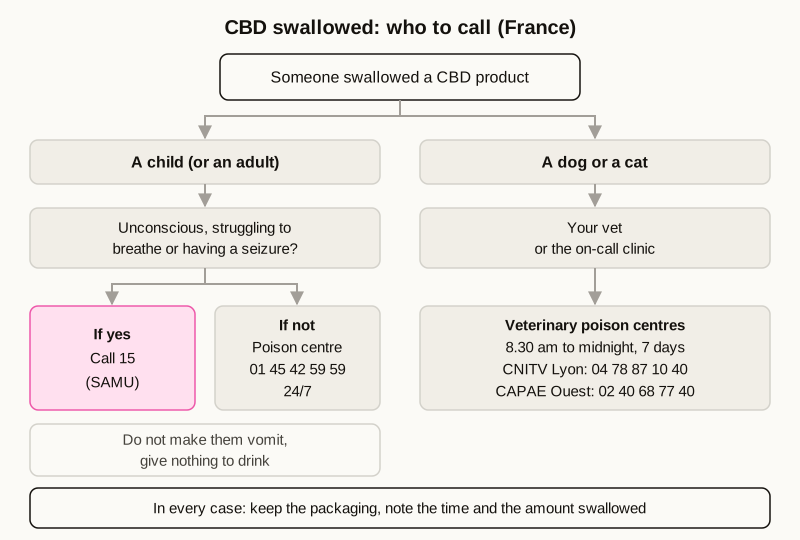
The four steps below follow the instructions of the French poison centres and the ANSM alert.
- If the child loses consciousness, has trouble breathing or has a seizure, call 15, the SAMU (emergency medical service), at once.
- In any other case, call the poison centre. The national number, 01 45 42 59 59, answers 24/7, and you should call before any symptom appears.
- Give nothing by mouth: do not make the child vomit, and give no drink, milk included.
- Keep the packaging, photograph it, and note the time and how much is missing. Hold on to the remaining product as well: the ANSM says it can be analysed by SINTES, a scheme run by the OFDT, the French drugs observatory.
If you are an adult and react badly to a product, the ANSM asks you to stop using it and to report the effect at signalement.social-sante.gouv.fr.
A dog or cat ate some: the vet first
Human poison centres do not deal with animals, so call your vet, or the on-call clinic at night. The list published by the Ordre des vétérinaires also gives two veterinary poison centres that answer calls.
| Centre | Phone | Hours |
|---|---|---|
| CNITV (Lyon veterinary school) | 04 78 87 10 40 | 8:30 am to midnight, 7 days a week |
| CAPAE Ouest (Nantes veterinary school) | 02 40 68 77 40 | 8:30 am to midnight, 7 days a week |
The CNITV asks members of the public to try their own vet first, while the CAPAE Ouest says it takes calls from the public free of charge.
Merck puts the onset of signs at 1 to 2 hours after THC is swallowed, or up to 4 hours in a dog that has not eaten. They usually clear within 1 to 3 days. The CAPAE Ouest cannabis page gives 12 to 72 hours. No antidote exists; with veterinary care, animals usually recover fully.
Symptoms to recognise
The Merck percentages come from calls about THC ingestion made to an American veterinary poison helpline between 2018 and 2023.
| What you see | Child or adult | Dog or cat | Sources |
|---|---|---|---|
| Drowsiness, lethargy | Yes | Yes, the most frequent sign (30%) | ANSM; Merck |
| Vomiting | Yes | Yes (15%) | ANSM; Merck |
| Drunken gait, loss of balance | Dizziness | Yes (21%) | ANSM; Merck |
| Urine leakage | Not listed | Yes, reported by 195 vets | Amissah 2022 |
| Heart rate | Fast (tachycardia) | Slow (bradycardia), reported by 112 vets | ANSM; Amissah 2022 |
| Dilated pupils, startling at noise or touch | Not listed | Yes | CAPAE Ouest; Merck |
| Agitation, hallucinations | Yes, sometimes with an acute anxiety attack | Yes, sometimes with aggression in a calm animal | ANSM; CAPAE Ouest |
| Loss of consciousness, seizures | Yes: call 15 | Veterinary emergency | ANSM; poison centres |
Any one of these signs is reason enough to call.
Smoke, guests, visits: the cases people forget
Start with smoke. According to the US CDC, secondhand cannabis smoke contains many of the toxic and cancer-causing chemicals found in tobacco smoke, and it can carry THC to children. Do not smoke in a room or a car with a child in it. For animals, the CAPAE Ouest considers smoke poisoning rare unless someone blows smoke straight into the animal's mouth. Our article on smoking hemp goes further.
When you have guests, a bag dropped in the hallway sits at dog height, so put bags and coats up high. When you visit friends who have children or a pet, keep your products on you.
Age matters too. CBD e-liquid may not be sold to minors, and the only CBD meant for a child is Epidyolex, a prescription medicine (CBD and minors). CBD sweets and chocolates tempt children the most, and the ANSM points out that they are not authorised for sale in the European Union (2026 regulations).
The printable checklist
Pin it inside the cupboard door or on the fridge.
Frequently asked questions
That is for a vet to judge. Merck says a dog that is lethargic, staggers or leaks urine has swallowed either a large amount or a product with more THC than its label states. Make the call with the packaging in front of you.
No. Poison centres ask you not to induce vomiting and not to give any drink, including milk. Call 01 45 42 59 59, or 15 if the child is unconscious, has trouble breathing or is having a seizure.
According to Merck, cats tolerate pure CBD well; THC and contaminants are where the risk lies. If your cat has licked some oil, tell the vet even if it seems fine.
Written by the Phytogrammes team
Each journal article draws on cited primary sources: ANSM, EFSA, EUR-Lex and peer-reviewed publications. Product profiles are distinguished from documented laboratory results. Our approach.
Article published on . CBD is not a medicine.