What is the legal age for CBD in France? What the law says
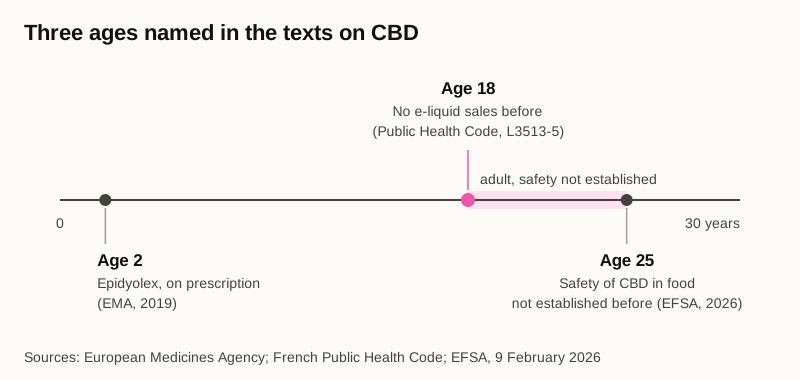
No French text sets a legal age for CBD as such; the rule depends on the format. A CBD e-liquid, like any vaping product, cannot be sold to a minor. Since mid-May 2026, oils to swallow and CBD foods may no longer be sold as food to anyone. EFSA has not established a safe dose for anyone under 25.
Key takeaways
- Hemp's founding text, the order of 30 December 2021, sets no age rule.
- CBD e-liquids count as vaping products, which may not be sold to under-18s.
- Since 26 February 2025, disposable puffs, with CBD or nicotine, have been banned for buyers of every age.
- In February 2026, EFSA concluded that the safety of CBD in food has not been established below age 25.
- Epidyolex, a medicine prescribed from age 2, is the only CBD intended for children.
The 2021 order regulates the plant, not the buyer
The whole sector rests on the order of 30 December 2021. It defines the authorised hemp varieties and caps their Δ⁹-THC content at 0.30%, with the same cap for extracts and the products containing them. The buyer's age is not mentioned. The MILDECA page on CBD, updated on 21 May 2025, summarises the conditions of sale and does not name a minimum age either.
The "no sale to under-18s" notice displayed in shops has no CBD-specific rule behind it. Depending on the format, it reflects a broader rule or a choice made by the seller. Our article on CBD regulation in 2026 covers the general framework.
The rule changes with the format
The table pairs common formats with the applicable text. The articles cited come from the French Public Health Code (CSP), available on Légifrance.
| Format | Age rule | Text |
|---|---|---|
| CBD e-liquid | Sale banned to under-18s, proof of age required | CSP, art. L3513-5 |
| Disposable CBD puff | Sale banned to everyone, whatever their age | Law no. 2025-175 of 24 February 2025 |
| Oil to swallow, capsule, gummy, chocolate | Sale as food not authorised, whatever the age | Regulation (EU) 2015/2283 |
| Flower or resin for smoking | No ban on sales to minors in the text that covers them | CSP, art. L3514-1 to L3514-6 |
| CBD cosmetic | No CBD-specific age rule | No specific text |
E-liquid is the clearest case. The CSP defines vaping products as liquids "containing nicotine where applicable", so nicotine is not required. A CBD e-liquid therefore qualifies, and article L3513-5 bans selling it or giving it to a minor under 18. The seller has to ask for proof of age. Once you are of age, our guide to dosage in mg/mL can help you choose an e-liquid.
Disposable puffs face a stricter rule. Law no. 2025-175, in force since 26 February 2025, bans the sale of these single-use devices. According to Service-Public.fr, fines reach €100,000, or €200,000 for a repeat offence. Our article on the puff ban covers what this means for CBD puffs.
Smokable flower is less intuitive. A CBD flower sold for smoking falls within the definition of "herbal products for smoking other than tobacco". The chapter that covers them requires warnings and an ingredient declaration and contains no ban on sales to minors. Article L3512-12, which does impose such a ban, applies to tobacco products. Under the current texts, refusing to sell flower to a minor is therefore a practice of shops.
CBD oil: 25, the EFSA benchmark
Oil raises the most questions, and two facts settle them. The first: since mid-May 2026, inspection services have applied the Novel Food regulation to foods and supplements containing CBD. The Ministry of Agriculture confirmed this plan in its answer to a written question published on 1 September 2026. An oil sold for swallowing can no longer be sold to anyone, adult or minor. The reasoning is explained in our article on the withdrawal of CBD gummies.
The second: on 9 February 2026, EFSA set a provisional safe intake of 0.0275 mg per kilo of body weight per day, about 2 mg for an adult of 70 kg. The European authority considers safety not established for people under 25, pregnant or breastfeeding women, and people on medication. No other authority has put a figure on an age for ingested CBD, and this one sits above the age of majority.
The first favourable EFSA opinion on a CBD food, issued on 18 September 2026, retains this age limit. It concerns synthetic CBD at least 98% pure in MCT oil, at no more than 2 mg a day, and is aimed solely at adults over 25, excluding pregnancy and breastfeeding. The opinion does not authorise any sale, since the European Commission and the member states have yet to decide. For now nothing changes in France: CBD foods and supplements remain unauthorised whatever the buyer's age.
Why shops still turn minors away
The trade's caution rests on health data. A study backed by MILDECA of 223 samples found that only 46% had a composition label, and that 81% of these labelled products stated a CBD content different from the one measured. It detected undeclared neo-cannabinoids in 6% of samples. On 19 June 2025, ANSM and Anses reported several hundred poisonings since early 2024 among people who had used products presented as CBD. The two agencies also warned about young children accidentally swallowing products whose packaging is sometimes appealing.
Teenagers face a further danger. In July 2026, the Réunion regional health agency relayed a message from the Directorate General for Health: since early 2025, exposure to synthetic cannabinoids has been increasing, mostly among minors and teenagers in particular, including in e-liquid form. These products are described in our article on PTC. Turning minors away keeps them out of a market where the label alone cannot be trusted.
For these reasons, Phytogrammes sells only to adults.
The only CBD intended for children is a medicine
There is no blanket ban on CBD for young people, since one medicine contains it. Epidyolex, an oral cannabidiol solution, has held an authorisation from the European Medicines Agency since 19 September 2019. Doctors prescribe it from age 2 for seizures in three rare conditions: Lennox-Gastaut syndrome, Dravet syndrome and tuberous sclerosis complex. That framework is detailed in our article on Epidyolex and the state of research, and it gives no licence whatsoever for unsupervised use in children.
Frequently asked questions
No text sets an age for CBD in general. Selling CBD e-liquids to under-18s is banned, and most shops extend that limit to flowers and resins. EFSA has not established the safety of ingested CBD for anyone under 25.
Not one meant to be swallowed. Since mid-May 2026, such products may no longer be sold as food or supplements to buyers of any age. An oil sold as a cosmetic comes under another framework, with no age rule specific to CBD.
No. Under article L3513-5 of the Public Health Code, a vaping product, with or without nicotine, may not be sold or given to a minor under 18, and the seller must ask for proof of age.
In case of life-threatening distress, loss of consciousness or collapse, ANSM and Anses advise calling 15, the French emergency medical number. For other signs, see a doctor or contact a poison control centre, for example on 01 45 42 59 59, the number both agencies give. Keep the product so that it can be analysed.
Written by the Phytogrammes team
Each journal article draws on cited primary sources: ANSM, EFSA, EUR-Lex and peer-reviewed publications. Product profiles are distinguished from documented laboratory results. Our approach.
Article published on . CBD is not a medicine.