CBD e-liquid: 300 mg does not mean 300 mg/ml
The big number on a CBD e-liquid bottle is the total amount it contains, not the concentration. A 10 ml bottle labelled 300 mg contains 30 mg per millilitre; the same total in 30 ml gives only 10. To compare two products, always bring the figure back to one millilitre, then check the composition and the batch certificate of analysis.
Contents
> Key takeaways > > - Concentration (mg/ml) = total amount (mg) ÷ bottle volume (ml). > - The only published human measurement gives 31% of CBD absorbed by smoking, from a 1986 study. > - An e-liquid is based on propylene glycol and vegetable glycerine: oil has no place in it. > - In France, a CBD e-liquid is a vaping product, and its sale to under-18s is banned. > - The ANSM found "CBD" e-liquids containing HHC, H4-CBD or synthetic cannabinoids.
The calculation: divide the total by the volume
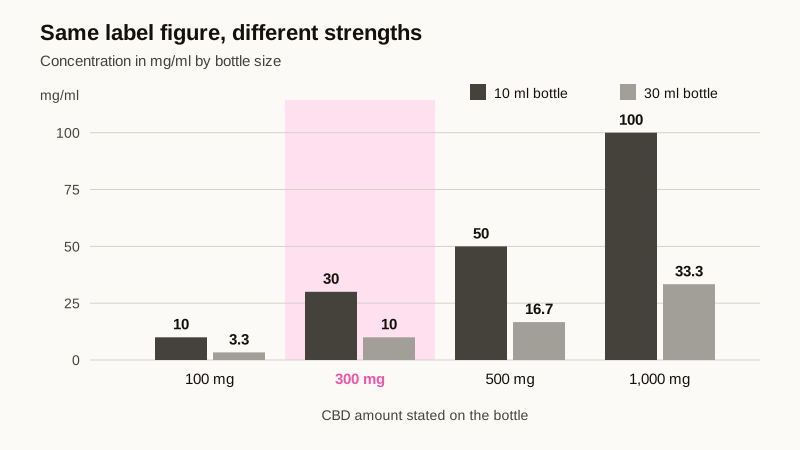
Concentration is the total amount of CBD divided by the bottle volume. A 10 ml bottle labelled 300 mg therefore contains 30 mg per millilitre. The same bottle labelled 1,000 mg contains 100. A 30 ml bottle labelled 300 mg contains only 10.
This is the most common mistake. The label highlights the bottle total, rarely the concentration. Two products at "300 mg" can differ by a factor of three.
| Stated amount | 10 ml bottle | 30 ml bottle |
|---|---|---|
| 100 mg | 10 mg/ml | 3.3 mg/ml |
| 300 mg | 30 mg/ml | 10 mg/ml |
| 500 mg | 50 mg/ml | 16.7 mg/ml |
| 1,000 mg | 100 mg/ml | 33.3 mg/ml |
The reverse calculation is useful too. If you vape 1 ml a day of a liquid at 30 mg/ml, you vaporise 30 mg of CBD. That figure is not the amount absorbed: part of the vapour is exhaled, and part settles in the mouth. How much liquid each puff vaporises also depends on the hardware, as our article on coil resistance and power explains.
How much CBD actually reaches the body
Human data are scarce. A systematic review published in 2018 in Frontiers in Pharmacology gathered the studies on the pharmacokinetics of cannabidiol in humans. It reports an average bioavailability of 31% by smoking, taken from a single 1986 study. No study has measured the absolute bioavailability of swallowed CBD in humans. The figures often quoted to compare vaping and swallowing are therefore not based on human data.
No authority has set a reference dose for inhaled CBD. The only official value concerns ingestion. On 9 February 2026, EFSA set a provisional safe level of 0.0275 mg per kilo per day, about 2 mg for a 70 kg adult. It applies to CBD of at least 98% purity taken as a food supplement. The agency could not establish the safety of CBD under 25, during pregnancy or breastfeeding, or for people on medication.
What an e-liquid contains, and what it must never contain
An e-liquid is based on two solvents, propylene glycol (PG) and vegetable glycerine (VG). Their ratio sets the viscosity and how the liquid behaves when heated. CBD is added and, often, flavourings. The CBD may come from an isolate, which is CBD alone, or from an extract that keeps other plant compounds. A full-spectrum extract can bring traces of THC, worth knowing if you drive. Our article on full spectrum versus isolate explains the differences. A CBD e-liquid can also contain nicotine: the label must say so.
No oil belongs in this mix. The reference case is the outbreak of vaping-associated lung injury (EVALI) in the United States. As of 18 February 2020, the Centers for Disease Control and Prevention counted 2,807 hospitalised cases or deaths, including 68 deaths. Vitamin E acetate, an oily substance added to thicken THC liquids, was found in the lung fluid of 48 patients out of 51.
A distorted version of this story often circulates. The first analysis report, published in November 2019, covered 29 bronchoalveolar lavage samples. Vitamin E acetate was present in all 29. Plant oils, medium-chain triglyceride oil and petroleum distillates were all below detection limits. The agent implicated is therefore vitamin E acetate, not coconut oil. The principle that follows still holds: a fatty substance has no business in an inhaled aerosol.
Heat raises another issue. A study published in 2021 in Scientific Reports shows that in the presence of oxygen, PG and glycerine break down from 133 to 175 °C. They then form formaldehyde, acetaldehyde, formic acid and acrylic acid. This breakdown starts well before any burnt taste. Pushing a coil beyond its range or pulling on a dry wick is not harmless.
Does CBD itself turn into THC in an e-cigarette? A Hungarian team heated pure CBD between 250 and 500 °C: 25 to 52% was transformed, mostly into Δ⁹-THC. A German team then vaped two CBD e-liquids with two devices, one pushed to 0.2 ohm and 200 watts. It found no rise in THC in the condensed liquids. Under realistic conditions of use, the conversion does not appear to occur to any notable extent.
The French legal framework
Under French law, a CBD e-liquid is a vaping product. Article L3513-1 of the Public Health Code covers liquids "containing nicotine where applicable", so also those that contain none. Two rules follow. Article L3513-5 bans sale to under-18s and requires the seller to ask for proof of age. Article L3513-4 bans direct or indirect advertising for these products. Our article on the legal age for CBD compares formats.
Law no. 2025-175 of 24 February 2025 bans prefilled, non-refillable vaping devices. Cartridges are expressly excluded from the ban, and refill bottles are not covered. Our article on the disposable puff ban details the measure.
The Δ⁹-THC content follows the general hemp rules. Paragraph III of article 1 of the decree of 30 December 2021 caps hemp extracts and the products that contain them at 0.30%, e-liquids included.
Finally, an e-liquid is not a food. The Ministry of Agriculture notice of 20 May 2026, which calls for the withdrawal of CBD foods and supplements, does not cover it. Its legality rests on being outside the food category, not on an authorisation of its own.
Why the lab test matters more than the label
French authorities have been explicit about this format. In a notice of 19 June 2025, the ANSM reported several hundred poisonings since early 2024 involving products presented as containing CBD. E-liquids are among the formats named. Tests found THC above the legal threshold, or HHC, HHC-O, H4-CBD, H2-CBD and MDMB-PINACA, a synthetic cannabinoid. The same notice cites a 2023 study: 8 products out of 10 showed a CBD content different from the one measured.
What is printed on the bottle is therefore no proof. Only a batch certificate of analysis answers the question. It should state the CBD content, in mg/ml or mg per bottle, a Δ⁹-THC content of 0.30% or less, and ideally a screen for semi-synthetic cannabinoids. Check that its batch number matches the bottle. Our guide to reading a certificate of analysis goes through each line.
CBD is not a medicine, and vaping is not harmless, with or without nicotine.
Frequently asked questions
A 10 ml bottle at 300 mg: how much per millilitre?
Thirty milligrams per millilitre. The stated amount is the bottle total, and the concentration is that total divided by the volume. A 30 ml bottle labelled 300 mg contains only 10 mg per millilitre.
Can you vape a CBD oil?
No. An oil has no place in an inhaled aerosol. The US outbreak of vaping-associated lung injury, 2,807 hospitalised cases or deaths as of 18 February 2020, was strongly linked to vitamin E acetate, an oily substance added to THC liquids.
Are CBD e-liquids still allowed in France?
Yes. They are vaping products, banned for sale to minors, and their Δ⁹-THC content must not exceed 0.30%. The withdrawal called for on 20 May 2026 concerns CBD foods and supplements. The law of 24 February 2025 bans prefilled non-refillable devices, not bottles.
Can vaping CBD cause a positive saliva test?
A well-purified CBD isolate contains no measurable THC. A full-spectrum extract, or a poorly controlled liquid, can contain some, and the law sets no minimum dose for drivers. Our guide to the saliva test explains this risk.
Does a CBD e-liquid contain nicotine?
Not necessarily. Some do, others do not. The label must say so, and a nicotine liquid is also subject to the specific rules for nicotine-containing products.
Written by the Phytogrammes team
Every article in this journal draws on primary sources (ANSM, EFSA, EUR-Lex, peer-reviewed publications) and on the lab's own practice: batch-by-batch HPLC analyses, measured cannabinoid profiles. Our approach.
Article published on . CBD is not a medicine.