Full spectrum or CBD isolate: 5 measurable differences
A full-spectrum extract keeps CBD and the other compounds of hemp, including Δ⁹-THC up to 0.30% in France. An isolate contains only purified CBD, with no THC or terpenes; broad spectrum sits between the two. The choice comes down to THC: roadside testing, competitive sport, reading the certificate. The entourage effect, often put forward for full spectrum, remains a hypothesis.
Contents
- 01Three extracts, one starting point
- 02The 5 differences, point by point
- 03THC, with the arithmetic
- 04Sport: only CBD is allowed
- 05The entourage effect: a hypothesis, not a selling point
- 06What the certificate should show, by format
- 07The French framework, the same for all three
- 08Frequently asked questions
> Key takeaways > > - At 0.30% Δ⁹-THC, one gram of full-spectrum oil can contain up to 3 mg of THC. > - Since a French ruling of 21 June 2023, driving after drug use is an offence whatever the dose. > - The World Anti-Doping Agency has allowed CBD since 2018 but bans all other cannabinoids in competition. > - Cell studies from 2019 and 2020 found no effect of common terpenes on CB1 and CB2 receptors, except possibly β-caryophyllene. > - Whatever the format, CBD cannot be sold as food in France.
Three extracts, one starting point
All three start from a hemp extract. What sets them apart is what is removed afterwards.
- Full spectrum: the extract keeps what the plant contained, CBD, minor cannabinoids such as CBG and CBN, terpenes, and THC within the legal limit. Our article on what "full spectrum" means covers the label in detail.
- Broad spectrum: the same extract, with the THC removed by chromatography. It keeps the other cannabinoids, as our explainer on broad-spectrum CBD describes.
- Isolate: CBD purified to 99% or more, as a crystalline powder. Our guide to what 99% means on a certificate shows how to check it.
No legal text defines these three labels. Only the certificate of analysis tells you what a bottle really contains.
The 5 differences, point by point
| Full spectrum | Broad spectrum | Isolate | |
|---|---|---|---|
| 1. Δ⁹-THC | Up to 0.30% | Removed, to be checked | Not detected, check the limit |
| 2. Minor cannabinoids | Present | Present | Absent |
| 3. Terpenes, taste | Present, plant taste | Often reduced | Absent, neutral taste |
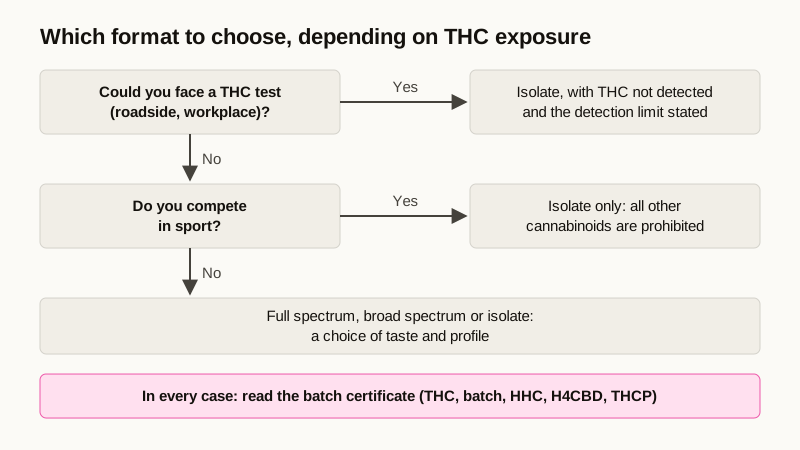
| 4. THC drug test | Real risk | Risk if traces remain | No THC, no positive result expected |
| 5. Competitive sport | Prohibited | Prohibited (CBG, CBN) | CBD allowed |
Rows 1, 4 and 5 come down to the same question: how much THC, and how many other cannabinoids, does the product contain.
THC, with the arithmetic
The 0.30% limit set by the French order of 30 December 2021 applies to the finished product. For an oil, 0.30% by mass means 3 mg of Δ⁹-THC per gram. The Full Spectrum oil in the Phytogrammes catalogue, for example, shows 5.1% CBD and 0.2% Δ⁹-THC on batch PG-26-AAD2, or 2 mg of THC per gram of oil (checked on 23 September 2026).
These traces are enough to cause trouble behind the wheel. The French drug information service Drogues Info Service puts it simply: if a CBD user tests positive on a saliva test, their product contains THC; CBD itself does not turn into THC in the body. And on 21 June 2023 the French Court of Cassation ruled that the offence of driving after drug use stands "whatever the dose absorbed". Our guide to CBD and drug testing gives the detection windows.
An isolate contains no THC, provided the certificate shows it. "Not detected" means "below the detection limit", and that limit should be stated.
Sport: only CBD is allowed
The World Anti-Doping Agency took cannabidiol off its list in 2018. In competition, it bans all other cannabinoids, natural or synthetic. The French anti-doping agency (AFLD) warns that CBD oils or extracts may contain other prohibited cannabinoids, and that it cannot vouch for any product.
For a tested athlete, full spectrum is therefore ruled out, and so is broad spectrum: it keeps CBG or CBN. That leaves isolate, with a certificate that lists the cannabinoids tested for. Our article on CBD and the WADA list gives the thresholds.
The entourage effect: a hypothesis, not a selling point
The idea that a whole extract works better than its isolated compounds was put forward by researcher Ethan Russo in a 2011 article in the British Journal of Pharmacology. He presented it as a lead: a synergy between cannabinoids and terpenes, "if proven".
Laboratory tests have not confirmed it for terpenes. In 2019, an Australian team tested six common terpenes, including limonene, myrcene and linalool, on human CB1 and CB2 receptors: none activated them or changed the effect of THC. A 2020 New Zealand study reached the same result, apart from a possible weak interaction of β-caryophyllene. Our article on the entourage effect reviews this work.
One fact is worth recalling: the only authorised CBD-based medicine, Epidyolex, contains purified CBD, not a full-spectrum extract. No authority has accepted a health claim linked to the entourage effect. Choosing full spectrum is therefore a matter of taste and plant profile, not of proven effectiveness.
What the certificate should show, by format
The last row matters: the French medicines agency (ANSM) classified these molecules as controlled drugs, HHC in 2023, then H4CBD and THCP on 3 June 2024. Our guide to reading a certificate of analysis goes through each block.
The French framework, the same for all three
The format changes nothing about legal status. On 20 May 2026, the French agriculture ministry restated that foods containing CBD are not authorised, food supplements included, under the novel food regulation. An oil therefore cannot be sold to be swallowed, whether full spectrum or isolate-based. Our overview of CBD regulation in 2026 describes the situation.
The oils in the CBD oils category are full-spectrum extracts; the catalogue offers no isolate or broad spectrum (checked on 23 September 2026).
Frequently asked questions
Is full spectrum more effective than an isolate?
No controlled study has shown it. The entourage effect is a hypothesis, and the cell studies of 2019 and 2020 found no action of common terpenes on CB1 and CB2 receptors.
Can a CBD isolate make a saliva test positive?
CBD without THC does not make a test positive, according to Drogues Info Service. The risk comes from THC traces: check on the certificate that THC is not detected and that the detection limit is stated.
Is broad spectrum safe for an athlete?
No. In principle it no longer contains THC, but it keeps cannabinoids such as CBG or CBN, which are prohibited in competition. Only CBD is allowed by the World Anti-Doping Agency.
How much THC does a full-spectrum oil contain?
At most 0.30% of its mass in France, or 3 mg of Δ⁹-THC per gram of oil. The actual value is on the batch certificate.
Why does isolate have no taste?
Because it no longer contains terpenes, the aromatic molecules of hemp. The plant taste of a full-spectrum oil comes from these terpenes and the extract's other compounds.
Written by the Phytogrammes team
Every article in this journal draws on primary sources (ANSM, EFSA, EUR-Lex, peer-reviewed publications) and on the lab's own practice: batch-by-batch HPLC analyses, measured cannabinoid profiles. Our approach.
Article published on . CBD is not a medicine.