Cannabis and mental health: why THC potency matters
The mental health risk linked to cannabis follows two variables above all: how much THC it contains and how often it is used. A study run in 11 cities found the odds of a psychotic disorder multiplied by 4.8 among daily users of cannabis at 10% THC or more. CBD, which has no psychotropic effect, is not part of that picture, but it is not a treatment either.
Contents
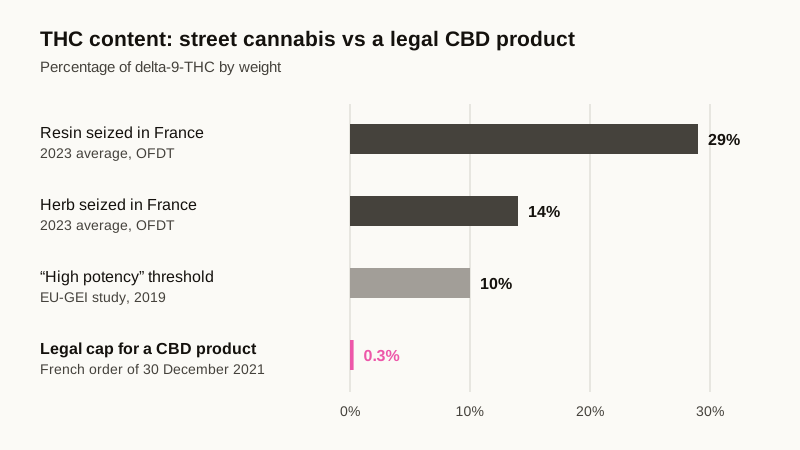
> Key takeaways > > - In 2023, resin seized in France averaged 29% THC, against a maximum of 0.30% in a legal CBD product. > - Daily use of high-potency cannabis is the pattern most strongly linked to first episodes of psychosis. > - Use that starts before 18 is associated with more depression and more suicide attempts in young adulthood. > - Trials of CBD in mental health remain small and their results diverge. The only authorised CBD medicine is for rare epilepsies. > - If you are struggling, Mon soutien psy, the 3114 line and Drogues Info Service are open without a prescription.
THC, dose and frequency
THC (delta-9-tetrahydrocannabinol) is the cannabis molecule that produces the high. It is also the one research links to mental health disorders. The European EU-GEI study, published in 2019 in The Lancet Psychiatry, compared 901 people seen for a first psychotic episode with 1,237 residents of the same cities, across 11 sites in Europe and Brazil.
Two figures sum it up. Daily cannabis use multiplied the odds of a psychotic disorder by 3.2 compared with never using. When the daily cannabis contained 10% THC or more, the factor rose to 4.8. Assuming the link is causal, the authors estimate that 30% of first episodes in London and 50% in Amsterdam could have been avoided without high-potency cannabis.
Street cannabis in France sits well above that 10% threshold. In its report on the drug supply in 2023, the French drugs observatory (OFDT) gives an average of 29% THC for seized resin and 14% for herb. In 2012, resin averaged 15.9%.
Adolescence, the most exposed period
The brain keeps maturing after 18, and the age of first use weighs on the risk. A 2019 meta-analysis in JAMA Psychiatry pooled 11 longitudinal studies, covering 23,317 people followed from adolescence to the age of 18 to 32. For young adults who had used cannabis before 18, it calculates:
| Condition in young adulthood | Estimated odds ratio |
|---|---|
| Depression | 1.37 |
| Anxiety | 1.18, not significant |
| Suicidal ideation | 1.50 |
| Suicide attempt | 3.46 |
The authors stress that the individual risk remains "moderate to low". It is the number of young people exposed that makes it a public health problem.
Danish registers add a second angle. Across nearly 6.9 million people followed between 1972 and 2021, a 2023 study found that a cannabis use disorder was associated, in boys aged 16 to 20, with a risk of schizophrenia multiplied by 3.84, against 1.81 in girls of the same age. In 2021, the share of schizophrenia cases attributable to that disorder reached 15% in men.
Association or cause: what research can claim
These studies are observational. They measure an association and cannot, on their own, prove that cannabis causes the disorder. Several lines of evidence point the same way, though:
- the effect grows with dose, frequency and early onset;
- in Denmark, the share of schizophrenia attributable to cannabis rose on average by 4.8% a year in men between 1972 and 2021;
- in the EU-GEI study, the cities where high-potency cannabis circulates most are also those with the highest incidence of psychosis.
The OFDT sums up the position of French health authorities in its summary of knowledge on cannabis: regular use can worsen some psychiatric disorders, and the risk of dependence is higher the earlier use begins. In 2023, according to the same source, 10.8% of 18-64 year olds had used cannabis in the past year, and 23.5% of 18-24 year olds.
CBD: a different profile, still modest trials
CBD (cannabidiol) does not produce the THC high. In its Kanavape judgment of 19 November 2020, the Court of Justice of the European Union noted that, unlike THC, "the CBD at issue does not appear to have any psychotropic effect or any harmful effect on human health", according to the current state of scientific knowledge.
Clinical trials of CBD in mental health do exist, but they are small and their results do not all point the same way:
| Study | Participants | CBD dose | Result |
|---|---|---|---|
| Bergamaschi et al., 2011 | 24 people with social anxiety | 600 mg, once | Less reported anxiety during a simulated public speaking test |
| McGuire et al., 2018 | 88 patients with schizophrenia on medication | 1,000 mg a day, 6 weeks | Small difference in positive symptoms, as an add-on to medication |
| Kwee et al., 2022 | 80 anxious patients in exposure therapy | 300 mg per session | No difference from placebo |
The sources: Bergamaschi et al., McGuire et al. and Kwee et al.. The doses tested ranged from 300 to 1,000 mg of pure CBD, and none of these trials led to an authorisation. The only authorised medicine with CBD as its sole active ingredient, Epidyolex, is restricted to seizures in three rare conditions, as our article on CBD and epilepsy explains. Our piece on CBD and occasional stress covers what French rules allow a seller to say.
One practical precaution: CBD changes the activity of several liver enzymes that break down antidepressants, anxiolytics and antiepileptics. Anyone under care for a mental health condition should talk to their doctor before taking it. Our article on CBD and medicine interactions describes the mechanism.
CBD products: what to check
The gap between street cannabis and a CBD product is THC. The French order of 30 December 2021 caps delta-9-THC at 0.30% in authorised hemp varieties, their extracts and the products that contain them. Our article on the legal THC level explains the threshold.
That cap only holds if it is measured. On a certificate of analysis, the Δ⁹-THC line must stay below 0.30%, and the batch number must match the product. Our guide to reading a certificate of analysis goes through each line, and the laboratory page describes the measuring methods.
Where to find help in France
Anxiety that takes over daily life, dark thoughts, cannabis use you no longer control: these call for a professional, not a product. Three services are open without a prescription.
- Mon soutien psy: up to 12 sessions a year with a partner psychologist, at €50 a session, reimbursed at 60% by the French health insurance. You can book directly without going through your doctor.
- 3114: the national suicide prevention line, free, open 24 hours a day, 7 days a week.
- Drogues Info Service: 0 800 23 13 13, a helpline open 7 days a week to talk about your own use or a relative's.
Youth consultation services and addiction centres (CSAPA) also take care of cannabis use. According to the OFDT, about 54,000 people were followed there for cannabis in 2022.
Frequently asked questions
Can CBD cause mental health problems?
Available studies do not link it to the psychosis risk documented for THC, and in 2020 the CJEU held that it did not appear to have a psychotropic effect. Long-term data remain thin. The real risk lies in the product: THC above 0.30% or an added synthetic cannabinoid.
At what THC level does the risk rise?
The EU-GEI study used 10% as its high-potency threshold. Daily use of cannabis above that threshold multiplied the odds of a psychotic disorder by 4.8. Frequency matters as much as potency.
Does cannabis cause schizophrenia?
Most users do not develop schizophrenia. Studies measure a higher risk, mainly in young men and daily users of high-potency products. They show a strong association, not an individual certainty.
Can I take CBD with an antidepressant?
Not without medical advice. CBD acts on liver enzymes that clear many psychotropic drugs, which can change their level in the blood. Your doctor or pharmacist can assess the combination.
Is CBD allowed for minors?
CBD flowers and resins are intended for adults. No consumer CBD product is designed for a teenager, whose brain is still maturing.
Written by the Phytogrammes team
Every article in this journal draws on primary sources (ANSM, EFSA, EUR-Lex, peer-reviewed publications) and on the lab's own practice: batch-by-batch HPLC analyses, measured cannabinoid profiles. Our approach.
Article published on . CBD is not a medicine.