CBD and stress: trials used up to 300 times the EFSA dose
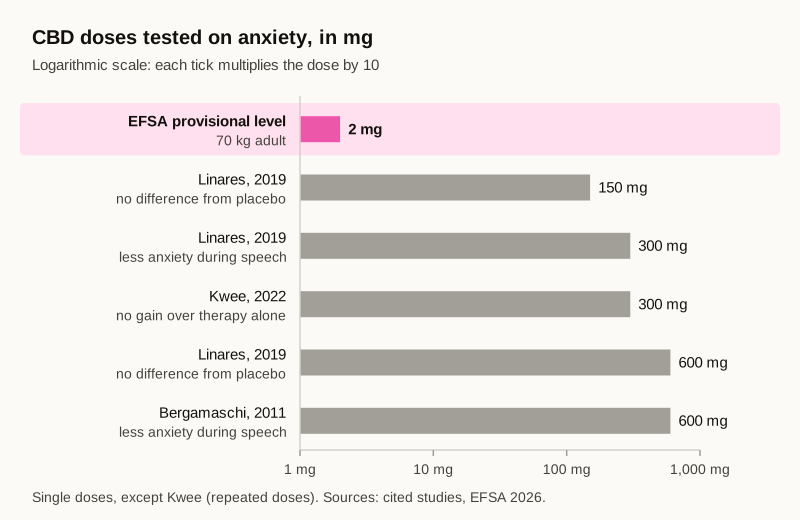
In France, no CBD product may present itself as reducing stress or anxiety. The trials that saw an effect looked at anxiety during public speaking, with a single dose of 300 to 600 mg, which is 150 to 300 times the provisional EFSA benchmark. With repeated doses, added to therapy, the only controlled trial found no benefit.
Contents
> Key takeaways > > - Stress is a normal reaction. Anxiety becomes a disorder when it is strong, lasting and gets in the way of daily life. > - In 2019, 300 mg of CBD reduced anxiety during a simulated speech, but neither 150 mg nor 600 mg did better than placebo. > - In 2022, 300 mg of CBD added to exposure therapy did not improve its results. > - EFSA provisionally sets 2 mg a day for 70 kg, and excludes people under 25, pregnancy and people on medication. > - CBD slows the clearance of some anti-anxiety drugs. An ongoing treatment is a matter for your doctor.
Stress, anxiety, anxiety disorder: three different things
Stress is the body's response to a demand: an exam, an interview, something unexpected. It fades when the situation passes. Anxiety anticipates a danger. It becomes a disorder, according to the Inserm report on anxiety disorders, when it is strong and lasting, unrelated to a real threat, and disrupts normal functioning.
It is not rare. According to Inserm, 21% of adults will have an anxiety disorder at some point in their lives, and 15% of people aged 18-65 have one in a given year. Women are affected twice as often as men.
The distinction matters when reading studies. Most CBD trials were run on anxiety induced in a lab, in healthy people or people with social phobia. They say nothing about end-of-day stress, nor about an anxiety disorder that has lasted for months.
What CBD and anxiety trials show
The most used protocol is the simulated public speaking test: the participant prepares and then gives a filmed speech, and researchers measure self-reported anxiety, blood pressure and heart rate at several points.
| Study | Participants | CBD dose | Result |
|---|---|---|---|
| Bergamaschi, 2011 | 24 patients with social phobia | 600 mg, single dose | Less anxiety than on placebo during the speech |
| Linares, 2019 | 57 healthy men | 150, 300 or 600 mg, single dose | Effect at 300 mg only |
| Shannon, 2019 | 72 patients at a psychiatric clinic | 25 mg a day for almost all | Anxiety scores down in 79.2%, no control group |
| Kwee, 2022 | Patients with social phobia or panic disorder | 300 mg before 8 therapy sessions | No difference from placebo |
The Bergamaschi study, published in 2011 in Neuropsychopharmacology, gave 600 mg of CBD or a placebo to 24 never-treated patients, an hour and a half before the test. The CBD group reported less anxiety and discomfort during the speech. Each group had 12 people.
In 2019, Linares and colleagues compared three doses in 57 healthy men. Only the 300 mg group reported less anxiety than the placebo group during the speech. Neither 150 mg nor 600 mg made a difference. The authors describe a bell-shaped curve, already seen in animals: more is not better. Our article on the biphasic effect of CBD looks at this in detail.
The Shannon case series, published in 2019 in The Permanente Journal, is often quoted for its 79.2% figure. It is a review of the records of 72 patients who took CBD on top of their usual care, with no placebo and no comparison group. The authors themselves conclude that controlled trials are needed.
The trial closest to repeated use is also the most disappointing. In the Netherlands, Kwee and colleagues gave 300 mg of CBD or a placebo before each of eight exposure therapy sessions to patients who had not responded to treatment. CBD improved neither the response to therapy nor the six-month follow-up. The same team reviewed 87 human and animal studies: in 70.3% of observations, CBD had no effect on anxiety.
Why do researchers keep looking? CBD slows the breakdown of anandamide, a molecule the body makes itself, which acts on the receptors of the endocannabinoid system. That is a research lead, not a demonstration.
What French law allows anyone to say
MILDECA is clear: products containing CBD may not make therapeutic claims, on pain of criminal penalties, unless they have been authorised as medicines. The only one that has is Epidyolex, for rare epilepsies.
The framework rests on Article L5111-1 of the French Public Health Code: any product presented as having curative or preventive properties against human diseases is a medicine. An oil sold "against anxiety" or as "anti-stress" would be an unauthorised medicine. Our article on advertising CBD products lists the forbidden wordings.
Swallowed, a CBD extract also falls under the novel food rules, which require prior EU authorisation. Our overview of CBD regulation in 2026 describes the French situation.
What has proven itself for stress and anxiety
For severe anxiety, the French National Authority for Health (HAS) sets an order: healthy habits, dealing with the causes of anxiety and non-drug treatments must come before prescribing benzodiazepines. When these anti-anxiety drugs are prescribed, total duration should not exceed 8 to 12 weeks for most patients.
Inserm cites cognitive behavioural therapy, based on gradual exposure to feared situations, along with lifestyle: regular routines, sleep, diet, physical activity.
Meditation has been studied too. A meta-analysis published in 2014 in JAMA Internal Medicine pooled 47 trials and 3,515 participants. Mindfulness programmes showed a moderate effect on anxiety after 8 weeks, and low-strength evidence on perceived stress. They did no better than other active treatments. Our article on CBD and yoga covers this practice.
Precautions: dose, medicines, pregnancy, driving
EFSA published on 9 February 2026 a provisional safe level of 0.0275 mg per kilo per day, or about 2 mg for a 70 kg adult. The agency considers that the safety of CBD cannot be established under 25, during pregnancy or breastfeeding, or in people on medication. Our article on the EFSA reference dose converts this benchmark into drops.
Interactions are the most concrete issue for an anxious person. According to the Epidyolex summary of product characteristics, CBD inhibits the CYP2C19 enzyme. Combined with clobazam, a benzodiazepine, it multiplies the level of its active metabolite by 3 to 4. Alcohol and other nervous system depressants make drowsiness stronger. Our article on the grapefruit effect explains this mechanism.
Two other points:
- ANSES proposed on 21 March 2025 classifying CBD as presumed toxic to reproduction (category 1B). It is a proposal submitted to the European Chemicals Agency, and a reason to abstain during pregnancy;
- a full-spectrum product can contain traces of THC. Article L235-1 of the French Highway Code penalises the mere presence of THC, with no threshold. Our guide to saliva drug testing explains this risk.
When to see someone
Anxiety that lasts, comes back for no clear reason, gets in the way of work, sleep or social life, or pushes you to use a substance to cope, is a matter for a health professional, not an over-the-counter product. Your GP is the first point of contact.
The Mon soutien psy scheme gives anyone aged 3 and over access to 12 sessions a year with a partner psychologist. A session costs €50, reimbursed at 60% by French health insurance, and you can book without going through a doctor.
Frequently asked questions
Can CBD replace an anti-anxiety drug?
No. No authority has recognised an anti-anxiety effect for CBD, and it can change the blood level of some anti-anxiety drugs such as clobazam. Any change to a treatment is decided with the doctor who prescribed it.
What CBD dose for stress?
There is no validated dose. EFSA provisionally sets 2 mg a day for a 70 kg adult. The trials that saw an effect on speech anxiety used 300 to 600 mg in one dose, with results that do not hold from one dose to the next.
Is CBD addictive?
The WHO expert committee concluded in 2018 that CBD shows no effects in humans indicating any potential for abuse or dependence. That does not remove the precautions linked to interactions.
Is an "anti-stress" CBD product legal?
No. Presenting a product as acting against a disease makes it a medicine under the Public Health Code. Only Epidyolex is authorised, and not for anxiety.
Can you combine CBD and an antidepressant?
Not without medical or pharmacist advice. Some antidepressants can be cleared by the same liver enzymes as CBD, which can make their blood concentration vary.
Written by the Phytogrammes team
Every article in this journal draws on primary sources (ANSM, EFSA, EUR-Lex, peer-reviewed publications) and on the lab's own practice: batch-by-batch HPLC analyses, measured cannabinoid profiles. Our approach.
Article published on . CBD is not a medicine.