Alcohol or cannabis: which is more harmful? The numbers
On almost every published measure, alcohol does more damage than cannabis: more deaths, more frequent dependence, and a narrower gap between the dose people drink and the toxic dose. That does not make cannabis harmless, especially with daily use of high-THC products. And used together, the two multiply by 29 the risk of being responsible for a fatal road crash.
Contents
> Key takeaways > > - A panel of 40 European experts rated alcohol 72 out of 100 for overall harm; every other drug except heroin and crack scored 38 or less. > - Alcohol causes 41,000 deaths a year in France according to Santé publique France, and 2.6 million worldwide in 2019 according to the WHO. > - In a large US survey, 22.7% of drinkers became dependent at some point in their lives, against 8.9% of cannabis users. > - Daily use of cannabis at 10% THC or more multiplies the risk of a psychotic disorder by 4.8, according to a study run across 11 sites. > - Behind the wheel, cannabis alone multiplies the risk of a fatal crash by 1.65, alcohol by 17.8 on average, both together by 29.
What drug-harm rankings actually measure
Comparing two substances means choosing what to compare. The most cited method is multi-criteria decision analysis: experts score each drug on a list of harms, then weight those criteria. In 2010, David Nutt's British committee scored 20 drugs on 16 criteria, nine for the user and seven for other people and society. Alcohol came top with an overall score of 72 out of 100, ahead of heroin (55) and crack cocaine (54). It dominates harm to others above all, with 46 points: injury, crime, economic costs, family adversity.
The exercise was repeated in 2015 across the European Union, with 40 experts. The result was almost identical: alcohol scored 72, heroin 55 and crack 50, and every other drug, cannabis included, 38 or less.
These rankings have one clear limit: they are expert judgements, and harm to society depends on how many people use a substance. Alcohol is very widespread, which mechanically inflates its collective costs. To know what a substance does to the person who takes it, other measures are needed.
Toxicity and mortality: alcohol far ahead
Toxicology offers a colder angle: the margin of exposure. It divides the dose that becomes dangerous in animals by the dose a person actually takes. The smaller the number, the closer ordinary use sits to the toxic threshold. In 2015, Dirk Lachenmeier and Jürgen Rehm calculated this margin for alcohol, tobacco, cannabis and the main illicit drugs. For an individual drinker, alcohol falls below 10, the "high risk" category, like nicotine, cocaine and heroin. At population level, it is the only substance that stays in that category. Cannabis exceeds 10,000, far ahead of every other substance studied.
This measure covers acute toxicity only. It counts neither accidents, nor mental health problems, nor diseases that develop over years. For alcohol, those diseases weigh heavily. The World Health Organization classifies it as an established carcinogen and attributes 2.6 million deaths worldwide to it in 2019. In France, Santé publique France counts 41,000 deaths a year linked to alcohol, making it the third cause of preventable death after tobacco and air pollution.
Dependence: who becomes dependent, and how fast
Both products can lead to dependence, but not at the same pace. The reference study is still the one by Catalina Lopez-Quintero and colleagues, published in 2011 from a large US general-population survey, NESARC. The authors estimated the probability that a person who has started using will one day become dependent.
| Substance | Lifetime dependence | Within 10 years of first use | Median delay of cases |
|---|---|---|---|
| Nicotine | 67.5% | 15.6% | 27 years |
| Alcohol | 22.7% | 11.0% | 13 years |
| Cocaine | 20.9% | 14.8% | 4 years |
| Cannabis | 8.9% | 5.9% | 5 years |
Two readings stand out from these figures. A drinker is about 2.5 times more likely than a cannabis user to become dependent. But when cannabis dependence does occur, it occurs fast: half of cases appear within 5 years, against 13 years for alcohol. The French observatory on drugs, the OFDT, notes that problematic cannabis use and dependence are well documented, and that the risk grows when use starts early.
Risks specific to cannabis
The main risk specific to cannabis concerns mental health. The EU-GEI study, published in 2019 in The Lancet Psychiatry, compared 901 people who had had a first psychotic episode with 1,237 controls, across 11 sites in Europe and Brazil. Daily cannabis use multiplied the risk of a psychotic disorder by 3.2 compared with people who had never used it. With products estimated at 10% THC or more, the factor rose to 4.8. In Paris, one of the three sites where such products were most used, it reached 4. Our article on cannabis and mental health covers this research in detail.
The OFDT adds that use can reduce memory and learning capacity in the medium term. The way it is used matters too: smoked with tobacco, cannabis adds the harms of combustion and nicotine to its own. Our article on tobacco and cannabis develops that comparison.
Alcohol and cannabis together: the risk multiplies
The most practical question is often not "which one" but "both at once". The clearest answer comes from the road. The ActuSAM study, published in 2016 by the French national road safety observatory (ONISR), analysed the fatal crashes of 2011 in France.
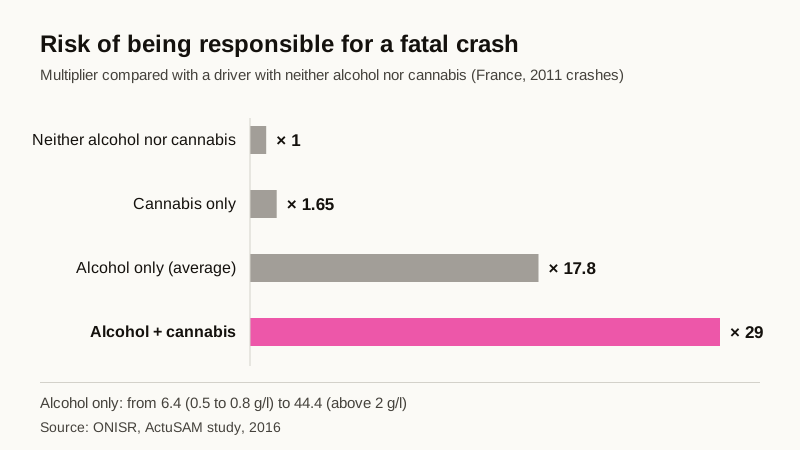
A driver who tests positive for cannabis multiplies by 1.65 the risk of being responsible for a fatal crash. A drunk driver multiplies it by 17.8 on average, from 6.4 between 0.5 and 0.8 g/l up to 44.4 above 2 g/l. Positive for both, the driver multiplies it by 29. More than one in two responsible drivers under the influence of cannabis had also been drinking.
French law follows the same logic. According to the official service-public.fr page, driving after drug use is punishable by 3 years in prison and a €9,000 fine, whatever the quantity. With alcohol on top, the penalty rises to 5 years and €15,000. Our article on CBD and driving explains why a full-spectrum oil can be enough to trigger a positive test.
Where does CBD fit in this comparison?
CBD sold legally in France does not belong in this comparison. It comes from hemp varieties with no more than 0.30% Δ⁹-THC, and it lacks the psychoactive effect of THC: our article on what CBD is sets out that framework. The studies cited above concern THC-rich cannabis, not CBD.
That does not make CBD a product without precautions. It interacts with some medicines, and full-spectrum products contain traces of THC. As for the idea of using CBD to drink less, trials are still rare and small: our overview of CBD and alcohol sums up what has been measured. CBD is not a treatment for dependence.
Frequently asked questions
Is alcohol more dangerous than cannabis?
On mortality, toxicity and the risk of dependence, yes. The British (2010) and European (2015) expert panels put alcohol first with 72 out of 100. Cannabis still carries its own risks, above all for mental health with daily use.
Can you overdose on cannabis?
In the Lachenmeier and Rehm study, the margin between the dose used and the toxic dose exceeds 10,000 for cannabis, the widest of all substances studied. That margin measures immediate toxicity only: it takes no account of accidents or mental health problems.
Is mixing alcohol and cannabis riskier?
Yes. Behind the wheel, the risk of being responsible for a fatal crash is multiplied by 29 with both, against 1.65 with cannabis alone and 17.8 with alcohol alone, according to the ActuSAM study. French law also punishes the combination more severely.
Does cannabis cause dependence faster than alcohol?
Less often, but faster. About 9% of cannabis users become dependent during their lives, against 23% of drinkers. But half of cannabis dependence cases appear within 5 years, against 13 years for alcohol.
Written by the Phytogrammes team
Every article in this journal draws on primary sources (ANSM, EFSA, EUR-Lex, peer-reviewed publications) and on the lab's own practice: batch-by-batch HPLC analyses, measured cannabinoid profiles. Our approach.
Article published on . CBD is not a medicine.