CBD (cannabidiol): definition and the French rules in 2026
*CBD is short for cannabidiol, a cannabinoid produced by hemp (Cannabis sativa L.) and first isolated in 1940. It does not cause the intoxication of THC and is not classified as a narcotic. In France, a CBD product can be sold if its Δ⁹-THC content does not exceed 0.30%, flowers included since 2022, but not as a food and not with a health promise.*
Contents
> Key takeaways > > - CBD is one of around a hundred hemp cannabinoids; its structure was described in 1963. > - It does not activate the CB1 receptor the way THC does, but the French drugs agency MILDECA notes that it acts on the brain. > - Flowers, resins and cosmetics are allowed below 0.30% Δ⁹-THC in the finished product. > - CBD foods and supplements are not authorised; checks were extended in May 2026. > - The only authorised CBD medicine is Epidyolex, reserved for three rare forms of epilepsy.
Definition: what the word CBD means
CBD is a cannabinoid, one of the molecules hemp makes in its trichomes, the tiny glands that cover its flowers. The plant produces around a hundred of them. CBD and THC are the most abundant and the best studied.
Its history is well documented. According to a review by pharmacologist Roger Pertwee, CBD was first obtained from cannabis in 1940 by Roger Adams's team. Its structure was worked out in 1963 in Raphael Mechoulam's laboratory, a year before the same laboratory isolated Δ⁹-THC.
The plant does not make CBD directly. It produces CBGA, which an enzyme turns into CBDA, the acidic form. Heat then removes a carboxyl group from CBDA and gives CBD: this is decarboxylation. Our pages on CBG and CBDA cover these steps, and our page on cannabinoids places CBD among the others.
CBD and THC: same plant, two legal statuses
THC activates the brain's CB1 receptor, which produces the cannabis high. CBD does not work that way. A 2015 cell study describes it as a negative allosteric modulator of the CB1 receptor: it binds elsewhere on the receptor and reduces the effect of the molecules that activate it.
Calling CBD "non-psychoactive" oversimplifies. MILDECA, the French interministerial mission against drugs, writes on its CBD page that it has psychoactive effects "in that it acts on the brain", while not causing dependence, unlike THC. The accurate wording is therefore: CBD does not get you high. Our article does CBD get you high? looks at the question in detail.
| Criterion | CBD | Δ⁹-THC |
|---|---|---|
| Intoxication | No | Yes |
| Action on the CB1 receptor | Indirect modulation | Activation |
| Status in France | Not a narcotic | Narcotic |
| Products on open sale | Allowed if Δ⁹-THC ≤ 0.30% | Banned above that level |
| Authorised medicine | Epidyolex | Medical cannabis, separate framework |
The French framework in seven dates
The current status of CBD was built in stages, between Luxembourg, Paris and Parma.
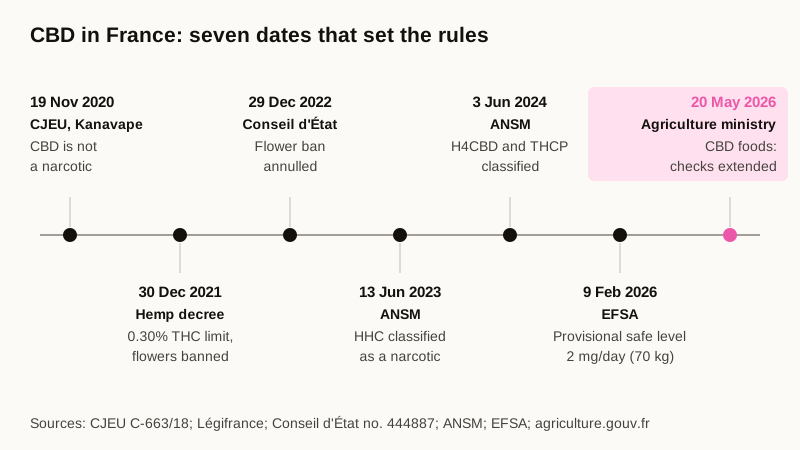
- 19 November 2020: in the Kanavape ruling (C-663/18), the Court of Justice of the European Union holds that CBD is not a narcotic drug within the meaning of the 1961 Convention.
- 30 December 2021: the hemp decree sets a 0.30% Δ⁹-THC limit for varieties, extracts and the products that contain them. It also bans the sale of raw flowers and leaves.
- 29 December 2022: the Conseil d'État annuls that ban (decision no. 444887). Flowers can be sold again.
- 13 June 2023: the ANSM classifies HHC and two derivatives as narcotics.
- 3 June 2024: the ANSM adds H4CBD, THCP and other derivatives.
- 9 February 2026: EFSA publishes a provisional safe level of 0.0275 mg per kilo per day, about 2 mg for a 70 kg adult.
- 20 May 2026: the Ministry of Agriculture states that CBD foods are illegal and extends checks to all of them.
What is allowed in 2026, product by product
| Product | Status | Condition |
|---|---|---|
| Flowers and leaves | Allowed | Catalogue variety, Δ⁹-THC ≤ 0.30% |
| Resins and extracts | Allowed | Δ⁹-THC ≤ 0.30% in the finished product |
| Cosmetics | Allowed | EU cosmetics regulation, for skin use |
| Oils to swallow, gummies, supplements, drinks | Not authorised | Novel food without EU authorisation |
| HHC, H4CBD, THCP and derivatives | Banned | Classified as narcotics |
The row that misleads most people is food. The ministry's text is clear: foods containing CBD are not authorised under the "novel foods" regulation, because their safety has not been shown. Only hemp seeds, their derivatives such as hemp seed oil, and leaves intended for infusion are outside that status. Our article on the Novel Food rules covers this point.
What about "French CBD"? Origin is not a legal condition: the variety and the THC level are. Our guide to French CBD and its labels explains what those claims actually guarantee.
What CBD is not: an over-the-counter medicine
A CBD product may not claim any therapeutic effect. MILDECA points out that such claims expose sellers to criminal penalties, unless the product is an authorised medicine. The only CBD-based medicine, Epidyolex, received its EU authorisation in 2019. It is prescribed from the age of 2, alongside other medicines, for Lennox-Gastaut syndrome, Dravet syndrome and tuberous sclerosis complex. Our article on Epidyolex summarises the trials behind it.
Authorities remain cautious on safety. EFSA considers that the safety of CBD cannot be established for people under 25, pregnant or breastfeeding women and people on medication. In March 2025, the French agency ANSES proposed classifying CBD as presumed toxic for reproduction, category 1B. CBD is also processed by liver enzymes that break down many medicines: talk to your doctor or pharmacist if you take any. Our page on drug interactions gives the known examples.
CBD and driving: the residual THC trap
A compliant CBD product can contain traces of THC, and roadside saliva tests look for THC. On 21 June 2023 (no. 22-85.530), the French Court of Cassation ruled that the offence of driving after using narcotics is made out whatever the dose, even if the product was on open sale. Since the law of 9 July 2025, article L235-1 of the Highway Code punishes this offence with three years in prison and a 9,000 euro fine. Our article on CBD and driving covers roadside checks.
Frequently asked questions
What does CBD stand for?
CBD stands for cannabidiol. It is a hemp cannabinoid, isolated in 1940, whose structure was described in 1963.
Does CBD get you high?
No. It does not activate the CB1 receptor the way THC does. MILDECA nonetheless notes that it acts on the brain: it is not inert.
Is CBD legal in France in 2026?
Yes for flowers, resins, extracts and cosmetics with no more than 0.30% Δ⁹-THC. No for foods and food supplements, which have no EU authorisation.
Are CBD and cannabis the same thing?
The plant is the same, Cannabis sativa L. Legal hemp comes from low-THC varieties. THC-rich cannabis remains a narcotic, and using it is punishable by up to one year in prison and a 3,750 euro fine.
Is CBD a medicine?
No, except Epidyolex, prescribed for three rare forms of epilepsy. Products sold in shops may not claim any health effect.
Written by the Phytogrammes team
Every article in this journal draws on primary sources (ANSM, EFSA, EUR-Lex, peer-reviewed publications) and on the lab's own practice: batch-by-batch HPLC analyses, measured cannabinoid profiles. Our approach.
Article published on . CBD is not a medicine.