CBD outside hemp: no other known plant makes it
*No: as of 2026, no plant other than hemp (Cannabis sativa L.) is known to make CBD. A few species produce chemical cousins, such as the CBGA of a South African everlasting or the perrottetinene of a liverwort. CBD without a hemp field does exist, though: engineered yeasts and synthetic chemistry can both produce it.*
Contents
> Key takeaways > > - CBD forms in hemp trichomes from CBGA, through an enzyme specific to the plant: CBDA synthase. > - Helichrysum umbraculigerum makes up to 4.3% CBGA and more than 40 cannabinoids, but neither CBD nor THC. > - The beta-caryophyllene in pepper binds the CB2 receptor; it is not a hemp cannabinoid and does not turn into CBD. > - On 18 September 2026, EFSA found a synthetic CBD safe at up to 2 mg a day, under strict conditions. That is not a sales authorisation.
CBD is a hemp molecule, and only a hemp molecule
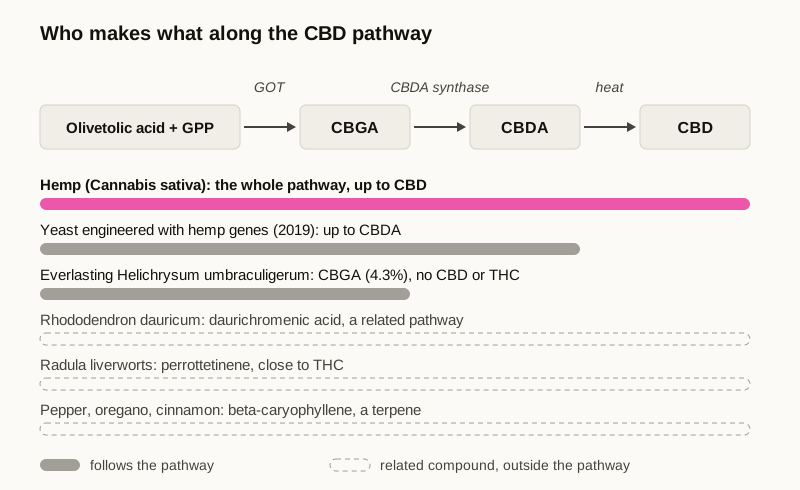
Hemp makes its cannabinoids in its trichomes, the small resin glands that mostly cover the female flowers. Everything starts from one precursor, cannabigerolic acid (CBGA). An enzyme, CBDA synthase, turns it into cannabidiolic acid (CBDA). Heat then strips a carboxyl group from CBDA and gives CBD: this is decarboxylation. Our page on CBG, the parent molecule of CBD walks through this chain.
The human body also makes molecules that act on the CB1 and CB2 receptors: anandamide and 2-AG, known as endocannabinoids. Their structure is very different from that of CBD. Our article on the endocannabinoid system explains this receptor network.
It is this shared target, not a shared molecule, that feeds the confusion. A plant can contain a compound that reaches the same receptors without holding any trace of CBD.
Four plants wrongly cited as "sources of CBD"
The plants that keep coming up in these discussions make related molecules or compounds active on the same receptors. None produces measurable CBD.
| Plant | What it makes | Link with CBD |
|---|---|---|
| Helichrysum umbraculigerum, a South African everlasting | CBGA (up to 4.3%), CBG, more than 40 cannabinoids | Same precursor, but no CBD or THC |
| Rhododendron dauricum, a Siberian rhododendron | Daurichromenic acid | Enzyme whose mechanism resembles the hemp synthases |
| Radula liverworts | Perrottetinene | Structure close to THC, not CBD |
| Black pepper, oregano, cinnamon | Beta-caryophyllene, a terpene | Binds the CB2 receptor, no structural link |
The South African everlasting. This is the most serious case. In 2023, a team at the Weizmann Institute published in Nature Plants an analysis of Helichrysum umbraculigerum, a member of the daisy family unrelated to hemp. The plant contains up to 4.3% cannabigerolic acid. It stores it in the trichomes of its leaves, not its flowers. The authors show that its enzymes arose independently of those of hemp: a case of parallel evolution. According to the Weizmann Institute's release, six of its more than 40 cannabinoids are identical to those in cannabis, including CBG, but not THC or CBD.
The Siberian rhododendron. Rhododendron dauricum makes daurichromenic acid in the glandular scales of its leaves. A 2017 study identified the enzyme that makes it. Its mechanism partly resembles that of the hemp synthases, but it works on a different substrate, grifolic acid. The end product is not a hemp cannabinoid.
*The Radula liverworts. These small, moss-like plants contain perrottetinene, a molecule whose shape recalls THC. In 2018, researchers at the University of Bern showed that it enters the mouse brain and acts through the CB1 receptor. Radula* preparations are sold online as a "legal high". This has nothing to do with CBD, which has no such effect.
Pepper and beta-caryophyllene. This terpene is abundant in the essential oils of black pepper, oregano and cinnamon, and hemp contains it too. A 2008 study described it as a selective ligand of the CB2 receptor, with an in vitro affinity of 155 nanomolar. A 2020 study found only a weak interaction with CB2 among five terpenes tested. The results disagree, and in any case beta-caryophyllene does not convert into CBD. Our article on beta-caryophyllene covers this work.
CBD without a plant: engineered yeast and chemical synthesis
The hemp pathway can be copied outside the plant. In 2019, a Berkeley team reported in Nature the complete biosynthesis of several cannabinoids in yeast, Saccharomyces cerevisiae, starting from a simple sugar, galactose. The yeast produced CBGA, THCA, CBDA and their short-chain equivalents, THCVA and CBDVA. It took the hemp genes plus an enzyme that was unknown at the time.
Synthetic chemistry also makes CBD, with no living organism involved. The latest opinion from the European Food Safety Authority deals with this kind of CBD. On 18 September 2026, EFSA assessed a CBD obtained by chemical synthesis, at least 98% pure, dissolved in medium-chain triglyceride oil and intended for food supplements. It found it safe at up to 2 mg a day, for adults over 25, excluding pregnancy and breastfeeding. Safety could not be established for people taking medication. An EFSA opinion is not an authorisation: the European Commission, with the member states, decides whether a novel food goes on the Union list.
Chemically, a pure CBD molecule is the same whether it comes from a flower, a yeast or a reactor. What changes are the possible impurities and everything that comes along with the molecule. A plant extract contains other cannabinoids and terpenes; a synthetic CBD or a 99% isolate contains almost none.
What French law looks at: use more than origin
Hemp. The order of 30 December 2021 authorises Cannabis sativa L. varieties listed in the official catalogues, with no more than 0.30% Δ⁹-THC, and caps extracts and finished products at the same threshold. The Council of State decision of 29 December 2022 struck down the ban on selling flowers and leaves.
Ingestion. Whether it comes from hemp or a laboratory, CBD meant to be swallowed falls under the EU novel food regulation. The French agriculture ministry restated this in a notice of 20 May 2026: foods containing CBD are illegal and must be withdrawn from the market. The notice states that cannabinoids "can be extracted by various processes or produced synthetically". Origin therefore changes nothing. Our overview of CBD regulation in 2026 describes this framework.
Modified molecules. Do not confuse "synthetic CBD" with a semi-synthetic cannabinoid. H4CBD, made by hydrogenating CBD, and HHC are molecules different from CBD. The ANSM, the French medicines agency, classified them as narcotics, from 3 June 2024 in the case of H4CBD. Our article on synthetic cannabinoids in CBD explains how to spot them.
Reading the origin of CBD on a certificate of analysis
The CBD level alone says nothing about origin. A 99% pure CBD can come out of an extractor or a synthesis. The rest of the profile tells you more:
| What the certificate shows | What you can infer |
|---|---|
| CBD, CBDA, CBG, traces of Δ⁹-THC and terpenes | Plant material or plant extract |
| CBD alone, other cannabinoids not detected | Isolate or synthetic CBD: the origin must be stated elsewhere |
| HHC, H4CBD or THCP detected | Product to avoid: narcotics in France |
A hemp flower or resin is plant material by definition; its certificate should show a full profile and Δ⁹-THC at 0.30% or less. Our guide to reading a certificate of analysis goes through each line, and the laboratory page describes the testing methods. CBD flowers are hemp buds: this full profile is what their certificate should show.
Frequently asked questions
Does any plant other than hemp contain CBD?
None is known so far. The everlasting Helichrysum umbraculigerum comes closest: it makes CBGA and CBG, but neither CBD nor THC, according to the team that studied it in 2023.
Is synthetic CBD the same as hemp CBD?
The pure molecule is identical. A synthetic CBD contains neither the other cannabinoids nor the terpenes of a plant extract, and its possible impurities depend on the manufacturing process.
Can you buy synthetic CBD in France?
For food use, no: no CBD, plant or synthetic, is authorised as a novel food so far. EFSA's favourable opinion of 18 September 2026 covers one application and is not an authorisation.
Does black pepper have effects similar to CBD?
It contains beta-caryophyllene, which binds the CB2 receptor according to a 2008 study, and more weakly according to a 2020 study. This terpene is not CBD and does not turn into CBD.
Could the South African everlasting replace hemp?
Not for CBD, which it does not make. The authors of the 2023 study present it rather as a source of CBGA and a pool of enzymes useful for producing cannabinoids in yeast.
Written by the Phytogrammes team
Every article in this journal draws on primary sources (ANSM, EFSA, EUR-Lex, peer-reviewed publications) and on the lab's own practice: batch-by-batch HPLC analyses, measured cannabinoid profiles. Our approach.
Article published on . CBD is not a medicine.