THCV: a natural cannabinoid tolerated only below 0.3%
THCV, or tetrahydrocannabivarin, is a natural hemp cannabinoid built like THC but with a side chain of 3 carbons instead of 5. In France, the ANSM only excludes it from the narcotics list if its content does not exceed 0.3%. Human studies remain rare and small: four trials, with 10 to 62 participants.
Contents
> Key takeaways > > - THCV is a "varin": the plant makes it from divarinic acid, not olivetolic acid. > - European hemp contains little of it; high levels are found mostly in cannabis populations from Asia and Africa. > - Depending on dose and model, it blocks or activates the CB1 receptor; a 2023 trial noted THC-like effects at 100 and 200 mg. > - Since June 2024, THCV and its acid form have been narcotics in France above 0.3% each. > - In the 2023 trial, 78 urine drug screens out of 79 came back positive for THC.
Definition: a short-chain THC
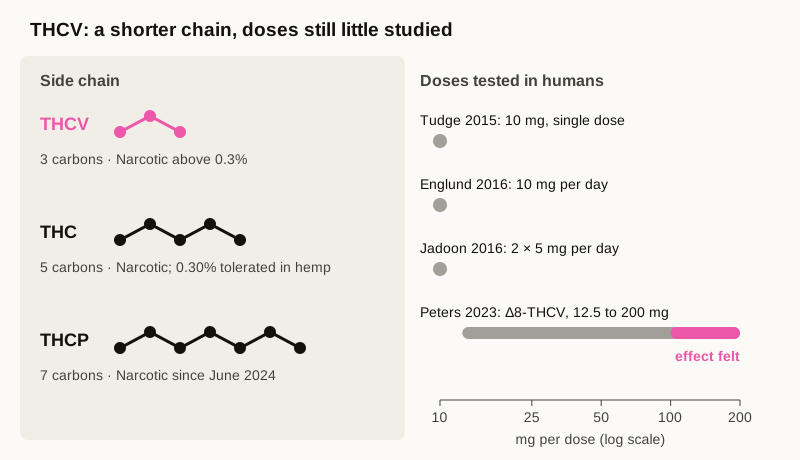
THCV shares THC's skeleton, but its side chain has three carbons (a propyl group) instead of five (a pentyl group). Chemists call these short-chain cannabinoids "varins": THCV, CBDV, CBGV. A 2021 review in Frontiers in Pharmacology notes that their precursor, cannabigerovarinic acid (CBGVA), is made from divarinic acid. The plant's synthases then turn it into THCVA, and heat gives THCV.
The length of this chain governs how the molecule fits into cannabinoid receptors. THCP, with seven carbons, sits at the other end of the series. Our page on THCP describes it, and the one on CBDV covers the varin of CBD.
Where is THCV found?
In most hemp grown in Europe, very little. A 2022 study on Croatian industrial hemp inflorescences detected no THCVA in its extracts. In 2004, an analysis of 157 cannabis populations showed that plants relatively rich in THCV or CBDV were common only in the authors' "indica" group. That group mainly brings together drug-type cannabis from Asia and Africa, not European farm hemp.
Breeders have since created THCV-rich varieties, as they did for CBG. A product that claims a lot of THCV therefore comes from genetics chosen for it, or from added purified THCV. Either way, its certificate of analysis should show the measured level. Our guide to reading a certificate of analysis explains where to find it.
Pharmacology: an effect that depends on dose
The reference review is still Roger Pertwee's, published in 2008 in the British Journal of Pharmacology. It describes THCV as blocking CB1 receptor agonists in vitro and, in animals, behaving "either as a CB1 antagonist or, at higher doses, as a CB1 receptor agonist". At the CB2 receptor, it acts in vitro as a potent partial agonist.
Put simply: at a low dose, THCV would dampen activation of CB1, the target of THC; at a high dose, it would activate it. These results come from cells and animals. They say nothing about an effect in humans at a given dose.
What human trials show
Four controlled trials have been published. All are small, and two were run with cannabis companies.
| Trial | Participants | Dose | Main result |
|---|---|---|---|
| Tudge et al., 2015 | 20 healthy volunteers | 10 mg, single dose | Subjective ratings unchanged; stronger brain responses on MRI |
| Englund et al., 2016 | 10 men | 10 mg a day, 5 days | Indistinguishable from placebo; THC injected afterwards felt weaker to 9 out of 10 |
| Jadoon et al., 2016 | 62 adults with type 2 diabetes | 5 mg twice a day, 13 weeks | Primary endpoint (HDL cholesterol) unchanged |
| Peters et al., 2023 | 21 healthy adults | Δ⁸-THCV, 12.5 to 200 mg | THC-like effects felt at 100 and 200 mg |
The trial by Englund and colleagues, at King's College London, gave 10 mg of THCV a day for five days, then 1 mg of intravenous THC. THCV on its own was indistinguishable from placebo. It curbed some effects of THC, such as the faster heart rate, and heightened others, such as memory intrusions. The authors ask for these results to be read with caution, given the sample size.
The trial by Jadoon and colleagues, run with GW Pharmaceuticals, involved 62 people. Its primary endpoint, HDL cholesterol, did not move. Among the secondary endpoints, fasting glucose fell by 1.2 mmol/l more than on placebo. A pilot trial of this size supports no promise: no THCV medicine is authorised. The only authorised cannabidiol medicine, Epidyolex, contains CBD, not THCV.
The trial by Peters and colleagues, run by researchers at Canopy Growth, tested Δ⁸-THCV, an isomer, in single rising doses. Adverse events were mostly mild; euphoric mood was the most common. At 100 and 200 mg, participants reported that they could "feel a drug effect".
Legal status in France: the 0.3% threshold
From 3 June 2024, the ANSM, the French medicines agency, classified as narcotics several cannabinoids built on the benzo[c]chromene core, that of THC, including HHC and THCP. An amending decision of the same day, announced on 4 June, went on to exclude THCV and THCVA "provided that their content does not exceed 0.3% each". The stated aim: not to target the traces found in industrial hemp.
In practice, the THCV naturally present in small amounts in a flower or an oil is tolerated. An enriched product containing more than 0.3% falls under the narcotics rules. The product must also stay within the 0.30% Δ⁹-THC cap set by the order of 30 December 2021. Our article on HHC traces how neighbouring molecules were classified.
For a product meant to be swallowed, the EU novel food regime also applies, covering all cannabinoid extracts. Our overview of CBD regulation in 2026 describes the situation.
THCV and drug testing
This is the most practical point for a driver. In the trial by Peters and colleagues, 78 urine drug screens out of 79 taken 8 hours after a dose of Δ⁸-THCV came back positive for THC. The authors conclude that a THCV product taken by mouth can make a THC drug test positive. Our guide to CBD and drug testing details the tests used in France.
Frequently asked questions
Does THCV get you high?
At 10 mg a day, a 2016 trial could not tell it apart from placebo. At 100 and 200 mg of Δ⁸-THCV, participants in a 2023 trial felt a THC-like effect, mild and with no measured impairment.
Is THCV legal in France?
Yes, if it does not exceed 0.3% in the product. Above that, the ANSM decision of June 2024 classifies it as a narcotic, like its acid form, THCVA.
What is the difference between THCV and THC?
A side chain of 3 carbons instead of 5. This difference changes how the molecule acts on the CB1 receptor: depending on the dose, THCV blocks or activates it.
Can THCV make a drug test positive?
Yes, according to the 2023 trial: 78 urine tests out of 79 were positive for THC after an oral dose of Δ⁸-THCV. French roadside tests look for THC.
Why is there little THCV in CBD sold in France?
Because European hemp makes very little of it. High levels come from selected genetics, and a product enriched above 0.3% is banned.
Written by the Phytogrammes team
Every article in this journal draws on primary sources (ANSM, EFSA, EUR-Lex, peer-reviewed publications) and on the lab's own practice: batch-by-batch HPLC analyses, measured cannabinoid profiles. Our approach.
Article published on . CBD is not a medicine.