CBD and fibromyalgia: what a 200-patient trial found
CBD has not been shown to have an effect on fibromyalgia. A trial run in Denmark on 200 patients over 24 weeks did not find 50 mg of CBD a day more effective than a placebo on pain. In France, the national health authority (HAS) considers the data insufficient to recommend cannabinoids for this condition, and CBD products sold over the counter are not medicines.
Contents
> Key takeaways > > - Fibromyalgia affects about 1.6% of the French population, according to Inserm. > - In the trial published in 2026 in the Annals of the Rheumatic Diseases, pain fell by 0.4 point with CBD and by 1.1 points with placebo, on a 0 to 10 scale. > - Earlier studies mostly tested THC or nabilone, a synthetic derivative, and their results are rated low quality. > - The HAS guidelines published in July 2025 put adapted physical activity first and do not recommend cannabinoids. > - Fibromyalgia was not among the conditions covered by the French medical cannabis pilot scheme.
Fibromyalgia in brief
Fibromyalgia combines widespread, lasting pain with fatigue and sleep problems. The Inserm collective expert review published in October 2020 puts its frequency at 1.6% of the population in France, with a strong female majority. The report noted at the time that its management was "not codified" and mostly aimed at symptoms.
That is no longer quite true. On 10 July 2025, the French national health authority (HAS) published guidelines on diagnosis and treatment strategy. The first line relies on adapted physical activity, learning to manage the condition and staying in work. Some antidepressants and antiepileptics at low doses come second. Opioids have only an occasional, cautious place.
The 2026 Danish trial: a negative result
The strongest study on the question was published in the Annals of the Rheumatic Diseases, online in August 2025 and in the March 2026 issue. It is a randomised, double-blind trial run at a specialist centre in Denmark. Randomised means chance decides who receives the product; double-blind means neither patients nor clinicians know who receives what.
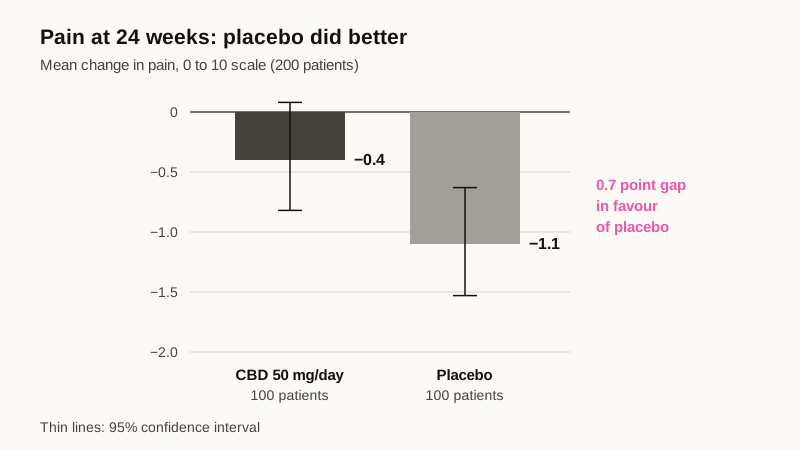
Of 273 people screened, 200 were included: 100 received 50 mg of plant-derived CBD a day as tablets, 100 a placebo, for 24 weeks. The main outcome was the change in pain, scored from 0 to 10 in a standard fibromyalgia questionnaire.
At week 24, pain had fallen by an average of 0.4 point in the CBD group and 1.1 points in the placebo group. The 0.7-point gap is statistically significant, in favour of placebo. Side effects were mostly mild and similarly spread across both groups. The authors conclude that their findings "do not support" CBD at 50 mg a day as an add-on painkiller in fibromyalgia.
The trial has limits: one dose, one centre, one country. It says nothing about other doses or other forms. None of the reviews cited by the HAS included a trial of this size on CBD alone, and this one shows no effect.
What earlier studies found
Before 2025, the data mostly concerned products containing THC.
A Dutch study published in Pain in 2019 had 20 patients inhale, in a single session, three pharmaceutical cannabis varieties, one of them rich in CBD, and a placebo variety. None did better than placebo on spontaneous pain. The authors also observed that CBD raised blood levels of THC while reducing its pain-relieving effect.
A systematic review published in 2023 in Biomedicines pooled four randomised trials and five observational studies, 564 patients in all. The trials mostly tested nabilone, a synthetic cannabinoid close to THC, and inhaled cannabis. The authors describe the evidence for a short-term fall in pain as "low quality".
The HAS reviewed this work in the evidence report behind its guidelines. It cites a Cochrane review limited to two trials and 72 participants, without enough data to conclude. It notes that the European rheumatology body (EULAR) does not recommend cannabinoids, for lack of data.
| Study | Product tested | Participants | Result on pain |
|---|---|---|---|
| Pain, 2019 | Inhaled cannabis, one CBD-rich variety, single session | 20 | No better than placebo |
| Biomedicines, 2023 (review) | Mostly nabilone and cannabis | 564 | Low-quality evidence, short term |
| Annals of the Rheumatic Diseases, 2026 | CBD alone, 50 mg a day, 24 weeks | 200 | Placebo slightly better |
Our article on what clinical studies really say about CBD explains how to read this kind of result.
The position of the French authorities
The HAS conclusion is clear: the data are insufficient to recommend the use of cannabinoids in fibromyalgia. The same text adds that CBD products sold over the counter have not been assessed for quality, composition or harmfulness, and that they do not have the status of medicines.
Medical cannabis is a separate matter. The pilot scheme run by the ANSM, the French medicines agency, covered five conditions, including refractory neuropathic pain, painful spasticity in multiple sclerosis and some drug-resistant epilepsies. Fibromyalgia was not one of them. The move to a permanent framework is under way: our article on the rollout of medical cannabis follows the timetable.
The only CBD-based medicine authorised in France is Epidyolex, prescribed for rare and severe forms of epilepsy: Lennox-Gastaut and Dravet syndromes, and tuberous sclerosis complex. Our update on Epidyolex and the research describes that framework.
What we can say, and what we do not
A CBD product sold freely cannot claim any effect on a disease. The state of research would not allow it either: the only large trial of CBD alone is negative. We therefore present none of our products as an answer to fibromyalgia.
Two precautions apply to anyone on medication. CBD can interact with some medicines, including antiepileptics, a class prescribed as second-line in fibromyalgia: our article on CBD drug interactions explains the mechanism. And your doctor remains the person to talk to about any decision on your care.
Frequently asked questions
Does CBD work for fibromyalgia pain?
The available data do not show it. In the 2026 Danish trial of 200 patients followed for 24 weeks, pain fell less with CBD (0.4 point) than with placebo (1.1 points). The HAS considers the data insufficient to recommend cannabinoids.
How many people have fibromyalgia in France?
About 1.6% of the population, according to the Inserm collective expert review published in 2020, with a strong female majority.
Is medical cannabis prescribed for fibromyalgia in France?
No. The ANSM pilot scheme covered five conditions, including refractory neuropathic pain, but not fibromyalgia. The HAS points this out in its 2025 guidelines.
What does the HAS recommend for fibromyalgia?
First line: adapted physical activity, learning to manage the condition and staying in work. Second line: some antidepressants and antiepileptics at low doses. Cannabinoids are not recommended, for lack of sufficient data.
Written by the Phytogrammes team
Every article in this journal draws on primary sources (ANSM, EFSA, EUR-Lex, peer-reviewed publications) and on the lab's own practice: batch-by-batch HPLC analyses, measured cannabinoid profiles. Our approach.
Article published on . CBD is not a medicine.