CBD to quit smoking: what 3 studies actually show
Only three studies have tested CBD in smokers, on 74 people in total and over a few days at most. The most cited one found about 40% fewer cigarettes smoked in one week with a CBD inhaler, a result never confirmed since. None measured lasting abstinence from tobacco: for that, nicotine replacement therapy remains the reference, and in France it is reimbursed.
Contents
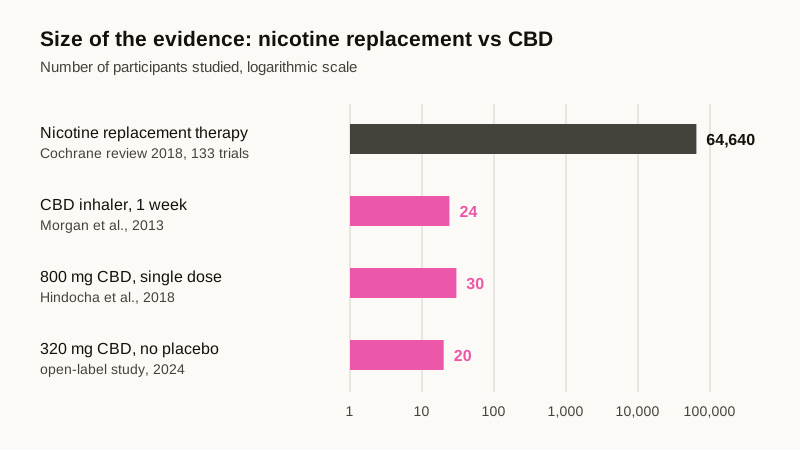
> Key takeaways > > - Morgan et al. (2013): 24 smokers, one week, about 40% fewer cigarettes with inhaled CBD, no change with placebo. > - Hindocha et al. (2018): a single 800 mg dose of CBD made cigarette images less appealing, without reducing craving or withdrawal. > - No study has followed smokers on CBD to six months of abstinence, the standard endpoint of cessation trials. > - Nicotine replacement raises the chances of quitting by 55%, according to 133 trials and 64,640 participants, and is reimbursed at 65% in France. > - In the lab, CBD slows the enzymes that clear nicotine: mention it to a professional if you use patches.
The three studies in smokers
CBD (cannabidiol) interests tobacco researchers because the endocannabinoid system plays a part in nicotine dependence. In humans, the data fit in one table:
| Study | Participants | Protocol | Main result |
|---|---|---|---|
| Morgan et al., 2013 | 24 smokers who wanted to quit | CBD or placebo inhaler, as needed, 1 week | About 40% fewer cigarettes on CBD, no difference on placebo |
| Hindocha et al., 2018 | 30 dependent smokers, after a night without tobacco | 800 mg oral CBD or placebo, once | Cigarette images less salient and rated less pleasant. Craving and withdrawal unchanged |
| 2024 study | 20 e-cigarette users | 320 mg CBD, no placebo, 4 h of abstinence | Lower reported withdrawal and anxiety |
The Morgan et al. trial, published in Addictive Behaviors, is the one that gets quoted most. Smokers used the inhaler whenever they felt the urge to smoke. The authors report the effect was partly maintained at follow-up, and call their own results preliminary.
The Hindocha et al. study, published in Addiction, measured something else: attentional bias, the tendency of the eyes to settle on anything that recalls cigarettes. After a night without tobacco, this bias increased on placebo and reversed on CBD. Craving and withdrawal symptoms, however, did not move.
The third, an open-label study in Cannabis and Cannabinoid Research, had no placebo group: participants knew they were taking CBD. The authors adjusted their results for participants' positive expectations, but this design cannot rule out an expectation effect.
What these results do not tell us
A smoking treatment is judged on one question: how many people are no longer smoking six months later. None of the three studies measured it. They lasted a week at most, had 20 to 30 participants, and two of them tested a single dose.
A 2021 review of CBD trials in addiction, in Frontiers in Psychiatry, left the Morgan study out of its analysis. The reviewers judged its indirect comparison design did not meet their criteria, and noted that published data are limited to very short protocols or single doses.
No CBD product holds a marketing authorisation for smoking cessation. The only authorised medicine with CBD as its sole active ingredient, Epidyolex, is for rare epilepsies, as our article on CBD and epilepsy explains.
Nicotine replacement: tested and reimbursed
Nicotine patches, gum, lozenges and inhalers have been tested on a completely different scale. The 2018 Cochrane review pools 133 trials and 64,640 participants followed for at least six months. Across all forms, nicotine replacement raises the probability of quitting by 55% compared with placebo or no treatment. For patches alone, the figure reaches 64%.
In France, most nicotine replacement products are reimbursed at 65% since 1 January 2019, on prescription. A doctor, midwife, nurse, dentist or physiotherapist can prescribe them. The Tabac Info Service line, on 39 89, offers free follow-up with a tobacco specialist.
| Criterion | Nicotine replacement | CBD |
|---|---|---|
| Published trials | 133 randomised trials | 3 studies, 2 of them placebo-controlled |
| Follow-up | At least 6 months | 4 hours to 1 week |
| Outcome measured | Quitting smoking | Cigarettes smoked, attention, reported withdrawal |
| Reimbursement | 65% on prescription | None |
CBD and nicotine: an interaction to know about
CBD is not neutral for people who already use nicotine. A 2023 study in Chemical Research in Toxicology shows, on human enzymes in the lab, that CBD and its metabolite inhibit CYP2A6 and CYP2B6. These are the liver enzymes that turn nicotine into cotinine so the body can clear it. The authors conclude that CBD could slow nicotine clearance in humans, which remains to be measured.
If you use patches or gum and are thinking about CBD, talk to the professional supporting you. Our article on CBD and medicine interactions explains the enzyme mechanism, and the one on the EFSA reference dose puts the amounts in context.
Smoking CBD flower is not quitting smoking
Swapping a cigarette for a joint of CBD flower does not remove combustion. Smoke from any burning plant contains tar and carbon monoxide, whatever the plant. And when CBD flower is mixed with tobacco, the nicotine comes with it. Our comparison of tobacco and cannabis for health details the differences, and our article on tobacco-free alternatives in a joint describes the options for adults who already consume.
Frequently asked questions
Does CBD reduce the urge to smoke?
The data do not show that. In the 2018 study, 800 mg of CBD did not change craving or withdrawal, even though it made cigarette images less appealing. The 2013 study measured fewer cigarettes smoked, not a weaker urge.
Can CBD replace nicotine patches?
No. Patches have been tested on tens of thousands of smokers followed for six months and are reimbursed. CBD has only been tested on a few dozen people over a few days, with no measure of quitting.
Can I use CBD and patches at the same time?
Ask your doctor or pharmacist first. In the lab, CBD slows the enzymes that clear nicotine, which could change how a nicotine replacement product works.
Who can help me stop smoking?
Your GP, a midwife, a nurse or a pharmacist, and the Tabac Info Service line on 39 89. Prescribed nicotine replacement is reimbursed at 65% by the French health insurance.
Written by the Phytogrammes team
Every article in this journal draws on primary sources (ANSM, EFSA, EUR-Lex, peer-reviewed publications) and on the lab's own practice: batch-by-batch HPLC analyses, measured cannabinoid profiles. Our approach.
Article published on . CBD is not a medicine.