CBD and endometriosis: what the placebo trial showed
CBD is not a treatment for endometriosis. The randomised DREAMLAND trial, published in January 2026, compared a CBD-rich oil with a placebo in 102 women who had undergone surgery and whose pelvic pain had returned: pain fell by the same amount in both groups, and the CBD group had more mild side effects. Other, smaller trials are under way.
Contents
> Key takeaways > > - Endometriosis affects about 10% of women, according to Inserm. > - In the DREAMLAND trial, up to 150 mg of CBD a day for 10 weeks did no better than placebo on pain. > - About 60% of participants in both groups saw their pain fall by at least 30%: the placebo effect weighs heavily. > - The favourable published results come mostly from self-reported surveys on cannabis, with no control group. > - CBD sold in shops is not a medicine; the only authorised cannabidiol medicine, Epidyolex, is for certain epilepsies.
Endometriosis, and why research is looking at CBD
Endometriosis is a chronic disease: tissue similar to the lining of the uterus grows outside the uterus, on the ovaries, the fallopian tubes or the peritoneum. According to the Inserm dossier, it concerns about 10% of women. Hormonal therapies are the first line, and surgery removes the lesions.
The CBD lead rests on two observations. The first is biological: some pathways involved in the disease are also CBD targets, including the endocannabinoid system, a network of receptors that plays a part in pain. The second comes from patients, some of whom report using cannabis. A review published in late 2024 in Trends in Pharmacological Sciences gathers data from patient samples and animal models on these pathways. It is written by an Edinburgh team, with a co-author from the company MRX Medical. This plausibility justifies trials; it says nothing about efficacy in women.
The DREAMLAND trial: CBD against placebo
The DREAMLAND trial was run at the Ribeirão Preto Medical School, University of São Paulo, and published in Cannabis and Cannabinoid Research. Its protocol:
| Item | Detail |
|---|---|
| Participants | 102 women with surgically confirmed endometriosis, already operated on, on hormonal therapy, with pain returning |
| Allocation | 51 on CBD-enriched oil, 51 on placebo, assigned at random |
| Blinding | Triple blind: neither participants, nor carers, nor assessors knew the group |
| Dose | Twice a day, from 10 mg a day in week one to 150 mg a day in week nine, then tapering |
| Duration | 10 weeks |
| Primary outcome | Pain intensity on a 0 to 100 mm visual scale, share of women whose pain fell by at least 30% and at least 50% |
About 40% of participants in each group saw their pain fall by at least 50%, and about 60% by at least 30%. At the end of treatment, mean pain was 41.6 mm on CBD and 36.8 mm on placebo. Both groups improved clearly, with no significant difference between them.
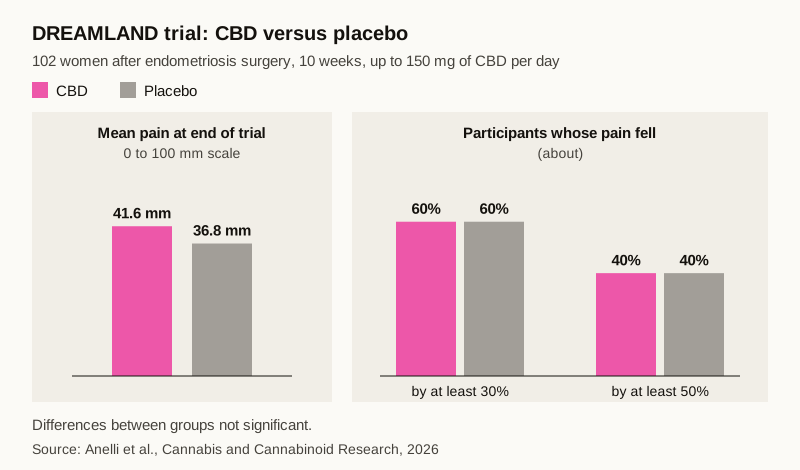
The trial was stopped at the interim analysis planned in the protocol, because there was no difference on the primary outcome and side effects were more frequent on CBD. These were mild effects, mostly digestive, and perceived weight changes; no serious effect was observed. The CBD group scored better on some psychological symptoms and some quality-of-life domains, the placebo group on the physical domains. The authors conclude that CBD was not superior to placebo.
Why the placebo effect matters so much here
Six participants in ten saw their pain fall by at least 30% on placebo. Without a control group, that improvement would have been credited to the product. That is the limit of the data most often shared.
An Australian online survey published in 2020 collected 484 responses from women with surgically confirmed endometriosis. Among those who used some form of self-management, 13% used cannabis. They rated its effect on pain at 7.6 out of 10, and 56% said they had cut their medicines by at least half. These figures are self-reported: respondents were recruited through patient groups on social media, the product was cannabis and not CBD alone, and no group received a placebo.
Our article on what CBD clinical studies say sets out the hierarchy: animal model, survey, open-label trial, placebo-controlled trial.
Trials under way
The ClinicalTrials.gov registry, checked on 23 September 2026, lists five studies combining cannabidiol and endometriosis. DREAMLAND and a US trial started in December 2020 have stopped, the second after 12 participants. Two US studies are recruiting, with 30 and 60 participants planned. A Spanish study of 10 participants, on a THC and CBD combination, no longer has an up-to-date status.
In the United Kingdom, the University of Edinburgh is preparing the ENDOCAN-1 trial: 100 participants, a CBD medicine called MRX-1, and recruitment announced for April 2026 in the Scottish health boards of Lothian and Grampian. It is a feasibility study looking for the dose, not yet proof of efficacy. Its authors present it as groundwork for a larger trial.
If you are considering CBD: the precautions
Talk to your doctor or gynaecologist first, and never stop a prescribed treatment on your own. CBD sold in shops is not a medicine and replaces neither diagnosis nor follow-up.
On 9 February 2026 the European Food Safety Authority set a provisional level of 0.0275 mg per kilo of body weight per day, about 2 mg a day for a 70 kg adult. It considers that the safety of CBD cannot be established for pregnant or breastfeeding women, people under 25 and people taking medication, which includes many patients on hormonal therapy. Our article on the EFSA reference dose details this calculation.
Three points are worth discussing at your appointment:
- interactions: CBD slows some liver enzymes that clear many medicines, as our articles on the grapefruit effect and on CBD and the liver explain;
- plans for pregnancy, common among patients: ANSES proposed on 21 March 2025 classifying CBD as presumed toxic to reproduction, as detailed in our article on CBD during pregnancy and breastfeeding;
- the route of use: CBD products meant to be swallowed fall under the novel food regime, described in our overview of CBD regulation in 2026.
The only authorised cannabidiol medicine, Epidyolex, is prescribed for certain rare epilepsies, not for endometriosis.
Frequently asked questions
Does CBD work for endometriosis pain?
The placebo-controlled trial published in 2026 does not show it. In DREAMLAND, 102 women took a CBD oil or a placebo for 10 weeks, and pain fell by the same amount in both groups.
Why do some patients say they feel better with cannabis?
Surveys collect a feeling, with no control group, from women who chose to use it. In DREAMLAND, about 60% of participants on placebo saw their pain fall by at least 30%: a real improvement, but not one due to the product.
What doses of CBD were tested?
DREAMLAND raised the dose from 10 to 150 mg a day over nine weeks, in two doses. The final dose is 75 times the provisional level of 2 mg a day set by EFSA for an adult, and it produced more mild side effects than the placebo.
Can CBD interact with an endometriosis treatment?
It can, because it slows liver enzymes that clear many medicines. Tell your doctor about any CBD use, especially if you take hormonal or pain medication.
Should we wait for other trials?
Yes, before drawing conclusions. The studies under way are small and mostly look at dose and feasibility. For now, nothing supports presenting CBD as an answer to endometriosis.
Written by the Phytogrammes team
Every article in this journal draws on primary sources (ANSM, EFSA, EUR-Lex, peer-reviewed publications) and on the lab's own practice: batch-by-batch HPLC analyses, measured cannabinoid profiles. Our approach.
Article published on . CBD is not a medicine.