Brain fog and CBD: what the science allows us to say
Brain fog is not a diagnosis: it is the everyday name for a complaint made up of slowed thinking, lack of clarity and trouble paying attention. France's health authority (HAS) describes it in particular in long Covid, and lack of sleep is a well-documented cause. We found no study showing that CBD improves concentration in healthy adults: a 2025 trial at 246 mg found no effect on memory.
Contents
> Key takeaways > > - "Brain fog" describes a feeling, not a disease; working out the cause is a doctor's job. > - In 2017, French adults slept on average 6 h 42 per 24 hours on weekdays, below the recommended minimum of 7 hours. > - A 2025 crossover trial (35 adults, 246 mg of CBD) measured no effect on learning or memory. > - Anxiety trials use 150 to 600 mg in a single dose, 75 to 300 times EFSA's provisional level. > - No CBD product may claim an effect on concentration in France.
A complaint, not a diagnosis
The expression "brain fog" does not match any defined disease. It appears in the medical literature in very different settings: long Covid, hypothyroidism, examined in a review published in 2022 in Thyroid, and disorders of wakefulness.
The Haute Autorité de santé gives a precise description in its sheet on the neurological symptoms of long Covid, updated in March 2022. Patients describe mental slowing, lack of clarity in their thinking, trouble paying attention, words that will not come. The sheet recommends a first assessment with a standardised test, the MoCA, then a neurological opinion if the problem persists.
That starting point matters for what follows: a word that covers several causes has no single remedy, and no product can claim to clear it.
Sleep, the first cause to look at
Inserm, the French medical research institute, notes in its sleep file that sleep plays a role in concentration, learning and memory. According to the Santé publique France survey cited by Inserm, adults slept on average 6 h 42 per 24 hours on weekdays in 2017, below the 7 hours usually recommended as a minimum, and 6 h 55 on average over the whole week.
Regular lack of sleep can therefore be enough to produce some of the symptoms grouped under this name. Other leads, such as a thyroid problem, a side effect of a medicine or the aftermath of an infection, need a medical examination. If the problem lasts several weeks or comes with other signs, talk to your doctor.
What trials say about CBD and cognition
The available studies are few, often small, and none of them involves people who complain of brain fog.
| Study | Participants | Dose | Result |
|---|---|---|---|
| Crossover trial, 2025 | 35 healthy adults analysed | 246 mg, by mouth | No effect on learning and verbal memory |
| Driving trial, 2020 | 26 occasional cannabis users | 13.75 mg vaporised | No difference from placebo, unlike THC |
| Public speaking, 2019 | 57 healthy men | 150, 300 or 600 mg | Lower reported anxiety at 300 mg only |
| Case series, 2019 | 72 adults seen at a psychiatric clinic | Variable | Anxiety scores down in 79.2%, no control group |
The 2025 trial, published in the Journal of Cannabis Research, set out to check that CBD does not impair memory. It found no difference from placebo, in either direction. The driving trial published in JAMA in 2020 shows the same thing in another setting: CBD-rich cannabis did not change lane keeping, whereas THC-rich cannabis made it worse.
The 2019 public speaking trial is often quoted for anxiety. Its bell-shaped curve is worth knowing: 300 mg lowered reported anxiety, while 150 and 600 mg changed nothing compared with placebo. Our article on CBD's biphasic effect looks at this pattern. The 2019 case series had no control group: it cannot separate the product's effect from natural change or the placebo effect.
A 2021 systematic review of brain imaging pools 17 studies and concludes that CBD alters the activity of certain brain networks. Changing an MRI picture is not the same as improving performance: none of these studies measures a gain in everyday concentration.
Trial doses bear no relation to a shop product
The memory and anxiety trials use single doses of 150 to 600 mg. EFSA set on 9 February 2026 a provisional safe intake of 0.0275 mg per kilo per day, about 2 mg for a 70 kg adult, for food supplements based on pure CBD.
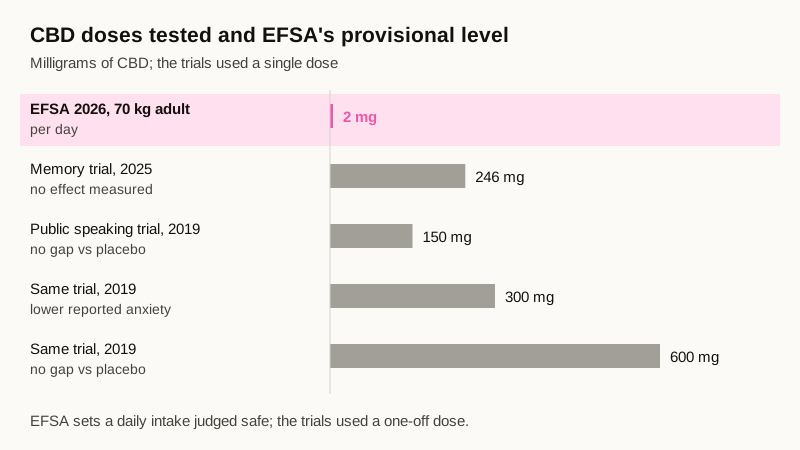
The gap ranges from 75 to 300-fold. A result obtained at 300 mg therefore says nothing about what a drop of oil does. Our article on EFSA's reference dose walks through the calculation, and the one on CBD and concentration sets out what a shop may and may not say.
French rules
No CBD product may claim a therapeutic effect in France, the French drug policy agency MILDECA reminds sellers. Foods and food supplements containing CBD are not authorised, as the French Ministry of Agriculture's notice of 20 May 2026 restates. EFSA adds that CBD safety is not established under the age of 25, during pregnancy or breastfeeding, or for people taking medication.
CBD is broken down by liver enzymes that also handle many medicines. If you take any treatment, particularly a sleeping pill or an anti-anxiety drug, talk to your doctor. Our article on CBD and the liver describes this mechanism, and the one on CBD and sleep reviews the trials in that area.
Frequently asked questions
Is brain fog a disease?
No. It is the everyday name for a complaint: slowed thinking, lack of clarity, trouble paying attention. It can come with lack of sleep, a thyroid problem, long Covid or a side effect of medication. If it persists, a doctor can sort out the cause.
Does CBD improve concentration?
We found no good-quality study showing this in healthy adults. A 2025 trial in 35 adults, using 246 mg of CBD, found no effect on learning or memory.
Does CBD impair memory or alertness?
The available trials do not show this: neither the 2025 memory trial nor the driving trial published in JAMA in 2020 found a difference from placebo. Drowsiness does appear, however, among the side effects recorded at very high doses, from 750 to 6,000 mg, in a phase I trial published in 2018. A product with too much THC can also reduce alertness.
Why do studies use such high doses?
These trials look for a measurable effect after a single dose, in volunteers. Their doses of 150 to 600 mg are 75 to 300 times the provisional level of 2 mg per day set by EFSA for a 70 kg adult.
Written by the Phytogrammes team
Every article in this journal draws on primary sources (ANSM, EFSA, EUR-Lex, peer-reviewed publications) and on the lab's own practice: batch-by-batch HPLC analyses, measured cannabinoid profiles. Our approach.
Article published on . CBD is not a medicine.