CBD and sleep: what the trials show, dose by dose
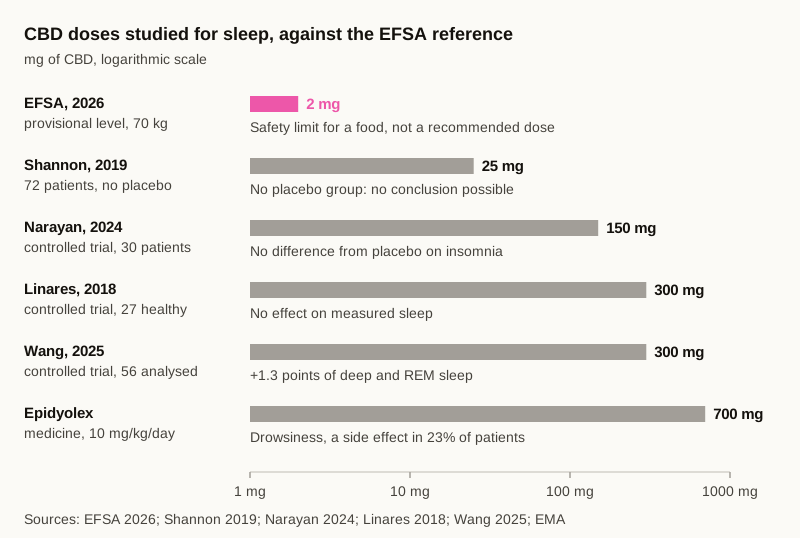
No health authority has recognised CBD as a sleep aid, and the controlled trials give no grounds to do so. In the most rigorous insomnia trial, 150 mg of CBD taken every night for two weeks did not reduce insomnia severity compared with a placebo. The doses studied are 12 to 150 times higher than the provisional reference of 2 mg a day set by EFSA in 2026.
Contents
> Key takeaways > > - In 27 healthy volunteers, 300 mg of CBD changed none of the sleep measures recorded in the lab. > - In 30 adults with insomnia, 150 mg a night improved reported well-being, not insomnia severity. > - The most cited study, 72 patients with no placebo group, allows no conclusion about an effect of CBD. > - Drowsiness is a side effect of the CBD medicine, seen in 23% of patients on high doses. > - For insomnia that lasts, cognitive behavioural therapy remains the first-line treatment.
What the controlled trials say
A controlled trial compares a group given the product with a group given a placebo, without participants knowing which one they take. It is the only way to separate the effect of a molecule from the effect of expectation, which is strong where sleep is concerned. For CBD alone, such trials are rare and small.
| Study | Participants | CBD per dose | Result against placebo |
|---|---|---|---|
| Linares et al., 2018 | 27 healthy volunteers, one night | 300 mg | No effect on sleep architecture |
| Narayan et al., 2024 | 30 adults with insomnia, 2 weeks | 150 mg | No difference in insomnia severity; better reported well-being |
| Wang et al., 2025 | 125 adults with insomnia, 56 analysed | 300 mg + terpenes | +1.3 points of deep and REM sleep, wrist-worn device |
The Linares trial, run in Brazil, recorded the sleep of 27 volunteers with polysomnography, the reference test that measures brain activity through the night. A 300 mg dose of CBD had no significant effect, either on sleep or on the cognitive tests taken on waking.
The Australian Narayan trial, published in the Journal of Clinical Sleep Medicine, involved 30 adults with moderate to severe insomnia. After two weeks at 150 mg a night, insomnia severity, reported time to fall asleep and night-time waking did not differ from the placebo group. The CBD group reported better well-being, and sleep efficiency measured at the wrist was better in the second week. The authors conclude that CBD was similar to placebo on most sleep outcomes.
The third trial combined 300 mg of CBD with eight terpenes. Of 125 participants enrolled, 56 were analysed: the others had dropped out or had not worn the sensor. Time spent in deep and REM sleep rose by 1.3 percentage points compared with placebo, with no effect on total sleep time. The study was funded by the company Defined Research, in which six of the eight authors hold shares.
Why the most cited study proves nothing
Many articles rely on a case series published in 2019 in The Permanente Journal. A US clinic followed 72 adults who came in for anxiety or sleep problems, mostly treated with 25 mg of CBD a day. After one month, 66.7% had better sleep scores, but those scores fluctuated afterwards.
The authors list the limits themselves: open-label treatment, no comparison group, and patients taking other psychiatric medicines. Without a placebo, there is no way to tell what is due to CBD, to the consultation or simply to the passage of time. This kind of study is for forming a hypothesis, not for testing it.
The EFSA reference: 2 mg a day
On 9 February 2026, EFSA published a provisional safe intake of 0.0275 mg of CBD per kilo of body weight per day, about 2 mg for a 70 kg adult. It applies to CBD at least 98% pure, and does not cover under-25s, pregnancy and breastfeeding, or people on medication. It is not a recommended dose but a safety limit. The calculation in drops is set out in how much CBD per day.
The gap with the trials is therefore large: 150 mg is 75 times that reference, 300 mg is 150 times. In 2025, the food safety commission of the German Research Foundation reviewed the data available at food-level doses. Its review in Nutrients finds no evidence that would support a health claim, including on sleep, relaxation or stress.
Drowsiness: a side effect, not a promise
The only CBD-based medicine, Epidyolex, is prescribed for rare epilepsies at 10 to 25 mg per kilo per day, or 700 to 1,750 mg for 70 kg. Its summary of product characteristics lists drowsiness among the most common side effects: 23% of patients. Drowsiness and sedation affected 43% of patients also taking clobazam, another anti-epileptic, against 14% of the others. The document advises not driving until you know how the treatment affects you.
Two lessons follow. The drowsiness described at these doses is not better-quality sleep; it is a side effect. And CBD interacts with other molecules that act on the brain: it is broken down in the liver by the CYP3A4 and CYP2C19 enzymes, which also process many medicines. If you take a sleeping pill, an anti-anxiety drug or an antidepressant, ask your doctor or pharmacist. The mechanism is explained in CBD's grapefruit effect.
What health authorities advise for difficult nights
French adults sleep 7 h 04 min on average on weekdays, and nearly a quarter sleep less than 6 hours, according to the 2025 survey by the French National Institute for Sleep and Vigilance, carried out among 1,000 people. 73% wake up at least once a night.
The French National Authority for Health (HAS) states that non-drug treatments should come before sleeping pills: sleep hygiene rules and cognitive behavioural therapy. Benzodiazepines are only justified for acute insomnia, for 4 weeks at most. The European insomnia guideline, updated in 2023, makes cognitive behavioural therapy for insomnia (CBT-I) the first-line treatment in adults, in person or online. It advises against antihistamines, immediate-release melatonin and herbal remedies.
Two products close to CBD deserve a word. Melatonin, the hormone of the sleep-wake rhythm, is compared with CBD in CBD and melatonin. "Sleep" gummies that combine CBN and THC are illegal in France, as explained in our article on CBN.
CBD is not a medicine. Insomnia lasting more than three months, or drowsiness that gets in the way of your day, warrants a medical appointment.
Frequently asked questions
Is CBD a sleeping pill?
No. No French or European authority recognises it as one, and the most rigorous insomnia trial, at 150 mg a night, showed no difference from placebo in insomnia severity. A CBD product cannot be sold with a sleep claim.
What CBD doses have been tested for sleep?
From 25 mg a day in a case series without placebo to 300 mg per dose in two controlled trials. The provisional EFSA reference is 2 mg a day for 70 kg. A 10% oil provides about 5 mg per drop, depending on the dropper.
Can you combine CBD and a sleeping pill?
Not without medical advice. CBD is broken down by the same liver enzymes as many medicines, and the Epidyolex leaflet reports more drowsiness with some combined treatments. Your doctor or pharmacist can check your treatment.
Can you drive the morning after taking CBD in the evening?
CBD is not tested for, but the THC in a full-spectrum product is, with no tolerance threshold. In an Australian trial from 2024, an oil with 10 mg of THC and 200 mg of CBD was no longer detected by saliva tests 10 and 18 hours after a single dose; regular use was not studied. Details are in the saliva test guide.
Written by the Phytogrammes team
Every article in this journal draws on primary sources (ANSM, EFSA, EUR-Lex, peer-reviewed publications) and on the lab's own practice: batch-by-batch HPLC analyses, measured cannabinoid profiles. Our approach.
Article published on . CBD is not a medicine.