CBDV (cannabidivarin): CBD with two fewer carbons
CBDV, or cannabidivarin, is a non-intoxicating hemp cannabinoid built like CBD but with a side chain two carbon atoms shorter. The plant makes it from a different precursor, divarinic acid, and only some lines accumulate much of it. In humans, the largest published trial, in 162 adults with epilepsy, showed no difference from placebo.
Contents
> Key takeaways > > - CBDV (C19H26O2) differs from CBD (C21H30O2) in its side chain: 3 carbons instead of 5. > - Chain length is set by the very first precursor; the enzymes that follow are the same as for CBD. > - A "CBDV flower" only means something with a certificate that measures CBDV, which not every test panel does. > - The 2021 phase 2 trial in 162 patients: 40.5% fewer seizures on CBDV, a comparable effect on placebo. > - CBDV is not a controlled narcotic in France; it follows the hemp framework at 0.30% Δ⁹-THC.
Definition: a cannabinoid from the "varin" family
Varin cannabinoids are homologues of the classic cannabinoids: same skeleton, but a three-carbon (propyl) alkyl chain instead of five (pentyl). A review published in 2026 in the Journal of Cannabis Research describes them as structurally homologous compounds with a three-carbon tail. CBDV is the varin version of CBD, just as THCV is that of THC.
The difference shows in the formula. According to PubChem, CBDV is C19H26O2, with a molar mass of 286.4 g/mol, against C21H30O2 and 314.5 g/mol for CBD. Two fewer CH2 groups are enough to change how the molecule binds to its targets, and so to make it a subject of study in its own right.
Like CBD, CBDV is not intoxicating: it does not produce the high of THC. Our page on THCV covers the other major varin cannabinoid.
How the plant makes CBDV
It all starts with the first building block. For CBD, the plant joins olivetolic acid, with a five-carbon chain, and geranyl pyrophosphate (GPP): it gets CBGA. For CBDV, it uses divarinic acid, with a three-carbon chain, and gets CBGVA. The 2026 review sums up what follows: cannabinoid synthases are not picky about their substrate and cyclise CBGVA into THCVA, CBDVA and CBCVA, just as they cyclise CBGA into THCA, CBDA and CBCA.
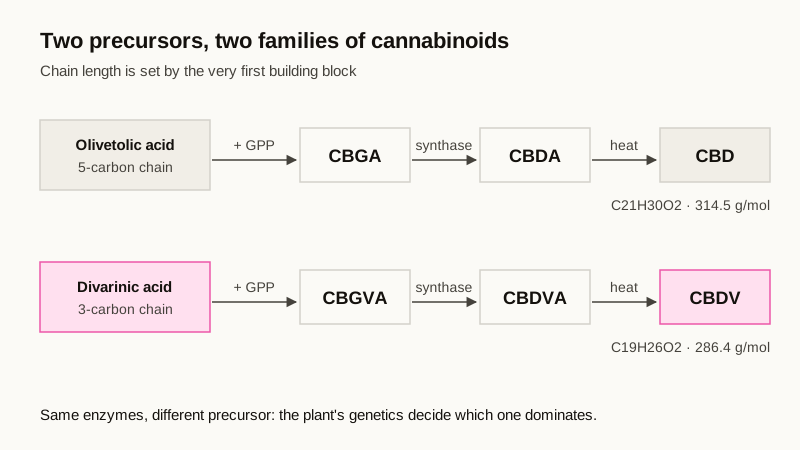
As with all cannabinoids, the plant first makes the acidic form, CBDVA. Heat then removes a carboxyl group and gives the neutral form, CBDV: this is decarboxylation, explained in our page on CBG, the mother molecule of CBD.
CBDV flowers: what to check
Since the chain is set before the enzymes act, CBDV content depends first on genetics. An analysis of 157 cannabis populations, published in 2004 in the American Journal of Botany, found plants relatively rich in THCV or CBDV only in populations the authors assign to Cannabis indica. At the other end, the 2026 review reports selected lines whose varin fraction reaches 69% or more of their cannabinoids.
A flower sold as "rich in CBDV" is therefore judged on one document only: a certificate of analysis that measures CBDV and CBDVA on the lot sold. Three points to check:
- There is a CBDV line. Not every panel includes it. The pages of our CBD flowers, read on 23 September 2026, measure CBD, CBDA, CBG, CBN, THC and THCA, not CBDV: we therefore sell no flower presented as rich in CBDV.
- Acidic and neutral forms. CBDVA (330.4 g/mol) loses about 13% of its mass when it becomes CBDV: total CBDV = CBDV + 0.867 × CBDVA. Adding the two lines without correction overstates the total.
- Δ⁹-THC. It must stay at 0.30% or less, and the certificate must carry the same lot number as the product.
Our guide to the certificate of analysis explains each line, and the laboratory page describes our measurement methods.
What research has measured in humans
CBDV has mostly been studied as an antiepileptic candidate. The strongest result is negative. A randomised phase 2 trial, published in 2021, compared CBDV with placebo in 162 adults whose focal seizures remained poorly controlled, 81 in each group. The dose rose to 800 mg twice a day. Seizures fell by 40.5% on CBDV, but placebo did almost as well, and the difference was not significant. Diarrhoea, nausea and drowsiness were more frequent on CBDV, and three participants saw their liver enzymes rise above three times the upper limit of normal.
A review published in Drugs in 2026 lists cannabidivarin among the compounds whose development for epilepsy was abandoned, for lack of superiority over placebo.
Two other leads remain preliminary:
- Rett syndrome. A phase 1 trial in Australia followed five girls, with no placebo group. Monthly seizures went down, and CBDV was judged well tolerated at 10 mg/kg a day. Five patients without a comparison allow no conclusion about efficacy.
- Autism. A 2021 imaging study gave a single 600 mg dose to 28 adult men and observed changes in brain connectivity. The authors themselves call it a preliminary proof of concept, with no measure of symptoms.
CBDV is therefore not a medicine. The only authorised cannabidiol medicine, Epidyolex, contains CBD, not CBDV.
Legal status of CBDV in France
CBDV is not among the cannabinoids classified as narcotics by the ANSM, which targeted HHC in 2023 and then H4CBD, THCP and other derivatives from 3 June 2024. It follows the hemp framework: the order of 30 December 2021 authorises Cannabis sativa L. varieties whose Δ⁹-THC content does not exceed 0.30%, and caps products made from them at the same threshold.
A CBDV extract intended to be swallowed also falls under Regulation (EU) 2015/2283 on novel foods, like CBD extracts. Our overview of CBD regulation in 2026 describes the French situation.
For athletes, the rule is stricter. The US Anti-Doping Agency points out that the World Anti-Doping Agency exempted only CBD: all other cannabinoids, natural or synthetic, remain prohibited in competition, CBDV included. Our article on CBD and the 2026 WADA list covers this in detail.
Frequently asked questions
Does CBDV get you high?
No. Like CBD, CBDV does not have THC's intoxicating effect. The risk lies in the actual product: a Δ⁹-THC level above 0.30% or an added semi-synthetic cannabinoid.
What is the difference between CBD and CBDV?
The side chain: five carbons for CBD, three for CBDV. The plant makes both by the same pathway, from two different precursors, olivetolic acid and divarinic acid.
Are there CBD flowers rich in CBDV?
Yes, from lines selected for varin cannabinoids. Their content can only be checked on a certificate that measures CBDV on the lot sold. The Phytogrammes catalogue does not offer any.
Is CBDV a medicine for epilepsy?
No. The largest published trial, in 162 adults, showed no difference from placebo, and its development for epilepsy was abandoned. No CBDV product may claim a therapeutic effect.
What is CBDVA?
It is the acidic form of CBDV, the one the plant produces. Heat turns it into CBDV by removing a carboxyl group.
Written by the Phytogrammes team
Every article in this journal draws on primary sources (ANSM, EFSA, EUR-Lex, peer-reviewed publications) and on the lab's own practice: batch-by-batch HPLC analyses, measured cannabinoid profiles. Our approach.
Article published on . CBD is not a medicine.