CBC (cannabichromene): molecule, levels and legal status
CBC, or cannabichromene, is a hemp cannabinoid isolated in 1966. It does not get you "high": studies find no activation of the CB1 receptor, the one behind the effect of THC. The plant makes little of it, about 0.03% CBC in a hemp tested in Canada in 2020, against 0.58% CBD. In France it is not a controlled narcotic and follows the rules for CBD: no more than 0.30% Δ⁹-THC in the finished product.
Contents
> Key takeaways > > - CBC comes from the same precursor as CBD and THC, CBGA, through its own enzyme, CBCA synthase. > - In a hemp tested in 2020, CBC and its acid form together weighed about 4% of total CBD. > - No clinical trial has yet studied CBC on its own; the human data come from an extract dominated by CBD. > - CBC is not a narcotic, unlike HHC, H4CBD and THCP, which are semi-synthetic. > - CBC is not a medicine, and no health claim is authorised for it.
Definition: a minor cannabinoid, known since 1966
Cannabichromene was described in 1966 by two teams working independently. Yehiel Gaoni and Raphael Mechoulam presented it in Chemical Communications as a new active principle of hashish. A German team, Claussen, von Spulak and Korte, published it the same year in Tetrahedron.
It is called "minor" because the plant makes little of it, not because it is marginal chemically. A review published in 2024 in the Journal of Pharmacology and Experimental Therapeutics notes that most cannabis varieties produce only small amounts. Several studies summarised in that review find no activation of the CB1 receptor, which fits the absence of a psychoactive effect.
| Cannabinoid | Acid form in the plant | Enzyme that makes it | Psychoactive | Status in France |
|---|---|---|---|---|
| CBC | CBCA | CBCA synthase | No | Allowed if Δ⁹-THC ≤ 0.30% |
| CBD | CBDA | CBDA synthase | No | Allowed if Δ⁹-THC ≤ 0.30% |
| CBG | CBGA | Geranyltransferase | No | Allowed if Δ⁹-THC ≤ 0.30% |
| THC | THCA | THCA synthase | Yes | Narcotic, tolerated below 0.30% in authorised hemp |
Biosynthesis: a branch of CBGA
Everything starts from CBGA, cannabigerolic acid, which our article on CBG presents as the mother molecule. Three enzymes compete for this substrate: THCA synthase, CBDA synthase and CBCA synthase. Each turns it into a different acid: THCA, CBDA or CBCA. The genetics of the variety decide which one dominates. In a CBD hemp it is CBDA synthase, and the CBCA branch stays small.
CBCA becomes CBC by losing a carboxyl group under heat and drying. It is the same reaction that turns CBDA into CBD. CBC and CBD even share the same molecular formula; only the arrangement of their atoms differs.
How much CBC is in hemp
Published measurements confirm the order of magnitude. In 2020 the National Research Council of Canada validated a method for measuring 17 cannabinoids and applied it to five lots of milled hemp. On average, these lots contained 0.289 mg of CBC and 0.520 mg of CBCA per gram, against 5.81 mg of CBD and 15.60 mg of CBDA.
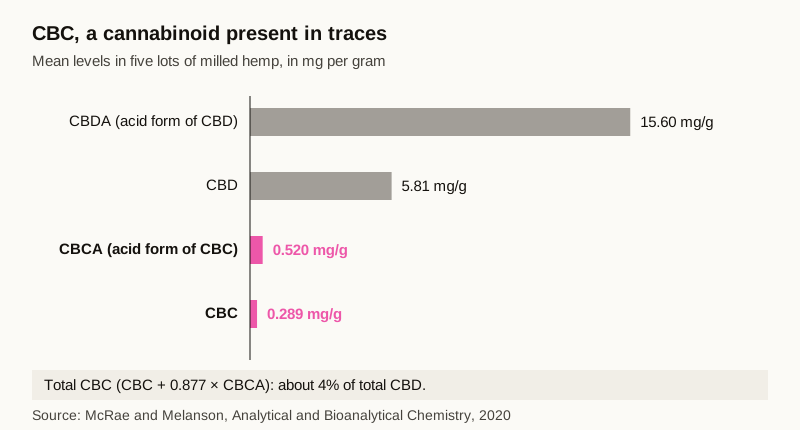
As with CBD, the total is calculated by correcting the acid form: total CBC = CBC + 0.877 × CBCA. On these lots that gives about 0.07% total CBC for 1.95% total CBD. CBC therefore weighs about 4% of the CBD.
A practical detail: the Phytogrammes product pages, checked on 23 September 2026, show a panel of six cannabinoids (CBD, CBDA, CBG, CBN, THC, THCA). CBC is not on it. A product sold for its CBC content should show that content, measured on the lot. Our guide to reading a certificate of analysis shows where to look for it.
What research has measured, and its limits
Most data on CBC come from cells and animals. The 2024 review lists them:
- at the receptor level, CBC is the most potent activator of the TRPA1 channel among the cannabinoids tested, and it also activates TRPV1 and the CB2 receptor;
- in animals, mainly mice and rats, effects have been observed in tests of pain, inflammation and seizures, with mechanisms still debated;
- in culture, activity has been measured against some Gram-positive bacteria.
In humans, no trial has studied CBC alone. The only pharmacokinetic data, meaning what happens to the molecule in the body, come from an extract in which testing revealed more CBC than THC. The oil contained 20 mg/ml of CBD, 1.1 mg/ml of CBC and 0.9 mg/ml of THC. At the highest daily doses, participants received 26.4 mg of CBC together with 480 mg of CBD and 21.6 mg of THC. CBC remained measurable in the blood, and this dose was tolerated in that mixture.
The review's authors note that CBC products are sold freely while their safety and efficacy have almost no supporting data. CBC is not a medicine. The only authorised medicine based on cannabidiol, Epidyolex, contains purified CBD.
Legal status of CBC in France
CBC is not on the list of narcotics. It follows the hemp framework: the order of 30 December 2021 allows Cannabis sativa L. varieties listed in the official catalogues whose Δ⁹-THC content does not exceed 0.30%, and applies that threshold to extracts and products containing them. The Conseil d'État decision of 29 December 2022 struck down the ban on selling raw flowers and leaves.
Do not confuse CBC with semi-synthetic cannabinoids. The ANSM classified HHC, HHCO and HHCP as narcotics from 13 June 2023, then H4CBD, THCP and other derivatives from 3 June 2024. CBC occurs naturally in the plant; those molecules are made by chemical conversion. Our article on the H4CBD ban traces that decision.
Swallowed, a CBC extract falls under the novel food regime, like CBD extracts: Regulation (EU) 2015/2283 only allows authorised novel foods on the market. Our overview of CBD regulation in 2026 describes the French situation.
On caution, ANSES proposed on 21 March 2025 classifying CBD as presumed toxic to reproduction. The proposal concerns CBD, not CBC, for which no equivalent data exist. By default, the same precautions apply during pregnancy and breastfeeding, as our article on the classification proposed by ANSES explains.
Where CBC is found
Isolated CBC remains rare. It turns up mainly as a minor component of full-spectrum oils, which keep the plant's whole range of cannabinoids, and of flowers. The idea that these minor components change the effect of CBD has a name, the entourage effect; it is a hypothesis, not an established result in humans. The catalogue oils are grouped in the CBD oils category.
Frequently asked questions
Is CBC a drug?
Not in the legal sense: it is not classified as a narcotic in France and is sold under the same conditions as CBD, with no more than 0.30% Δ⁹-THC. It has no known psychoactive effect.
Does CBC get you high?
No. Several studies find no activation of the CB1 receptor, the one behind the effect of THC. The risk lies in what the product really contains: too much THC, or an added semi-synthetic cannabinoid.
What is the difference between CBC and CBD?
Both come from CBGA and share the same molecular formula, but a different enzyme makes each and their structures differ. In lab models, CBC acts mainly on the TRPA1 and TRPV1 channels and on the CB2 receptor. CBD is far more abundant in hemp.
Can you find flowers rich in CBC?
Rarely. In the hemp tested in 2020, total CBC was about 4% of total CBD. A high CBC content should be read on the lot's analysis, not on the product name.
Are CBC and HHC the same thing?
No. CBC occurs naturally in hemp and is not controlled. HHC is a semi-synthetic cannabinoid, classified as a narcotic in France since 13 June 2023.
Written by the Phytogrammes team
Every article in this journal draws on primary sources (ANSM, EFSA, EUR-Lex, peer-reviewed publications) and on the lab's own practice: batch-by-batch HPLC analyses, measured cannabinoid profiles. Our approach.
Article published on . CBD is not a medicine.