CBDA (cannabidiolic acid): the raw form of CBD
CBDA, or cannabidiolic acid, is the form in which hemp makes CBD. It carries an extra carboxyl group, which heat removes: this is decarboxylation, and it turns CBDA into CBD. At 110 °C, half of the CBDA in an extract is converted in about 14 minutes; at room temperature, the reaction takes months.
Contents
> Key takeaways > > - CBDA is the direct precursor of CBD. The plant makes it from CBGA through an enzyme, CBDA synthase. > - Conversion to CBD depends mostly on temperature: its half-life drops from 231 minutes at 80 °C to 14 minutes at 110 °C. > - On a certificate of analysis, total CBD is calculated as CBD + 0.877 × CBDA. > - Research on CBDA is mostly preclinical. No medicine contains CBDA. > - In France, a food containing CBDA is not allowed, like any CBD food.
What is CBDA?
CBDA is an acidic cannabinoid. Hemp (Cannabis sativa L.) does not make CBD, THC or CBC directly: it first produces their acidic forms. The common starting point is cannabigerolic acid, CBGA. According to a 2021 review in Frontiers in Pharmacology, three enzymes compete for this CBGA and turn it into THCA, CBDA or CBCA. In a CBD-rich variety, CBDA synthase dominates.
So CBDA is not a by-product. It is the native form of CBD in the living plant and in a flower that has simply been dried. Our page on CBG, the mother molecule, describes the step before this one.
| Acidic form (in the plant) | Neutral form (after heating) | Psychoactive effect of the neutral form |
|---|---|---|
| CBGA | CBG | No |
| CBDA | CBD | No |
| THCA | THC | Yes |
| CBCA | CBC | No |
The difference between CBDA and CBD comes down to one chemical group, the carboxyl (COOH). CBDA weighs 358.5 g/mol and CBD 314.5 g/mol: when the molecule loses this group as CO₂, it loses about 12% of its mass.
From CBDA to CBD: decarboxylation, with numbers
Decarboxylation is the reaction that removes the carboxyl group. It answers a common question: what is the process that converts CBDA into CBD called? Heat is its main driver.
A 2016 study in Cannabis and Cannabinoid Research heated flower extracts in a vacuum oven at 80 to 145 °C, for 60 minutes at most. The authors measured a reaction rate at each temperature. For CBDA, the rate constant rises from 0.05 × 10⁻³ per second at 80 °C to 0.83 × 10⁻³ per second at 110 °C. It is about half that of THCA. We derived half-lives from these constants, meaning the time needed to convert half of the CBDA.
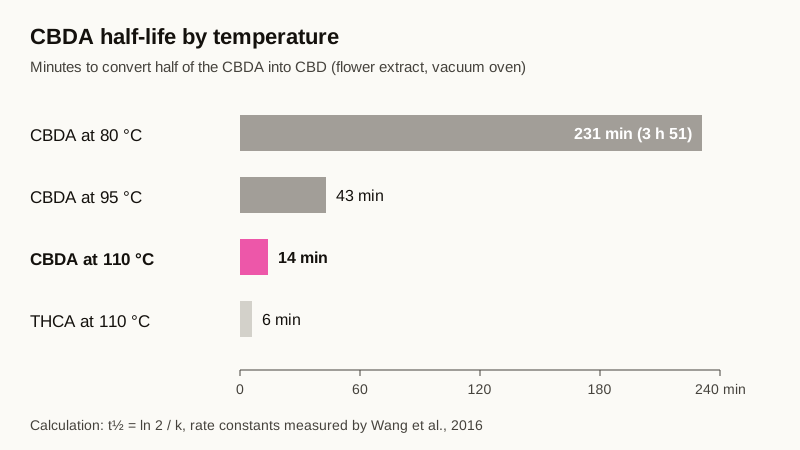
Three practical lessons follow. Below 100 °C, the reaction is not complete after an hour, as the authors note. Above that, it speeds up quickly. Finally, the CBDA reaction is not clean: at 110 °C, the sum of CBDA + CBD fell by 18% in the extracts, and by 25% at 130 °C. Some of the molecules break down or turn into something other than CBD. Heating for longer does not automatically give more CBD.
At room temperature, conversion also happens, but slowly. A January 2026 review in the Journal of Cannabis Research states that acidic cannabinoids decarboxylate slowly during prolonged storage, with heat remaining the dominant factor. Light and air also play a part. Our guide to decarboxylation covers home methods.
Reading CBDA on a certificate of analysis
A dried CBD flower contains mostly CBDA, not CBD. A certificate of analysis produced by liquid chromatography (HPLC), a method that does not heat the sample, therefore shows two separate lines. Adding them together overstates the total, since CBDA loses 12% of its mass when it becomes CBD.
The standard calculation is: total CBD = CBD + 0.877 × CBDA. Hypothetical example: a flower shows 1.2% CBD and 9.0% CBDA. Its total CBD is 1.2 + 0.877 × 9.0, or 9.1%. That is the figure that matters once the flower is heated, for example in a vaporiser.
The same reasoning applies to THCA, with the same 0.877 factor. THCA is what counts for the legal THC limit, as our page on THCA explains. Our guide to reading a certificate of analysis goes through each line, and the laboratory page presents the measurement methods.
What research says about CBDA
Almost all data on CBDA come from cells and animals. The 2021 review cited above describes CBDA as a modulator of the serotonin 5-HT1A receptor: in vitro, it strengthens the binding of an agonist of this receptor. In rodents, low doses of CBDA reduced behaviours linked to nausea, with a potency about 1,000 times greater than CBD in these models. The same review reports in vitro inhibition of the COX-2 enzyme, nine times more selective than for COX-1.
In humans, the 2026 review notes a lack of well-controlled clinical trials. It cites a single published trial, phase I/II, open-label, with no placebo group, using a CBDA-rich extract in patients with Rett syndrome. A trial of this kind supports no conclusion about any effect. No authorised medicine contains CBDA: the only cannabidiol medicine, Epidyolex, contains purified CBD.
Legal status of CBDA in France
CBDA is not classified as a narcotic. The ANSM decision in force from 3 June 2024 covers H4CBD, THCP and HHCPO, and excludes THCA present in hemp that meets the THC limit. CBDA therefore follows the hemp framework: the order of 30 December 2021 caps Δ⁹-THC at 0.30% in varieties, extracts and the products that contain them.
For products you swallow, the answer is different. Regulation (EU) 2015/2283 requires authorisation for any food rarely consumed in the Union before 15 May 1997. On 20 May 2026, the French Ministry of Agriculture restated that foods containing CBD or any other cannabinoid are not authorised and must be withdrawn from the market. Raw hemp juice or a "raw" tincture sold as food falls under this rule. Our overview of CBD regulation in 2026 describes what is still on sale, and our page CBD: definition and French framework puts CBD in context.
Frequently asked questions
What is the difference between CBDA and CBD?
CBDA is the acidic form the plant produces. CBD is the neutral form obtained when heat removes the carboxyl group from CBDA. Neither makes you "high".
What is the process of converting CBDA to CBD called?
Decarboxylation. Based on the rates measured in the 2016 study, half of the CBDA in an extract is converted in about 43 minutes at 95 °C and in 14 minutes at 110 °C.
Why does my certificate show more CBDA than CBD?
Because the flower has not been heated. CBD only appears after decarboxylation. To estimate the CBD potential, calculate CBD + 0.877 × CBDA.
Is CBDA legal in France?
Yes in a flower, resin or cosmetic made from authorised hemp, with no more than 0.30% Δ⁹-THC. No in a food or food supplement, which falls under the novel food regime and has received no authorisation.
Is CBDA more effective than CBD?
Nothing allows us to say so. The potency comparisons come from animal models, and the only published human trial had no placebo group.
Written by the Phytogrammes team
Every article in this journal draws on primary sources (ANSM, EFSA, EUR-Lex, peer-reviewed publications) and on the lab's own practice: batch-by-batch HPLC analyses, measured cannabinoid profiles. Our approach.
Article published on . CBD is not a medicine.