THCJD: banned in France since 2024 without being named
THCJD, or tetrahydrocannabioctyl, is a variant of THC whose side chain has eight carbon atoms instead of five. No published measurement shows that it forms in any meaningful amount in hemp: products sold under this name are made by synthesis. In France it is not named, but its structure falls within the family of derivatives that the ANSM classified as narcotics from 3 June 2024.
Contents
> Key takeaways > > - THCJD has the same skeleton as THC, with an 8-carbon side chain (formula C₂₄H₃₆O₂). > - It is also called THC-C8 or THC-octyl on labels and certificates. > - The ANSM decision of 22 May 2024 covers any substance derived from the benzo[c]chromene core carrying an alkyl chain: THCJD is one of them. > - In 2026, an analysis of five US products sold as "THC-JD" found none in any of them. > - No human study has assessed its toxicity.
What is THCJD?
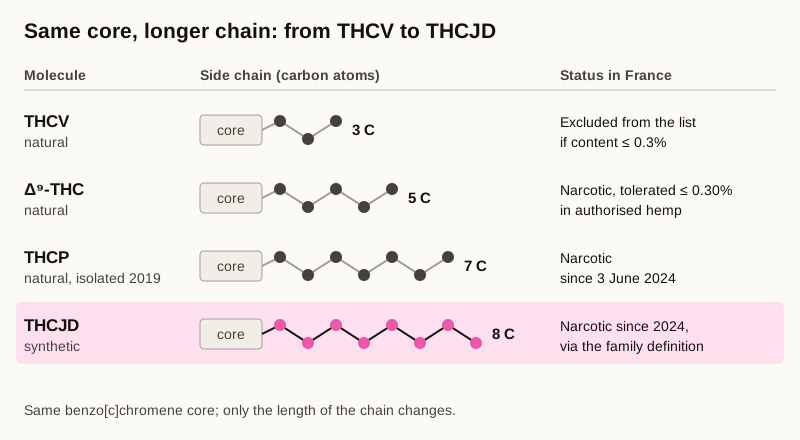
THCJD is a homologue of Δ⁹-THC, the psychoactive molecule in cannabis. "Homologue" means the skeleton is the same and only the length of one chain changes. Here it is the side chain attached at position 3, which has five carbons in THC and eight in THCJD. A 2026 study describes it as a semi-synthetic cannabinoid with an eight-carbon side chain.
On a certificate of analysis it may appear as THC-C8, THC-octyl or 3-octyl-THC. Do not confuse it with "THC-O", THC acetate, a different synthetic molecule. The letters "JD" do not correspond to any chemical nomenclature.
This chain is not a detail: its length affects the molecule's activity. The Italian team that isolated THCP in 2019 points out that synthetic THC analogues with a longer side chain have shown far higher cannabimimetic activity than THC itself. Our page on THCP describes the seven-carbon homologue.
Natural or synthetic?
Synthetic, in practice. The 2026 study states that THCJD exists only in trace amounts in hemp, but cites no measurement to support this. We found no publication that has quantified it in a plant. THCP is a different case: it was isolated in 2019 from a medical cannabis variety, then confirmed by synthesis.
The THCJD on sale is therefore made in a lab, often from other cannabinoids. A 2024 toxicology study sums up the mechanism: the surplus of hemp-derived CBD can serve as raw material to produce, by semi-synthesis, a whole range of THC variants. It is the same route as HHC, traced in our timeline of the HHC ban.
What is known about its effects: almost nothing
There is no human trial. The only solid pharmacological data come from cells. The 2024 study cited above tested 30 THC variants on the CB1 receptor, the target through which THC acts on the brain. THC-C8 was among the homologues that showed a higher potential to activate CB1 than Δ⁹-THC. A cell test says nothing about dose, duration or toxicity in humans.
The "19 times stronger than THC" figure circulating online does not come from a study. The 2026 team attributes it to a US cannabis trade association and does not endorse it.
For molecules of the same family, the ANSM based its classification on reports received by France's addiction-monitoring centres. It cites vomiting, loss of consciousness, coma and seizures, and effects "more severe and more intense" than those of cannabis.
What "THC-JD" products actually contain
The name on the package guarantees nothing. In 2026, chemists at Portland State University analysed five vape products bought in the United States and sold as containing THC-JD. They found none in any of them. The main compound in four of them was Δ⁸-THC, and the fifth contained THC acetate.
THC-JD does circulate, though. A study of US online retail sites recorded it in 2023 among 26 different psychoactive compounds, across 804 products examined. More than half of those products (54%) blended two to eight of these compounds. A Japanese team also identified its two isomers in products sold online in Japan in 2022 and 2023.
Legal status in France: covered by a family definition
The ANSM no longer classifies molecules only one by one. Its decision of 22 May 2024, in force since 3 June 2024, adds to the narcotics list "any substance derived from the benzo[c]chromene core", with a list of permitted substitutions. At position 3, the text allows in particular "an alkyl chain", with no length limit. THCJD, which carries an octyl chain at that position, falls within this definition.
A second decision of 3 June 2024 sets out the exclusions: CBN and CBNA, THCV and THCVA below 0.3%, and THCA within the limit set by the order of 30 December 2021. THCJD is not among these exceptions. Reading its absence from the named list as permission is therefore a mistake.
| Molecule | Side chain | Origin | Status in France |
|---|---|---|---|
| THCV | 3 carbons | Natural | Excluded from the list if content is 0.3% or less |
| Δ⁹-THC | 5 carbons | Natural | Narcotic, tolerated below 0.30% in authorised hemp |
| THCP | 7 carbons | Natural, isolated in 2019 | Narcotic since 3 June 2024 |
| THCJD | 8 carbons | Synthetic | Narcotic since 3 June 2024, via the family definition |
The rules for CBD do not change: a CBD product remains legal if it contains no more than 0.30% Δ⁹-THC, as our article on the permitted THC level explains.
How to avoid it
Three signs should raise a flag. The first is effect-driven wording: "stronger than THC", "new legal molecule", "high". A compliant CBD product is not sold on psychoactive effects. The second is a certificate listing THC-JD, THC-C8, THC-octyl or any unfamiliar acronym. The third is no certificate at all, or one with no batch number.
One technical point is worth knowing: a lab only finds what it looks for. A certificate that does not mention THCJD does not prove it is absent if the method was not looking for it. Our guide to reading a certificate of analysis shows where to look, and our article on synthetic cannabinoids in CBD covers the other molecules to watch for. Our laboratory page describes how cannabinoids are measured.
Frequently asked questions
What is THCJD?
It is a variant of THC whose side chain has eight carbons instead of five. It is also sold as THC-C8, THC-octyl or tetrahydrocannabioctyl. Products containing it are made by synthesis.
Is THCJD banned in France?
Yes. It is not named, but its structure falls within the family of benzo[c]chromene derivatives that the ANSM classified as narcotics, in force since 3 June 2024. It is not among the exclusions.
Does THCJD occur naturally in hemp?
No publication we reviewed has quantified it in a plant. THCP, its seven-carbon neighbour, was isolated from a medical cannabis variety in 2019.
Is THCJD stronger than THC?
A cell test published in 2024 found a higher potential to activate the CB1 receptor than THC. The "19 times stronger" figure does not come from any study. No human trial has been published.
How can you tell whether a product contains THCJD?
Only an analysis that looks for the molecule can say. Be wary of products sold for psychoactive effects, and of certificates with no batch number or listing unfamiliar acronyms.
Written by the Phytogrammes team
Every article in this journal draws on primary sources (ANSM, EFSA, EUR-Lex, peer-reviewed publications) and on the lab's own practice: batch-by-batch HPLC analyses, measured cannabinoid profiles. Our approach.
Article published on . CBD is not a medicine.