THC detox: why nothing speeds up clearing it for a test
No drink, no kit and no workout has been shown to speed up THC elimination. The molecule is stored in body fat, which releases it slowly, and the liver then turns it into the metabolites that tests look for. Only the time since the last use brings levels down: from a few hours in saliva after occasional use to several weeks in urine after daily use.
Contents
> Key takeaways > > - THC is fat-soluble: it builds up in fatty tissue and leaves it slowly, which lengthens its half-life in regular users. > - Within five days, more than 65% of THC is eliminated in faeces and about 20% in urine, as metabolites. > - Among 86 chronic users followed in 1985, some stayed positive in urine for up to 46 consecutive days. > - Drinking a lot dilutes urine, which labs detect; exercise can push THC back up in the blood. > - Behind the wheel, French law sets no threshold: the presence of THC is enough, with 3 years in prison and a €9,000 fine at stake.
What happens to THC in the body
THC, the psychoactive molecule in cannabis, is highly fat-soluble. After inhalation or ingestion, it enters the blood and then moves into fat-rich organs. A reference review published in 2007 sums up the mechanism: with prolonged use, THC concentrates in human fat and stays there for a long time, and this slow release is what lengthens its half-life. In chronic users, the terminal half-life of THC in plasma exceeds 4.1 days.
The liver then converts THC, mainly through the enzymes CYP2C9 and CYP3A4, into 11-OH-THC and then THC-COOH. That last one, which is inactive, is the molecule most urine tests look for. Within five days, 80 to 90% of a dose is eliminated: more than 65% in faeces, about 20% in urine.
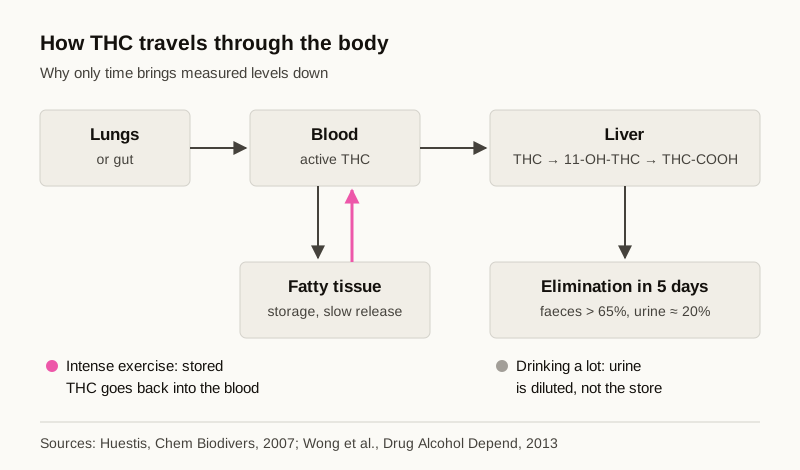
This route explains why a "detox" cannot empty the store quickly. THC is not sitting in urine that could be flushed out: it is in fat, and it leaves at its own pace.
How long THC stays detectable
The duration depends on the sample, the dose and above all how often someone uses. The figures below come from public sources and controlled studies; they are orders of magnitude, not individual guarantees.
| Sample | Occasional use | Regular or daily use | Source |
|---|---|---|---|
| Saliva | 6 to 8 hours | Up to 24 hours, up to 8 days for heavy use | Drogues Info Service |
| Blood | 2 to 8 hours | THC still measurable after 30 days in 2 of 5 users followed | Drogues Info Service; Bergamaschi, 2013 |
| Urine (THC-COOH) | About 34 to 89 hours after one cigarette | Up to 46 consecutive days | Huestis, 2007; Ellis, 1985 |
| Hair | Unreliable for light use | About 3 months over 3 cm of hair | Taylor, 2017 |
Saliva and blood reflect recent use. According to the detection-time table of Drogues Info Service, the French public drug helpline, THC stays in saliva for 6 to 8 hours after occasional use, and up to 24 hours after regular use. In blood, it can be measured for 2 to 8 hours after occasional use. In heavy users, the fat store changes everything: in a study of 30 daily smokers, 2 of the 5 participants followed through 30 days of abstinence still had THC in their blood, at 0.3 µg/l, at the end of follow-up.
Urine keeps the trace longer, because the test looks for THC-COOH. After a single cigarette, THC-COOH stayed detectable for an average of 34 hours at a low dose and 89 hours at a higher dose, at a 15 ng/ml cutoff. Among 86 chronic users followed in 1985, some were positive for up to 46 consecutive days, and the average elimination time was 27 days.
Hair, finally, grows about 1 cm a month. But it is poor at detecting light use: only 39% of the occasional users in a 2017 study tested positive. Our article on hair testing details its limits.
Detox methods put to the test
Drinking lots of water
Water does not touch the THC stored in fat. It dilutes urine, which lowers the THC-COOH concentration for a few hours, and labs know it. A sample is classed as "dilute" when its creatinine is below 20 mg/dl and its specific gravity below 1.003. Among 21,696 samples tested in Taiwan, dilution accounted for 89 to 95% of non-compliant samples. The lab then reports the sample as dilute instead of calling it negative.
Exercising just before
This is the riskiest idea. In a 2013 trial, 14 regular users cycled for 35 minutes: their blood THC rose slightly after the effort, more so in those with a higher body mass index. By burning fat, exercise can release some of the stored THC back into circulation. Right before a blood test, that is the opposite of what you want.
Detox kits, capsules and drinks
None of these products has been shown to speed up THC elimination, and no health authority recognises such an effect. CBD does not mask THC either: our guide to CBD and drug testing cites a study where adding CBD did not lower THC levels.
Behind the wheel: no legal shortcut
In France, roadside testing uses saliva. The order of 13 December 2016 sets the detection thresholds: 15 ng/ml of saliva for the roadside test, then 1 ng/ml of saliva or 0.5 ng/ml of blood for the confirmation analysis in a lab. These are technical thresholds, not a tolerance.
Article L235-1 of the Highway Code punishes driving after drug use with 3 years in prison and a €9,000 fine, with no threshold. The Cour de cassation ruled in a judgment of 21 June 2023 that the offence is made out whatever the dose absorbed, even after a legally sold product. The only precaution that works is not driving while THC may be present.
What about CBD?
Tests do not look for CBD. But a full-spectrum CBD product legally contains up to 0.30% Δ⁹-THC, and that THC follows the same route as THC from cannabis. Taken every day, it can be enough to trigger a positive test: the drug-testing guide mentioned above describes an oil with 0.02% THC that turned 7 of 14 participants positive in urine within four weeks.
If you have to take a test, only a product whose certificate of analysis shows Δ⁹-THC as not detected really limits the risk. Our guide to reading a certificate of analysis shows where to find that line, and the article on how long CBD stays in the body completes these figures.
Frequently asked questions
How can I clear THC faster?
No method has been shown to speed up elimination. THC leaves fat at its own pace, and only time without further use brings levels down. Drinking, fasting or sweating does not empty that store.
How long does THC stay in the blood?
2 to 8 hours after occasional use, according to Drogues Info Service. In a daily smoker, THC can remain measurable for several weeks: in one study, 2 of 5 participants still had some after 30 days.
Does drinking lots of water before a urine test help?
No. Water dilutes urine without removing stored THC, and an overly dilute sample is spotted by its creatinine and specific gravity. The lab reports it as dilute.
Does exercise help eliminate THC?
Not in any useful way before a test. A 35-minute workout even raised blood THC slightly in regular users, by releasing some of the THC stored in fat.
Can CBD make me test positive for THC?
Yes, if it is a full-spectrum product taken regularly. The test does not look for CBD but for THC, which these products legally contain up to 0.30%.
Written by the Phytogrammes team
Every article in this journal draws on primary sources (ANSM, EFSA, EUR-Lex, peer-reviewed publications) and on the lab's own practice: batch-by-batch HPLC analyses, measured cannabinoid profiles. Our approach.
Article published on . CBD is not a medicine.