CBD decarboxylation: what temperature, and for how long?
Decarboxylation is the reaction that turns CBDA, the form hemp actually makes, into CBD: heat strips a carboxyl group from the molecule, which leaves as CO₂. Published measurements put the effective range between 110 and 140 °C. At 110 °C it takes about an hour to convert 95% of the CBDA in an extract; below 100 °C the reaction stays incomplete, and from 160 °C the CBD content starts to fall.
Contents
> Key takeaways > > - A hemp flower contains mostly CBDA. CBD only appears in quantity after heating. > - At 110 °C, half the CBDA in an extract is converted in 14 minutes, 95% in about 60 minutes. > - In boiling water, conversion stays low: 6.6% of THCA in 15 minutes, and CBDA reacts about half as fast. > - Above 160 °C, measured CBD and THC levels decrease. > - In France, foods containing CBD have been withdrawn from sale since May 2026: this article describes a chemical reaction, not a recipe.
Decarboxylation: definition and total CBD
Hemp makes almost no CBD directly. Its glands produce cannabidiolic acid, CBDA, which carries an extra carboxyl group (COOH). When heated, that group breaks off and leaves as CO₂, and what remains is CBD. The same reaction turns THCA into THC and CBGA into CBG.
The molecule loses about 12% of its mass along the way. So a certificate of analysis that lists CBD and CBDA separately cannot simply be added up. The standard formula is: total CBD = CBD + 0.877 × CBDA. Example: a flower with 0.5% CBD and 8% CBDA can yield at most 7.5% CBD once fully heated. Our guide to reading a certificate of analysis walks through this calculation line by line.
The reaction also happens without an oven. It moves slowly during drying and storage, and almost instantly in a vaporiser or when the plant burns. For a home preparation, the whole point is to take it to completion without destroying what it produces.
Temperature and time: what the studies measured
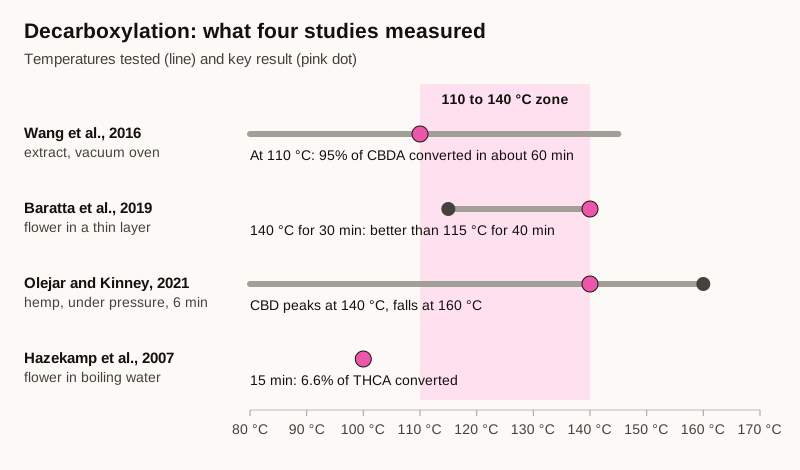
The reference is a kinetics study published in 2016 in Cannabis and Cannabinoid Research. Wang and colleagues heated flower extracts in vials, in a vacuum oven that removed air and light, between 80 and 145 °C. They measured a reaction rate at each temperature. CBDA converted about half as fast as THCA. From their rates we calculated the share converted after 30 and 60 minutes.
| Temperature | CBDA converted in 30 min | CBDA converted in 60 min | Time to convert half |
|---|---|---|---|
| 80 °C | 8.6% | 16.5% | 231 min |
| 95 °C | 38.5% | 62.2% | 43 min |
| 110 °C | 77.6% | 95.0% | 14 min |
Two limits matter. First, these figures describe an extract under vacuum, not crumbled flower in a kitchen oven. Second, the reaction is not clean: at 110 °C the combined CBDA + CBD in the extract fell by 18% over the heating, and by 25% at 130 °C. Part of the CBDA goes on to form other compounds. Heating for longer does not always mean more CBD.
Two other teams fill in the picture. In 2019 an Italian team of pharmacists compared several protocols for oils: pre-heating at 140 °C for 30 minutes gave better results than pre-heating at 115 °C for 40 minutes. The authors stress layer thickness: no more than 5 mm of material, ideally 1 to 2 mm, so the heat spreads evenly. In 2021 a study in the Journal of Cannabis Research heated hemp under pressure for 6 minutes. CBD content peaked at 140 °C, then dropped at 160 °C, where both CBD and THC showed signs of degradation.
Oven, fat, water, vaporiser: the methods compared
The table sums up what each method can achieve, based on the measurements cited above.
| Method | Actual temperature | What the measurements show | Weak point |
|---|---|---|---|
| Oven, material spread out | 110 to 140 °C | Near-complete conversion in 30 to 60 min | Inaccurate thermostat, terpenes lost |
| Fat in a water bath | 100 °C at most | At best 62% in an hour at 95 °C | Incomplete without pre-heating |
| Boiling water, tea | 100 °C | 6.6% of THCA converted in 15 min | Cannabinoids barely dissolve in water |
| Vaporiser set to 210 °C | 210 °C | At least 94.6% of acids converted | Inhalation only |
The oven is the only home method that reaches the effective range. Fat heated in a water bath never goes above 100 °C: it extracts CBD well, since CBD dissolves in fat, but it converts only part of the CBDA. That is why the Italian protocol pre-heats the material in an oven before the oil bath. Water does even less: in the 2007 study on cannabis tea, only 6.6% of the THCA added to boiling water came out as THC after 15 minutes. Since CBDA reacts more slowly, a tea converts even less of it.
A vaporiser, by contrast, needs no preparation. In 2016 an in vitro study in PLOS One tested five devices at 210 °C: the electric models decarboxylated at least 94.6% of the acids. Our guide to vaporisation temperature covers these measurements in detail.
The mistakes that skew the result
The first is trusting the thermostat. The dial setting is not the temperature at the tray: an oven thermometer placed next to the material lets you check. Fifteen degrees is enough to move from 62% to 95% of CBDA converted in an hour, according to the table.
The second is layer thickness. A layer thicker than 5 mm heats poorly in the middle, according to the Italian team. Crumble the flower without grinding it to powder, and spread it in a single layer.
The third is going too hot to save time. From 160 °C, the measured CBD losses outweigh the gain in speed. Terpenes, which are more volatile, also evaporate during heating: the material's smell changes and turns more toasted.
The fourth is the starting material. An old flower, or one stored somewhere warm, has already started to decarboxylate, and its certificate of analysis, if it dates from harvest, no longer describes the product exactly. When you choose CBD flowers, look at the analysis date as closely as the percentage shown.
What French law says
The chemistry does not change a product's legal status. Hemp flowers can be sold in France when they contain no more than 0.30% Δ⁹-THC and are not presented as food. For products meant to be swallowed, the Ministry of Agriculture restated on 20 May 2026 that foods containing CBD are not authorised and must be withdrawn from the market, because they lack approval under the EU novel food regulation. Our overview of CBD regulation in 2026 explains what remains on sale.
One last point is often forgotten: decarboxylation also turns THCA into THC. A compliant flower contains traces of both, and heating raises its free THC content. For a fat-based preparation, our article on the mistakes to avoid with CBD butter returns to this question and to dose calculation.
Frequently asked questions
What is CBD decarboxylation?
It is the chemical reaction that turns CBDA, made by the plant, into CBD. Heat removes a carboxyl group from the molecule, which leaves as CO₂. The same reaction turns THCA into THC.
At what temperature, and for how long, should CBD be decarboxylated?
Studies place the effective range between 110 and 140 °C. At 110 °C, 95% of the CBDA in an extract is converted in about 60 minutes; a protocol at 140 °C for 30 minutes has also proved effective. Below 100 °C, the reaction stays incomplete.
Do you need to decarboxylate a flower before vaporising it?
No. An electric vaporiser set to 210 °C converts at least 94.6% of the acids during inhalation, according to a 2016 study of five devices.
Does a CBD flower tea decarboxylate the CBDA?
Very little. After 15 minutes of boiling, only 6.6% of the THCA was converted in the 2007 study, and CBDA reacts about half as fast as THCA. Infusions made from flowering tops have also been withdrawn from sale in France since May 2026.
Why does my certificate show little CBD and a lot of CBDA?
Because the flower has not been heated. The potential is calculated with the formula CBD + 0.877 × CBDA, which accounts for the mass lost with the CO₂.
Written by the Phytogrammes team
Every article in this journal draws on primary sources (ANSM, EFSA, EUR-Lex, peer-reviewed publications) and on the lab's own practice: batch-by-batch HPLC analyses, measured cannabinoid profiles. Our approach.
Article published on . CBD is not a medicine.