CBD vaporisation temperature: what the measurements say
Vaporisers tested in the lab were mostly set between 185 and 210 °C. At 210 °C, five devices tested in 2016 delivered 46 to 70% of the CBD in the flower. The figures of 157 °C for THC and 160 to 180 °C for CBD, repeated everywhere, are not boiling points measured at normal pressure. At around 230 °C the material starts to burn, which is exactly what vaporisation tries to avoid.
Contents
> Key takeaways > > - The "157 °C" for THC is a vacuum distillation temperature, not a boiling point. A 2025 study puts the latter at 245 °C. > - The "160 to 180 °C" for CBD comes from the same 2001 table and was not measured at normal pressure. > - At 210 °C, the electric models tested in 2016 converted at least 94.6% of the acids (CBDA, THCA) into neutral forms. > - In 2009, vapour produced at 170 °C had the worst ratio of cannabinoids to by-products. > - Vaporising sharply reduces combustion compounds, without making inhalation risk-free.
Where the temperature tables come from
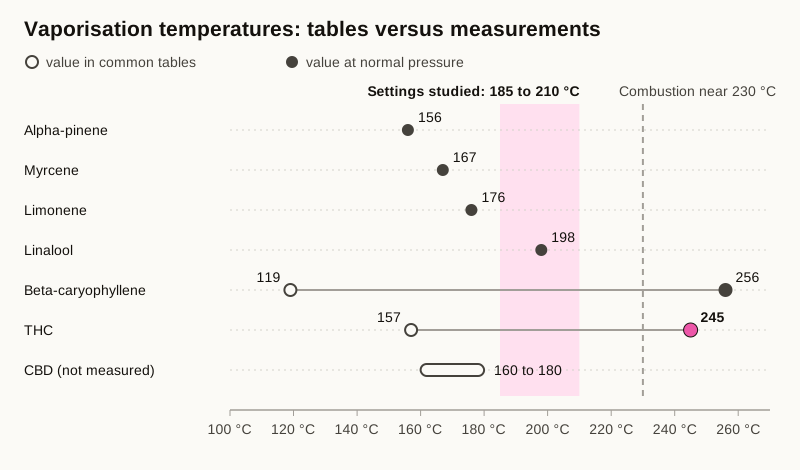
Almost every table online copies a 2001 review by McPartland and Russo in the Journal of Cannabis Therapeutics. Its tables of cannabis constituents give a "boiling point" for each molecule: 157 °C for THC, 160 to 180 °C for CBD, 185 °C for CBN, 220 °C for CBC. A note states that values are given at atmospheric pressure unless otherwise noted.
For THC, that is not the case. A 2025 study in the Journal of Cannabis Research traced the figure back: 157 °C is the temperature at which chemists distilled THC under a strong vacuum, at 0.05 Torr, in work from 1941 and 1964. The authors measured the boiling point at normal pressure by thermogravimetric analysis: about 245 °C. To our knowledge no equivalent measurement has been published for CBD. Its "160 to 180 °C" therefore remains a value without a verifiable source.
For terpenes, the table values hold up, with one exception. We compared them with the PubChem database, which compiles reference data at 760 mmHg.
| Compound | 2001 table | Reference at normal pressure | Gap |
|---|---|---|---|
| Alpha-pinene | 156 °C | 155 to 156 °C | None |
| Myrcene | 166 to 168 °C | 166 to 167 °C | None |
| Limonene | 177 °C | 175 to 176 °C | Negligible |
| Linalool | 198 °C | 198 °C | None |
| Beta-caryophyllene | 119 °C | about 256 °C | More than 130 °C |
| THC | 157 °C | 245 °C (2025 study) | Nearly 90 °C |
| CBD | 160 to 180 °C | Not measured | Unknown |
Beta-caryophyllene looks like the THC case: PubChem gives a boiling point near 130 °C at a reduced pressure of 14 mmHg, and near 256 °C at normal pressure. The 119 °C figure therefore also seems to come from a measurement under vacuum. Our article on beta-caryophyllene introduces this terpene.
Why a vaporiser works below the boiling point
A molecule does not need to reach its boiling point to turn into vapour. A puddle evaporates at 20 °C without ever boiling. The same goes for cannabinoids: the higher the temperature, the faster they evaporate. A vaporiser set to 200 °C therefore releases THC and CBD even though their boiling points are higher.
Heat also does a second job. The flower contains mostly CBDA, the acidic form of CBD, which has to lose a carboxyl group to become CBD. At these temperatures the conversion is almost instant. Our article on decarboxylation explains this reaction.
What the studies measured
The first published study dates from 2004. Gieringer and colleagues vaporised 200 mg samples of cannabis between 155 and 218 °C with a tabletop device and compared the vapour with smoke. According to their article in the Journal of Cannabis Therapeutics, the device delivered 36 to 61% of the THC in the sample. The gas phase of the vapour contained mostly cannabinoids plus three other compounds in trace amounts, against more than 111 compounds in the smoke, including polycyclic aromatic hydrocarbons. The authors place combustion near 230 °C. The study was partly funded by groups in favour of cannabis law reform and by the device's manufacturer.
In 2016, a Swiss team published in PLOS One a validation of five vaporisers, using THC-rich flowers and CBD-rich flowers. The four electric models were set to 210 °C; the fifth, gas-heated, had no temperature control.
| Device (type) | Share of CBD delivered |
|---|---|
| Arizer Solo (electric, pocket) | 70.0% |
| DaVinci Vaporizer (electric, pocket) | 56.7% |
| Plenty Vaporizer (electric, handheld) | 56.1% |
| Volcano Medic (electric, tabletop) | 51.4% |
| Vape-or-Smoke (gas, no control) | 45.9% |
The electric models converted at least 94.6% of the acids into neutral forms, against 87.7 to 93.3% for the gas device, the only one to show visible signs of combustion. Temperature control therefore matters more than the device's format.
A 2009 Dutch study runs against a common belief. With a tabletop vaporiser, vapour produced at 170 °C had the worst ratio of cannabinoids to by-products, whereas at 200 and 230 °C the ratio was clearly better than that of smoke from a cannabis cigarette. A lower temperature is not necessarily a "cleaner" one.
Which temperature to choose
No study has compared settings for CBD alone. Without a dedicated measurement, a cautious rule emerges from the work cited: start at around 185 to 200 °C, go up to 210 °C only if needed, and stay well clear of 230 °C. The 2004 team set its device to 202 °C and reports that one of its earlier studies, with a different model, found an optimum near 185 °C and saw toxic compounds appear above 200 °C.
- Below 180 °C, CBD is released more slowly, and the only available measurement, at 170 °C, is not favourable.
- Between 185 and 210 °C, you are in the range where most of the studied settings sit. Terpenes, most of which boil between 155 and 200 °C, are released too.
- Above 210 °C, you move closer to combustion, which the 2004 authors place near 230 °C.
The choice between conduction and convection comes next. Conduction heats the material through contact with a hot surface; convection passes hot air through it. The 2016 study does not settle the question: the clearest gap separated the devices with temperature control from the gas model without it. For a CBD flower, an even grind helps the heat spread. For resin, settings and cleaning differ: our article on hash in a vaporiser covers them, and the one on useful accessories helps you choose equipment.
Vaporising is not risk-free
The studies describe a reduction in combustion compounds, not their disappearance. The 2016 authors note that vaporisation aims to avoid the formation of tar, polycyclic aromatic hydrocarbons, carbon monoxide and benzene; they do not conclude that inhalation is harmless. None of these studies looked at long-term health effects.
Two more points. Vaporising a flower has nothing to do with vaping an e-liquid, which contains solvents and flavourings heated by a coil: our article on dosing CBD e-liquids covers that format. And heat also turns the THCA in a compliant flower into THC: the vapour contains traces of it, even when the flower meets the 0.30% Δ⁹-THC limit.
Frequently asked questions
What temperature should I vaporise a CBD flower at?
Most of the settings studied sit between 185 and 210 °C: start at around 185 to 200 °C and go up only if needed. Beyond that you move closer to combustion, near 230 °C. No study has compared temperatures for CBD alone.
Does CBD evaporate at 160 °C?
It already evaporates, but more slowly than at 200 °C. The 160 to 180 °C figure is not a boiling point measured at normal pressure. For THC, the equivalent 157 °C figure comes from vacuum distillation; its real boiling point is estimated at 245 °C.
Does vaporisation decarboxylate CBDA?
Yes. In 2016, electric vaporisers set to 210 °C converted at least 94.6% of the acids into CBD and THC. There is no need to heat the flower beforehand.
Should I choose a conduction or a convection vaporiser?
Both work. In the 2016 study, the sharpest gap separated the electric devices with adjustable temperature from the gas device without control, which delivered less CBD and showed signs of combustion.
Is vaporisation less harmful than combustion?
Studies measure far fewer combustion compounds in vapour: three compounds in trace amounts against more than 111 in smoke, in 2004. That is a reduction in by-products, not proof of zero risk.
Written by the Phytogrammes team
Every article in this journal draws on primary sources (ANSM, EFSA, EUR-Lex, peer-reviewed publications) and on the lab's own practice: batch-by-batch HPLC analyses, measured cannabinoid profiles. Our approach.
Article published on . CBD is not a medicine.