CBD for cats: absorbed 7 times less than in dogs
No CBD dose has been validated for cats, and no veterinary medicine containing CBD is authorised in France. Published trials have tested 2 to 30.5 mg of CBD per kilo in small groups of healthy cats. Above all, they show that at the same dose a cat absorbs far less CBD than a dog, with wide differences from one animal to the next: the decision belongs to your vet.
Contents
> Key takeaways > > - At 2 mg/kg, peak blood CBD was about 7 times lower in cats than in dogs: 43 versus 301 ng/mL. > - In healthy cats, the adverse effects observed were mostly drooling, licking, head shaking and short-lived drowsiness. > - No effect of CBD on any feline disease has been established. A trial on travel stress found no difference from a placebo. > - In France, a CBD product that claims a therapeutic effect for an animal is a veterinary medicine. None is authorised. > - The best-documented danger is THC: oils containing it caused more neurological effects in cats.
What published trials have measured in cats
Five published studies have given CBD to healthy cats, three of them against a placebo. None involved sick cats. The groups are small, and at least four studies were funded by pet-product manufacturers: Ellevet Sciences, Canopy Growth and Mars Petcare.
| Study | Cats | CBD dose | Duration | What was observed |
|---|---|---|---|---|
| Deabold et al., 2019 | 8 | 2 mg/kg twice a day | 12 weeks | Low absorption, frequent licking and head shaking, raised ALT in 1 cat |
| Kulpa et al., 2021 | 20, of which 4 on CBD alone | 11 rising doses, from 2.8 to 30.5 mg/kg | Doses at least 3 days apart | Mild, short-lived effects: drooling, drowsiness |
| Coltherd et al., 2024 | 19, then 20 | 4 mg/kg a day, with food | 4 weeks, then 26 | Well tolerated over 26 weeks; ALT up at 4 weeks in the first trial |
| Lyons et al., 2024 | 12 | 2 or 5 mg/kg, extract with 1 part THC to 20 parts CBD | Single dose, 48 h follow-up | Drooling in 2 cats at the high dose, variation between cats above 100% |
| Weller et al., 2024 | 40 | 4 mg/kg | Single dose | No effect on cortisol or behaviour during transport |
ALT (alanine aminotransferase) is a liver enzyme. A rise in a blood test signals that the liver is under strain, and vets monitor it during any long course of treatment.
Why a cat is not dosed like a dog
The Deabold trial gave the same product, at the same dose, to 8 dogs and 8 cats. The result is clear: peak blood CBD reached 301 ng/mL in dogs and 43 ng/mL in cats. Total exposure over the day, measured by the area under the curve, was 1,297 versus 164 ng·h/mL.
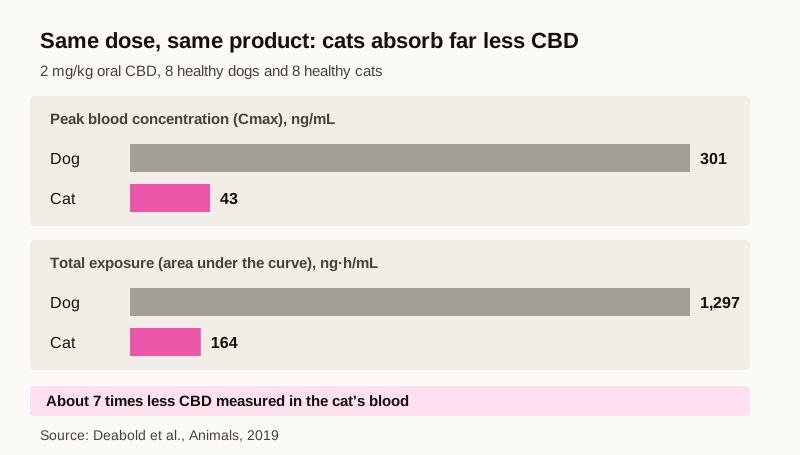
Lower absorption does not mean the dose should go up. First, the form of the product changes everything. A 2025 review in the Journal of Feline Medicine and Surgery reports, depending on the study, peaks of 42 ng/mL with a fish-oil base and 465 ng/mL with a paste. Food matters too: 463 ng/mL in fed cats against 269 ng/mL in fasted cats, at the same dose.
Second, cats process cannabinoids through different pathways from humans. The same review describes hydroxylation at positions 6 and 4' in cats, where humans mainly produce a derivative hydroxylated at position 7. More broadly, cats clear many phenolic compounds poorly: they lack the UGT1A6 enzyme, inactivated in every member of the cat family, which explains their sensitivity to paracetamol. No study has shown that this deficit affects CBD. It simply illustrates why data from dogs or humans do not carry over to cats.
Third, individual differences are large. In the Lyons trial, the coefficient of variation of blood levels exceeded 100% at some sampling times: cats given the same dose had very different blood levels.
The adverse effects observed
In the healthy cats of these trials, the effects reported stayed mild. In the Deabold trial, across 1,344 observations over twelve weeks, the researchers recorded 476 episodes of excessive licking (35.4%) and 339 of head shaking (25.2%). In the Kulpa trial, CBD oil mainly caused drooling and about an hour of drowsiness, which cleared without treatment. Vomiting and diarrhoea were attributed to the MCT carrier oil rather than to CBD.
The liver is the thing to watch. One cat in the Deabold trial kept ALT above the normal range for the whole trial. In the first Coltherd trial, ALT in the CBD group was 1.44 times higher than on placebo at four weeks, and two cats from that group were withdrawn from the long study for suspected cholangitis, an inflammation of the bile ducts. The 26-week trial did not find this difference.
THC is the best-documented danger. In the Kulpa trial, oils containing THC caused more neurological effects and behaviour changes than the CBD oil. The 2025 review also notes that combining CBD and THC made these effects last longer. An oil sold for humans may contain THC up to the legal limit of 0.3%, so knowing the measured level matters as much as the CBD dose.
In humans, CBD alters how some medicines act by slowing the liver enzymes that clear them. This mechanism, covered in our article on CBD and drug interactions, has not been studied in cats. A cat already on treatment is therefore the case where the vet's opinion counts most.
The legal framework in France
A CBD product that claims a therapeutic effect for an animal, against pain for example, is a veterinary medicine. Anses points this out: such a product must be authorised by Anses or by the European Commission, on criteria of quality, safety and efficacy. No veterinary medicine containing CBD is authorised in France.
As an exception, a vet may prescribe a human medicine when no suitable veterinary medicine exists: this is the "cascade" of article L5143-4 of the French Public Health Code. For pain in dogs and cats, the veterinary medicines agency (ANMV) has pointed out that authorised medicines exist, which rules out CBD by that route.
On the food side, the French agriculture ministry's notice of 20 May 2026 calls for the withdrawal of CBD foodstuffs intended for humans, as they lack novel food authorisation. It does not deal with pet products. Our update on CBD regulation in 2026 explains this regime. For horses, which also fall under racing rules, see CBD in equines.
Before you talk to your vet
Bring precise information, not a brand name. Your vet will need:
- the cat's weight, age and current treatments;
- the product's real concentration, in mg of CBD per mL;
- the measured Δ⁹-THC level, and the absence of other cannabinoids such as HHC;
- the list of excipients: carrier oil, flavourings, sweeteners.
A rough figure shows why an oil made for humans is a poor fit. The lowest dose in the trials, 2 mg/kg, comes to 8 mg for a 4 kg cat, or 0.16 mL of a 5% oil, less than a fifth of a millilitre. This calculation is not a dosage: it shows that a few drops either way change the dose completely.
A product's data can be checked on its certificate of analysis: our guide explains how to read a certificate of analysis, and the laboratory page describes the measurement methods. For dogs, the reference points and limits are different: see our article on CBD for dogs and the veterinary framework.
Frequently asked questions
Is CBD dangerous for a cat?
In healthy cats, the trials recorded only mild, short-lived effects, up to 30.5 mg/kg in spaced doses. Rises in liver enzymes were seen in a few cats. The main risk comes from THC, and sick cats or cats already on treatment have not been studied.
What CBD dose for a cat?
No dose has been validated. The trials used 2 to 5 mg/kg for repeated or single doses, and up to 30.5 mg/kg in spaced rising doses. These are research doses, not recommendations: only your vet can judge whether it makes sense for your cat.
Can I give a cat CBD oil meant for a human or a dog?
Not without a vet's advice. An oil made for humans is very concentrated for an animal of a few kilos, may contain THC up to 0.3% and flavourings. Data from dogs do not apply to cats, which absorb and process CBD differently.
Can a vet prescribe CBD in France?
No. No veterinary medicine containing CBD is authorised, and the ANMV considers that the cascade does not allow CBD to be prescribed for pain, since authorised medicines exist.
Does CBD calm a stressed cat?
The data do not show it. In a 2024 trial on 40 cats, a 4 mg/kg dose given two hours before transport in a carrier changed neither cortisol nor behaviour compared with a placebo.
Written by the Phytogrammes team
Every article in this journal draws on primary sources (ANSM, EFSA, EUR-Lex, peer-reviewed publications) and on the lab's own practice: batch-by-batch HPLC analyses, measured cannabinoid profiles. Our approach.
Article published on . CBD is not a medicine.