Full spectrum CBD oil: what it contains, THC included
A full spectrum CBD oil contains CBD plus the other compounds extracted from hemp: minor cannabinoids such as CBG and CBN, terpenes, and Δ⁹-THC up to 0.30% in France. Broad spectrum removes that THC, and isolate keeps only CBD. Those THC traces matter at the wheel and in competitive sport, and the entourage effect used to justify this format remains a hypothesis.
Contents
- 01Definition: what “full spectrum” means
- 02Full spectrum, broad spectrum, isolate: the differences
- 03The compounds in a full spectrum oil
- 04The entourage effect: a hypothesis, not a proof
- 05The THC in a full spectrum oil, in milligrams
- 06Athletes: broad spectrum is not enough
- 07What French law says in 2026
- 08Checking a full spectrum oil
- 09Frequently asked questions
> Key takeaways > > - “Full spectrum” means an oil that keeps all the compounds in the extract, THC included. No text defines the term: only the certificate of analysis tells you what is in the bottle. > - At the 0.30% threshold, 1 g of oil can contain up to 3 mg of Δ⁹-THC. Those traces can be enough to trigger a positive drug test. > - The World Anti-Doping Agency bans all cannabinoids in competition except CBD, including CBG and CBN. > - The entourage effect is a hypothesis. A 2020 study found no effect of the terpenes tested on CB1 and CB2 receptors, apart from a possible weak interaction of β-caryophyllene. > - Selling CBD as a food or supplement is not authorised in France, according to the Ministry of Agriculture (20 May 2026).
Definition: what “full spectrum” means
A full spectrum oil is made from a hemp extract that has not been purified down to a single molecule. It keeps what the extraction captured from the flower: CBD as the main compound, other cannabinoids in small amounts, terpenes, and Δ⁹-THC within the legal limit. The extract is then diluted in a vegetable oil, often medium-chain triglyceride (MCT) oil or hemp seed oil.
The term comes from marketing, not from law. We found no French or European text that sets its minimum content. Two “full spectrum” oils can therefore have very different profiles. Only the batch certificate of analysis tells you whether CBG, CBN or THC are really there, and in what amount.
Full spectrum, broad spectrum, isolate: the differences
The three formats differ in what is removed from the extract. Broad spectrum removes the THC but keeps the other cannabinoids and some of the terpenes. Isolate is purified CBD, often 99% or more, with no other cannabinoid or terpene.
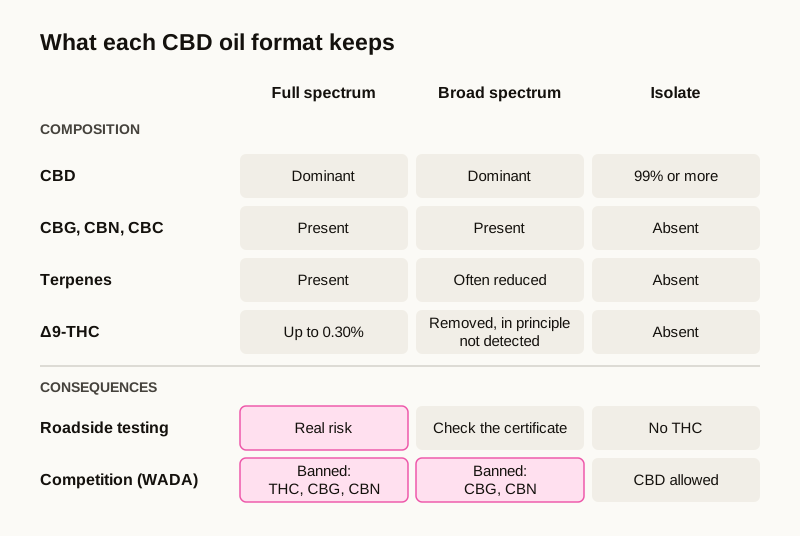
Our comparison of full spectrum and isolate helps you choose by use. How the oil is made, from plant to bottle, is covered in our article on supercritical CO2 extraction.
The compounds in a full spectrum oil
Hemp produces more than 100 cannabinoids, according to a 2021 review in the Journal of Pharmacology and Experimental Therapeutics. In an oil, only a few rise above trace level:
- CBD, the main compound, with no psychoactive effect.
- CBDA, its acidic form, which remains when the extract has not been heated.
- CBG, the precursor of the other cannabinoids, of which little remains in a mature flower. Our page on CBG explains its chemistry.
- CBN, which comes from the breakdown of THC over time, with light and air. It increases in an aged product.
- CBC, present in small amounts.
Terpenes give the smell and taste. A 2011 review by Ethan Russo covers limonene, myrcene, α-pinene, linalool and β-caryophyllene. β-caryophyllene (often shortened to BCP) draws attention because a 2020 study, cited below, noted a possible weak interaction with the CB2 receptor. Our article on hemp terpenes covers them in detail.
The entourage effect: a hypothesis, not a proof
The sales argument for full spectrum is called the entourage effect: the plant's compounds would work better together than CBD alone. The term was coined in 1998, in a study by Raphael Mechoulam's team. It did not concern the plant but lipids produced in mice, which boosted the action of an endocannabinoid. In 2011, Ethan Russo extended the idea to cannabis cannabinoids and terpenes in a review in the British Journal of Pharmacology, presenting it as a lead to test.
Direct tests have not confirmed the idea at receptor level. In 2020, a New Zealand team measured the effect of five cannabis terpenes on CB1 and CB2 receptors, alone or mixed with THC or CBD. Apart from a possible weak interaction of β-caryophyllene with CB2, it found no effect. No European authority has approved any claim linked to the entourage effect. A full spectrum oil is therefore not “more effective” than an isolate: it differs in composition and taste.
The THC in a full spectrum oil, in milligrams
The 0.30% Δ⁹-THC threshold set by the decree of 30 December 2021 applies to the mass of the finished product. The arithmetic is simple: 1 g of oil at 0.30% contains at most 3 mg of Δ⁹-THC, and 10 g contain at most 30 mg. A compliant oil often contains less, but only the batch certificate says so.
On the road, the decree of 13 December 2016 sets the saliva test threshold at 15 ng/ml and the confirmatory analysis threshold at 1 ng/ml of saliva. On 21 June 2023, France's Court of Cassation ruled that driving after using a narcotic is punishable even if the product was sold legally. If you drive, choose an isolate or a broad spectrum whose certificate shows THC as not detected. Our guide to drug testing covers detection windows.
Athletes: broad spectrum is not enough
The World Anti-Doping Agency's 2026 Prohibited List bans “all natural and synthetic cannabinoids” in competition, with a single exception: cannabidiol. The CBG, CBN and CBC in a full or broad spectrum oil are therefore prohibited substances in competition, just like THC. For a tested athlete, only an isolate whose certificate shows no other cannabinoid limits this risk.
What French law says in 2026
The 2021 decree allows hemp extracts below 0.30% Δ⁹-THC, and the Conseil d'État ruling of 29 December 2022 struck down the ban on selling flowers and leaves. An oil must contain no cannabinoid classified as a narcotic: HHC since June 2023, H4CBD and THCP since 3 June 2024.
The oil's status also depends on its use. On 20 May 2026, the Ministry of Agriculture restated that foods containing CBD are not authorised, food supplements included, under the European novel food regulation. Our update on the 2026 regulations describes the situation.
On 9 February 2026, EFSA set a provisional safe intake of 2 mg of CBD per day for a 70 kg adult. This benchmark only applies to CBD at least 98% pure: it does not apply to a full spectrum extract. EFSA also considers that CBD safety cannot be established under 25, during pregnancy or breastfeeding, or for people on medication. ANSES also proposed in March 2025 to classify CBD as a presumed reproductive toxicant, based on animal studies. Our article on EFSA's reference dose details these figures.
Checking a full spectrum oil
The certificate of analysis is the only document that proves the claim. Here are the points to check, in order:
- The batch number, the same on the bottle and on the certificate.
- The full cannabinoid profile: CBD, CBDA, CBG, CBN, CBC. With no measurable minor cannabinoid, the “full spectrum” label rests on nothing.
- Δ⁹-THC, at 0.30% or less, and no HHC, H4CBD or THCP when the lab tested for them.
- Contaminants: residual solvents, pesticides, heavy metals.
- The amount of CBD in milligrams: a 10 ml oil at 10% contains about 1,000 mg of CBD. Be wary of a label that gives a percentage without a volume.
Our guide to the certificate of analysis goes through each line, and our laboratory page describes the measurement methods. The oils in the catalogue are grouped in the CBD oils category, including a full spectrum oil. For storage, which limits the conversion of THC into CBN, see our article on shelf life, light and heat.
Frequently asked questions
Is full spectrum better than isolate?
No controlled study shows it. The argument rests on the entourage effect, a hypothesis that receptor tests have not confirmed. The real difference lies in composition, taste and the presence of THC.
Can a full spectrum oil get you high?
A compliant oil contains at most 0.30% Δ⁹-THC, a level not designed to produce a psychoactive effect. It can, however, make a drug test positive.
Why does it taste stronger than an isolate?
Because the extract keeps terpenes and other plant compounds. An isolate purified to 99% tastes almost neutral.
Can an athlete use broad spectrum?
It is risky. The World Anti-Doping Agency bans all cannabinoids except CBD in competition, which includes the CBG and CBN that a broad spectrum oil keeps.
Should full spectrum be avoided during pregnancy?
Yes, like any CBD product. EFSA considers that its safety cannot be established during pregnancy and breastfeeding, and ANSES proposed in 2025 to classify CBD as a presumed reproductive toxicant.
Written by the Phytogrammes team
Every article in this journal draws on primary sources (ANSM, EFSA, EUR-Lex, peer-reviewed publications) and on the lab's own practice: batch-by-batch HPLC analyses, measured cannabinoid profiles. Our approach.
Article published on . CBD is not a medicine.