CBD terpenes: 200 molecules, under 1% of the flower
Terpenes are the scent molecules of hemp. More than 200 have been identified in it, yet they make up less than 1% of the plant in most analyses, and up to 10% of trichome content. They give CBD flower its smell and taste. Their role in an "entourage effect" with cannabinoids is still a hypothesis, one that receptor tests have not confirmed.
Contents
- 01Definition: molecules built in blocks of five carbons
- 02The main hemp terpenes
- 03β-caryophyllene, a terpene that binds to CB2
- 04Entourage effect: the hypothesis and what tests showed
- 05Drying and storage: terpenes go first
- 06Full spectrum, broad spectrum, isolate: where the terpenes are
- 07Terpenes and skin: the case of cosmetics
- 08Frequently asked questions
> Key takeaways > > - Terpenes are built from units of five carbon atoms; monoterpenes have 10, sesquiterpenes 15. > - Myrcene, limonene, linalool, pinene and β-caryophyllene are among the most common in hemp. > - β-caryophyllene binds to the CB2 receptor, not CB1: it does not get you high. > - In 2020, five major terpenes tested alone or in mixtures did not change CB1 or CB2 receptor activity. > - During drying and storage, terpenes go before cannabinoids: over 50% in four months.
Definition: molecules built in blocks of five carbons
A terpene is an organic compound made of isoprene units, a small molecule with five carbon atoms. Two units give a monoterpene (10 carbons), three a sesquiterpene (15), four a diterpene (20). When the molecule also carries an oxygen atom, like linalool, it is called a terpenoid. In everyday use, the two words overlap.
Most monoterpenes are volatile: they evaporate at room temperature and reach the nose. That is why we smell them. Sesquiterpenes, which are heavier, evaporate more slowly.
The plant kingdom holds a great many of them. A review by pharmacologist Ethan Russo, published in 2011 in the British Journal of Pharmacology, puts the number of fully characterised terpenoids at 15,000 to 20,000, with more than 200 reported in cannabis. Their yield there is modest: less than 1% in most analyses, but up to 10% of trichome content.
Trichomes are the tiny glands that cover female flowers. A study published in 2020 in Scientific Reports notes that cannabinoids and terpenoids are produced and stored there, in the secretory cells. That is why an extraction that keeps one group often keeps the other. Our article on trichomes describes these glands, and the one on cannabinoids covers the other family.
The main hemp terpenes
The profile varies with the strain, growing conditions, drying and storage. A few terpenes still turn up in most analyses.
| Terpene | Family | Smell | Also found in |
|---|---|---|---|
| β-myrcene | Monoterpene | Herbal, musky | Hops |
| d-limonene | Monoterpene | Citrus | Lemon and orange peel |
| Linalool | Monoterpene (alcohol) | Floral | Lavender |
| α-pinene | Monoterpene | Pine, resin | Conifers, rosemary |
| β-caryophyllene | Sesquiterpene | Spicy, peppery | Black pepper, oregano, cinnamon |
| Humulene | Sesquiterpene | Woody, earthy | Hops |
A strain's name does not guarantee its dominant terpene. A flower called "Lemon" is not necessarily dominated by limonene: only a terpene assay, when the lab runs one, settles the question. Our guide to the certificate of analysis shows where to read those lines. The CBD flower product pages describe the aroma profile of each product.
β-caryophyllene, a terpene that binds to CB2
β-caryophyllene stands apart among the common hemp terpenes. A study published in 2008 in PNAS showed that it binds selectively to the CB2 receptor, with a binding constant of 155 nanomolar, without binding to the CB1 receptor. It is CB1, in the brain, that produces the THC high: β-caryophyllene therefore does not get you high.
The authors point out that it is common in spices, and estimate possible dietary intake at 10 to 200 mg a day. It can make up to 35% of cannabis essential oil. Their inflammation experiments were done in mice: they say nothing about the effect of CBD flower in humans. Our article on β-caryophyllene and the CB2 receptor goes through this work.
Entourage effect: the hypothesis and what tests showed
The term "entourage effect" refers to the idea that hemp compounds act together differently from each one alone. Russo formalised it in his 2011 review, proposing that terpenes modulate the action of cannabinoids. He set a benchmark: a terpene present above 0.05% would be of pharmacological interest.
The hypothesis has been tested at the receptors. In 2020, a team published results in Frontiers in Pharmacology for five terpenes: myrcene, α-pinene, β-pinene, β-caryophyllene and limonene. None of them, alone or in mixtures, changed CB1 or CB2 receptor signalling, even combined with THC, CBD or an endocannabinoid. If an entourage effect exists, it does not work through direct action on these receptors.
No European authority has approved a health claim linked to terpenes or the entourage effect. A seller who says terpenes "strengthen" CBD is going beyond what the data allow. Our review of the entourage effect covers the human trials.
Drying and storage: terpenes go first
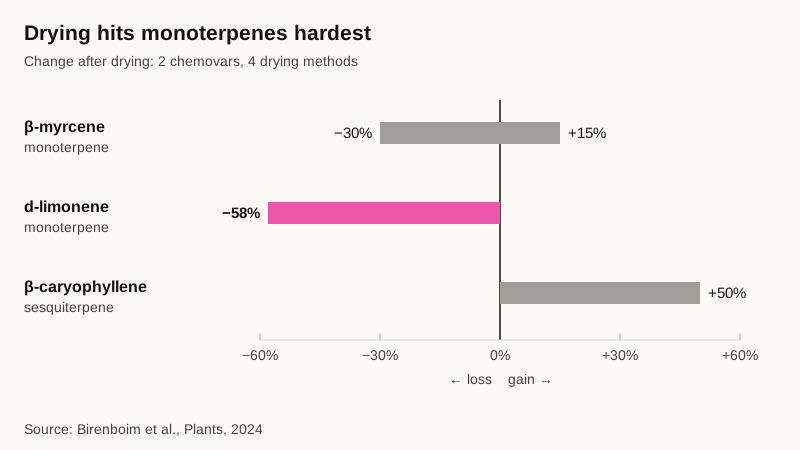
The volatility that makes terpenes fragrant also makes them fragile. A study published in 2024 in the journal Plants compared four drying methods on two strains. Monoterpenes proved more sensitive to drying than sesquiterpenes. d-Limonene lost up to 58% in one strain and stayed stable in the other. β-Myrcene lost 3 to 30% depending on the case, and gained 15% with one method. β-Caryophyllene, by contrast, rose in relative concentration, by up to 50%.
Storage extends the loss. In a study published in 2020 in Frontiers in Plant Science, terpenoids in stored flowers had lost more than 50% within four months, at every temperature tested, while cannabinoids lost 26% on average in a year. A flower that barely smells any more has mostly lost its terpenes. Our guides to drying and curing and to storing flower draw the practical rules.
Full spectrum, broad spectrum, isolate: where the terpenes are
A CBD isolate is purified cannabidiol. It contains no terpenes and no other cannabinoids, and it is almost odourless. A full-spectrum extract keeps hemp's terpenes and other cannabinoids, with traces of THC below the legal limit of 0.30%. A broad-spectrum extract removes the THC and keeps the rest.
Some manufacturers add isolated terpenes, sometimes taken from other plants, to recreate an aroma. An honest product says so on the label. Our comparison of full spectrum and isolate helps you choose for your use.
Terpenes and skin: the case of cosmetics
Russo notes that these terpenes are common flavour components in food, with a known safety profile. Skin is a different matter. Limonene and linalool are among the fragrance allergens that EU cosmetics law requires to be named on the label above 0.001% in a leave-on product and 0.01% in a rinse-off product. A full-spectrum CBD cream may therefore list them among its ingredients. Our article on fragrance allergens in CBD cosmetics explains how to spot them.
Frequently asked questions
What is a terpene, in one sentence?
A scent molecule made by plants, built from units of five carbon atoms. In hemp, terpenes are made in the trichomes, like cannabinoids.
Do terpenes get you high?
No. The five major terpenes tested in 2020 do not act on the CB1 receptor, which is responsible for the THC high. β-caryophyllene binds to CB2, which plays no part in that effect.
Does a CBD isolate contain terpenes?
No. An isolate is purified CBD, with no terpenes or other cannabinoids, which is why it has almost no smell. To keep hemp's terpenes, you need a full-spectrum or broad-spectrum extract.
Can terpenes make a saliva test positive?
No. Saliva tests look for THC. A full-spectrum product may, however, contain traces of THC, and it is that THC which can make a test positive.
Why does CBD flower lose its smell?
Because its terpenes evaporate and break down faster than its cannabinoids. A 2020 study measured over 50% of terpenoids lost in four months of storage.
Written by the Phytogrammes team
Every article in this journal draws on primary sources (ANSM, EFSA, EUR-Lex, peer-reviewed publications) and on the lab's own practice: batch-by-batch HPLC analyses, measured cannabinoid profiles. Our approach.
Article published on . CBD is not a medicine.