Cannabinoids: definition, 3 families and what is legal
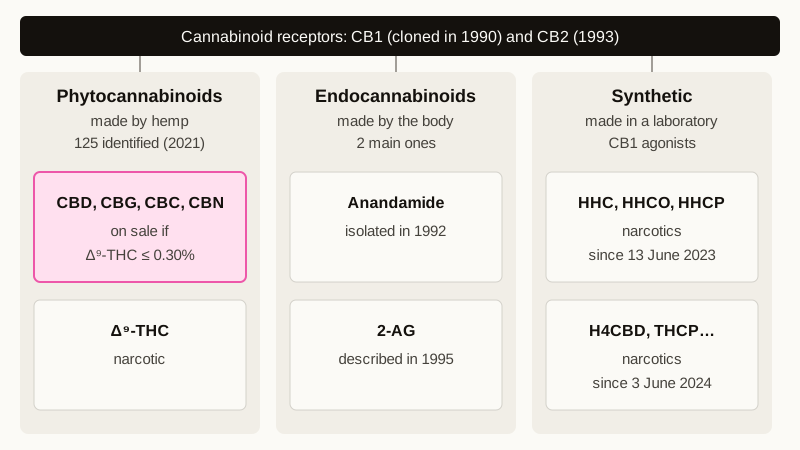
A cannabinoid is a molecule that acts on the body's cannabinoid receptors, CB1 and CB2, or that belongs to the chemical family of THC and CBD. There are three families: phytocannabinoids from hemp, 125 of which have been identified, endocannabinoids made by the body, and synthetic cannabinoids. In France, CBD, CBG, CBC and CBN can be sold if the product contains no more than 0.30% Δ⁹-THC; THC and synthetic molecules are narcotics.
Contents
> Key takeaways > > - A 2021 review lists 125 cannabinoids among more than 500 compounds in hemp, grouped into 11 chemical types. > - The plant makes acidic forms (CBDA, THCA); heat or light turns them into CBD and THC. > - The body makes its own cannabinoids: anandamide, identified in 1992, and 2-AG, in 1995. > - Synthetic cannabinoids activate the CB1 receptor far more strongly than THC; all those sold as "alternatives" are banned. > - The only CBD medicine available in France is Epidyolex, prescribed for certain rare epilepsies.
Definition: a chemical family and two receptors
The word has two overlapping meanings. In the chemical sense, a cannabinoid is one of the molecules specific to hemp, built on the same skeleton as THC and CBD. In the pharmacological sense, it is any molecule that binds to the cannabinoid receptors, whether it comes from the plant, the body or a laboratory.
History follows that order. Raphael Mechoulam described the structure of CBD in 1963, then that of THC in 1964. The CB1 receptor was cloned in 1990; a study published in Nature described a G protein-coupled receptor found in the brain. CB2 followed in 1993, found mainly in immune cells. The body therefore had to make its own molecules to activate these receptors: they were identified in 1992 and 1995. Together they form the endocannabinoid system.
Phytocannabinoids: 125 molecules, 11 chemical types
A review published in 2021 in Molecules lists more than 500 compounds in Cannabis sativa, 125 of them identified as cannabinoids. The authors group them into 11 chemical types, including the CBD, Δ⁹-THC, CBG, CBC and CBN types. They are made in the trichomes, the small resin glands on female flowers.
The main ones come from a single molecule. The plant makes cannabigerolic acid (CBGA), then three enzymes, THCA synthase, CBDA synthase and CBCA synthase, turn it into THCA, CBDA and CBCA. The genetics of the cultivar decide which one dominates: CBD hemp mostly carries CBDA synthase. These acidic forms then lose a carboxyl group under heat or light and become CBD, THC, CBC or CBG. This is decarboxylation.
CBN follows a different path: the plant does not make it. It appears when THC breaks down, with time and oxidation, and binds less well than THC to the CB1 and CB2 receptors.
| Molecule | Origin | Psychoactive effect | Status in France |
|---|---|---|---|
| CBD | Heating of CBDA | No | Sale allowed if Δ⁹-THC ≤ 0.30% |
| CBG | Heating of unconverted CBGA | No | Sale allowed if Δ⁹-THC ≤ 0.30% |
| CBC | Heating of CBCA | No | Sale allowed if Δ⁹-THC ≤ 0.30% |
| CBN | Breakdown of THC | Low affinity for CB1 | Not classified, same THC limit |
| Δ⁹-THC | Heating of THCA | Yes | Narcotic, tolerated at 0.30% at most in hemp |
| THCA | Acidic form made by the plant | No, as long as it is not heated | Narcotic, except in hemp that meets the 0.30% limit |
Endocannabinoids: the ones the body makes
The human body produces its own cannabinoids. The first, anandamide, was isolated in 1992 from pig brain during a search for molecules able to bind to the cannabinoid receptor. Its name comes from the Sanskrit ananda, "bliss". The second, 2-arachidonoylglycerol or 2-AG, was described in 1995 by two teams, one Israeli, one Japanese.
These two molecules do not share the structure of CBD or THC. They derive from arachidonic acid, a fatty acid, and are made on demand, then broken down by enzymes. THC partly mimics their action on the CB1 receptor, which explains its psychoactive effect. CBD, for its part, binds weakly to CB1 and CB2; its studied targets are many, and the detail is in the endocannabinoid system article mentioned above.
Synthetic cannabinoids: the banned family
Synthetic cannabinoids are made in a laboratory to activate the CB1 receptor. What sets them apart from THC is intensity. A review published in 2025 points out that THC is a partial CB1 agonist, whereas most synthetic cannabinoids on sale are full agonists, sometimes more than 100 times as potent. JWH-018, found in "Spice" or "K2" blends, is the best-known example.
A second category has spread on the CBD market: semi-synthetic molecules, made by chemically modifying a hemp cannabinoid. ANSM classed HHC, HHCO and HHCP as narcotics from 13 June 2023, then H4CBD, THCP and other derivatives from 3 June 2024. The same decision covers THCA, except when it is present in hemp whose THC content meets the 0.30% limit.
These products still circulate under misleading names. Our article on synthetic cannabinoids explains how to spot them, and the HHC timeline traces its ban.
What French law allows
The framework rests on a threshold. The order of 30 December 2021 authorises Cannabis sativa L. varieties listed in the official catalogues whose Δ⁹-THC content does not exceed 0.30%, and applies that ceiling to extracts and to products containing them. The Conseil d'État struck down on 29 December 2022 the ban on selling raw flowers and leaves that the order contained.
Two further limits apply. MILDECA, the French interministerial drugs agency, points out that CBD products may not make therapeutic claims, on pain of criminal penalties, unless they are authorised as medicines. And a cannabinoid meant to be swallowed also falls under the novel food rules, detailed in our overview of CBD regulation in 2026.
Medicines: Epidyolex and medical cannabis
The only CBD medicine available in France is Epidyolex, a solution of purified CBD. It has been authorised in the European Union since 2019, on the opinion of the European Medicines Agency, as an add-on to other medicines in Lennox-Gastaut syndrome and Dravet syndrome, together with clobazam, and in tuberous sclerosis complex, from the age of 2. Only neurologists and paediatric neurologists may prescribe it. Our article on Epidyolex sums up the trials that led to this authorisation.
Medical cannabis, which contains THC, follows a different route. The French experiment ended on 31 December 2024; according to ANSM, the transition period that followed will end three months after the French National Authority for Health (HAS) publishes its opinion. Our update on medical cannabis in 2026 follows the file.
Frequently asked questions
What is a simple definition of a cannabinoid?
It is a molecule that acts on the CB1 and CB2 cannabinoid receptors, or that belongs to the chemical family of THC and CBD. It can come from hemp, from the human body or from a laboratory.
How many cannabinoids are there?
A 2021 review lists 125 in hemp, out of more than 500 compounds identified in the plant. The body makes two main ones, anandamide and 2-AG. Synthetic cannabinoids form a separate family that keeps changing as new molecules are banned.
What are the types of cannabinoids?
Three families: phytocannabinoids, made by hemp (CBD, THC, CBG, CBC, CBN…), endocannabinoids, made by the body, and synthetic or semi-synthetic cannabinoids, created in a laboratory.
Are all hemp cannabinoids legal in France?
What is the difference between a cannabinoid and a terpene?
They are two different chemical families, made in the same glands of the hemp plant. Terpenes, such as myrcene or limonene, are fragrant compounds found in many plants. Our article on hemp terpenes covers their chemistry.
Written by the Phytogrammes team
Every article in this journal draws on primary sources (ANSM, EFSA, EUR-Lex, peer-reviewed publications) and on the lab's own practice: batch-by-batch HPLC analyses, measured cannabinoid profiles. Our approach.
Article published on . CBD is not a medicine.