Delta-9 THC in France: legal status, 0.30% and medical use
Delta-9 THC (Δ⁹-tetrahydrocannabinol) is the main psychoactive molecule in cannabis. In France it is a narcotic: producing, selling or using it is prohibited. There are two exceptions: hemp and hemp products, tolerated up to 0.30% Δ⁹-THC, and authorised medicines, none of which containing THC is on sale as of September 2026.
Contents
> Key takeaways > > - Δ⁹-THC is on the narcotics list set by the order of 22 February 1990, under the generic term "tetrahydrocannabinols". > - Hemp has been tolerated at 0.30% Δ⁹-THC since the order of 30 December 2021; the limit was 0.20% before. > - Sativex, a THC and CBD medicine, was authorised in 2014 but has never been sold in France. > - HHC has been a listed narcotic since 13 June 2023, H4CBD and THCP since 3 June 2024. > - Behind the wheel, the mere presence of THC is punished by 3 years in prison and a €9,000 fine.
Delta-9 THC in two minutes
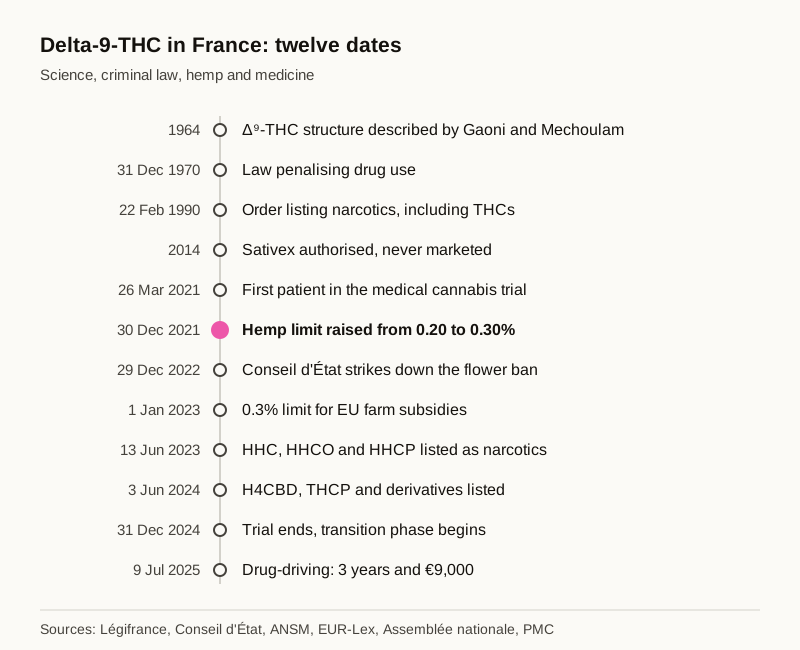
Δ⁹-THC is a cannabinoid, one of the molecules specific to hemp. Its structure was established in 1964 by Yehiel Gaoni and Raphael Mechoulam, the first to describe its isolation and stereochemistry. The "9" refers to the position of a double bond in the molecule. Moved to position 8, it gives Δ⁸-THC, an isomer found in trace amounts.
The plant makes almost no THC in its active form. It produces THCA, the acidic form, which heat converts into THC: this is called decarboxylation. That is why a certificate of analysis shows two lines, Δ⁹-THC and THCA, and why a total THC figure is calculated. Our article on THCA covers this raw form, and the one on the differences between THC and CBD compares the two molecules.
| Molecule | Nature | Status in France (September 2026) |
|---|---|---|
| Δ⁹-THC | Natural cannabinoid, psychoactive | Narcotic; tolerated at 0.30% in authorised hemp |
| THCA | Natural acidic form of THC | Listed in 2024, except in hemp whose THC stays within 0.3% |
| Δ⁸-THC | Isomer, often synthesised from CBD | Narcotic, covered by the term "tetrahydrocannabinols" |
| HHC, HHCO, HHCP | Semi-synthetic | Narcotics since 13 June 2023 |
| H4CBD, THCP, HHCPO | Semi-synthetic | Narcotics since 3 June 2024 |
| CBD | Natural cannabinoid, not psychoactive | Not listed; sold subject to the THC limit |
Why THC is a narcotic in France
Three texts fit together. Article L5132-7 of the Public Health Code gives the ANSM, the French medicines agency, the power to list narcotics. The order of 22 February 1990 sets the list; its annex IV covers "tetrahydrocannabinols, their esters, ethers, salts". Finally, article R5132-86 prohibits the production, sale and use of cannabis, its resin and tetrahydrocannabinols, "natural or synthetic".
The generic term has a practical consequence: it covers Δ⁸-THC and the other isomers without naming them. Our article on delta-8 THC describes its risks.
Use itself has been punishable since the law of 31 December 1970 on combating drug addiction. Article L3421-1 of the Public Health Code provides for one year in prison and a €3,750 fine. Since 20 August 2026, the on-the-spot criminal fine that can replace it is €500, or €400 if paid quickly.
The 0.30% limit: a tolerance, not permission for THC
Article R5132-86 allows exemptions by ministerial order. The hemp exemption is the order of 30 December 2021. It authorises Cannabis sativa L. varieties whose Δ⁹-THC content does not exceed 0.30%, and caps extracts and products containing them at the same level. It replaced the order of 22 August 1990, which set the limit at 0.20%.
The move to 0.30% follows the European Union. Since 1 January 2023, Regulation (EU) 2021/2115 on the common agricultural policy only grants hemp subsidies to varieties with no more than 0.3% THC. The Conseil d'État then struck down the ban on selling raw flowers and leaves on 29 December 2022, keeping the limit.
The limit does not make THC legal. It tolerates a residual presence in a hemp product; a product designed for its psychoactive effect remains a narcotic. How this level is measured, Δ⁹-THC alone or total THC, is detailed in our article on the legal THC level.
The derivatives listed in 2023 and 2024
From 2022, shops sold semi-synthetic cannabinoids, made in a lab from CBD, that slipped through the list. The ANSM listed HHC, HHCO and HHCP from 13 June 2023. A decision of 22 May 2024 added, from 3 June 2024, H4CBD, H2CBD and a whole chemical family, the benzo[c]chromene derivatives, including HHCPO, THCP and THCA.
THCA needs a clarification. A decision of 3 June 2024 took CBN and CBNA out of this listing, along with THCV, THCVA and THCA present in hemp products, as long as their THC content complies with the 0.3% limit. A compliant CBD flower therefore contains THCA without being a narcotic. A THCA-enriched product whose THC exceeds that limit is one. The full timeline is in our article on HHC.
Medical THC in France in 2026
No THC medicine is sold in pharmacies. Sativex, a THC and CBD spray for spasticity in multiple sclerosis, received its marketing authorisation in 2014. The government confirmed in 2023 that it has never been marketed: no additional impact on morbidity, mortality or quality of life had been shown, and price negotiations begun in 2015 with the manufacturer failed.
Dronabinol, synthetic THC sold as Marinol, remains available case by case. The ANSM issues named-patient compassionate access authorisations, notably for neuropathic pain after other treatments have failed. The medicine has no marketing authorisation in France.
A medical cannabis trial enrolled its first patient on 26 March 2021 and ended on 31 December 2024. Patients already treated continue in a transition phase, extended until 31 December 2026. The permanent framework is still waiting for its texts: our article on medical cannabis in 2026 tracks the timetable. On the CBD side, the only authorised medicine is Epidyolex, restricted to three rare forms of epilepsy.
The legalisation debate
Two institutions have recommended changing the law, with no legislative follow-up so far. In May 2021, an interim report from a fact-finding mission of the Assemblée nationale called for "regulated legalisation" of so-called recreational cannabis. On 24 January 2023, the Economic, Social and Environmental Council adopted an opinion in favour of controlled legalisation, by 87 votes to 25 with 16 abstentions.
These opinions are not binding. In September 2026, Δ⁹-THC is still a narcotic and the recent trend points towards tougher rules, with heavier drug-driving penalties and a higher on-the-spot fine. Our article on French cannabis law and its figures gives the context.
Driving: zero THC threshold
Article L235-1 of the Highway Code has punished driving after drug use with 3 years in prison and a €9,000 fine since the law of 9 July 2025. There is no tolerance threshold: a blood or saliva test that establishes use is enough. On top of that come the loss of six points and a suspension or cancellation of the licence.
The Cour de cassation applied this to CBD products in a ruling of 21 June 2023: the offence is made out "regardless of the dose absorbed", even if the product was sold legally. Our guide to CBD and drug testing gives the tests' detection thresholds.
Frequently asked questions
Is delta-9 THC legal in France?
No. It is a narcotic. Only its residual presence is tolerated in hemp and hemp products, up to 0.30% Δ⁹-THC. A product designed for its psychoactive effect remains prohibited, whatever its level.
What is the maximum THC level allowed in France?
0.30% Δ⁹-THC, in the plant as in extracts and finished products, under the order of 30 December 2021. Before 2022, the limit was 0.20%.
Is medical THC allowed in France?
No THC medicine is on the market. Sativex was authorised in 2014 but has never been sold. Dronabinol is supplied case by case with ANSM authorisation, and the medical cannabis trial ended in late 2024.
Is THCA banned in France?
It has been listed since 3 June 2024, but excluded from the listing when present in a hemp product whose THC stays within 0.3%. A product enriched in THCA beyond that limit is a narcotic.
Is delta-8 THC banned in France?
Yes. The narcotics list covers "tetrahydrocannabinols" without distinguishing isomers, and article R5132-86 includes both natural and synthetic forms.
Written by the Phytogrammes team
Every article in this journal draws on primary sources (ANSM, EFSA, EUR-Lex, peer-reviewed publications) and on the lab's own practice: batch-by-batch HPLC analyses, measured cannabinoid profiles. Our approach.
Article published on . CBD is not a medicine.