Swiss CBD in France: 1% THC against 0.30%
Switzerland does not treat hemp as a narcotic when its total THC content stays below 1.0%. France only allows 0.30% Δ⁹-THC, and its official measurement method counts most of the THCA. A flower bought legally in Switzerland can therefore be illegal in France: the threshold that applies is the one of the country where you hold the product.
Contents
> Key takeaways > > - Switzerland: below 1.0% total THC, meaning THC plus its acidic form, THCA, converted by calculation. > - France: no more than 0.30% Δ⁹-THC, for varieties, extracts and finished products. > - The official French method heats the sample to 300 °C, which turns almost all the THCA into THC. > - A Swiss flower between 0.33 and 1.0% total THC is legal in Switzerland, but above the French threshold under the official measurement. > - In both countries, CBD foods are not authorised.
The Swiss threshold: 1.0% total THC
The reference document is an enforcement guide written by Swissmedic, the Federal Office of Public Health, the Federal Food Safety and Veterinary Office, and the associations of cantonal pharmacists and chemists. Version 8.0 is dated 1 May 2025. It states the rule plainly: cannabis and cannabis preparations with a total THC content below 1.0% are not considered narcotics under the ordinance on narcotics schedules.
Three details from the same document correct common assumptions. The reform of 1 August 2022, which opened up medical cannabis, did not change the 1.0% limit. Non-medical use of a product at 1.0% or more remains prohibited. And since 1 October 2024, hemp below 1.0% has been sold as a herbal smoking product under the tobacco products act. Switzerland is not a country where anything goes: it simply draws the line higher.
The French threshold: 0.30% Δ⁹-THC
In France, the order of 30 December 2021 only authorises Cannabis sativa L. varieties listed in the official catalogues whose Δ⁹-tetrahydrocannabinol content does not exceed 0.30%. The same cap applies to hemp extracts and the products that contain them. The order also banned the sale of raw flowers, but the Conseil d'État annulled that ban on 29 December 2022. It held that CBD has no psychoactive effect, does not cause dependence, and that tests can tell varieties apart.
Above the threshold, a product leaves the authorised hemp framework and falls under narcotics law. On THCA, the ANSM settled the matter in 2024: its decision in force from 3 June 2024 classifies THCA as a narcotic, unless it is present in hemp whose THC content meets the 0.3% threshold. Our article on the legal THC level explains where the figure comes from.
Δ⁹-THC or total THC: what each country measures
The Swiss text refers to total THC: Δ⁹-THC plus THCA, converted with the standard formula Δ⁹-THC + 0.877 × THCA. The 0.877 factor corrects for the mass THCA loses when it becomes THC. The French text refers to Δ⁹-THC alone, which looks more lenient.
The official French method changes the picture. The annex to the order measures the THC of varieties by gas chromatography, with an injector heated to 300 °C. A 2022 study in Frontiers in Chemistry showed that under these conditions almost all the THCA turns into THC. The official figure is therefore close to total THC. The gap between the two countries remains roughly 1 to 3.
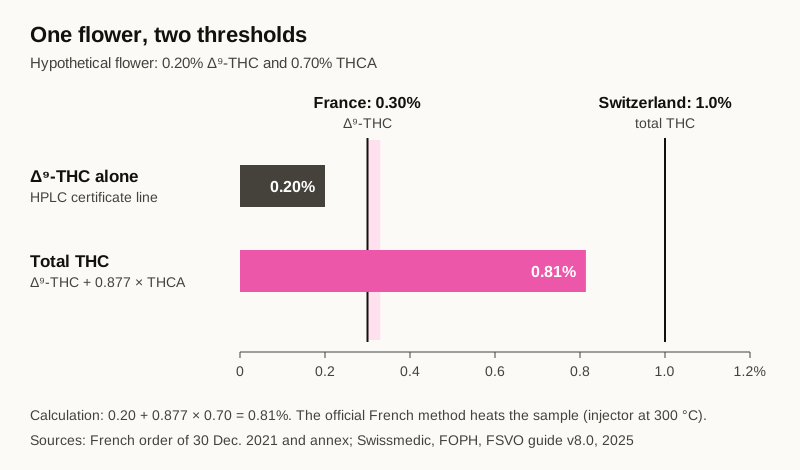
Take a hypothetical flower with 0.20% Δ⁹-THC and 0.70% THCA. Its total THC is 0.20 + 0.877 × 0.70, or 0.81%. In Switzerland it is below 1.0%: it can be sold as a smoking product. In France, its Δ⁹-THC line looks compliant, but the official method, which heats the sample, would put it well above 0.30%, even with the 0.03-point tolerance. On a certificate produced by liquid chromatography (HPLC), read both lines: our guide to reading a certificate of analysis explains how.
Switzerland and France, point by point
| Question | Switzerland | France |
|---|---|---|
| THC threshold | Below 1.0% | 0.30% at most |
| What is measured | Total THC (Δ⁹-THC + converted THCA) | Δ⁹-THC, official method at 300 °C |
| Flowers | Sold as a smoking product since 1 October 2024 | Sold since the annulment of 29 December 2022 |
| CBD foods | Novel food, no authorisation | Withdrawal restated on 20 May 2026 |
| Non-medical use above the threshold | Prohibited | Prohibited (narcotic) |
| Reference text | Enforcement guide v8.0, 1 May 2025 | Order of 30 December 2021 |
On food, the two countries agree. The Swiss guide states that no product with added cannabinoids has been authorised as a novel food. In France, the Ministry of Agriculture restated on 20 May 2026 that foods containing CBD or any other cannabinoid must be withdrawn from the market.
Bringing CBD back from Switzerland: what to check
A product bought in Switzerland must comply with French law as soon as it is in France. Three checks apply:
- The certificate of analysis for the batch: Δ⁹-THC and THCA, to estimate total THC.
- Total THC, which must stay below 0.30%. A Swiss flower sold as "under 1%" tells you nothing more.
- The type of product: a food, an oil sold as a supplement or a CBD gummy is not authorised in France, whatever its content.
Switzerland does not make export easy either. Its enforcement guide states that Swissmedic issues no certificate of no objection for importing or exporting cannabis below 1.0% total THC, because internationally these products fall under the 1961 Single Convention on Narcotic Drugs. To import into Switzerland, you need a batch certificate of analysis from a laboratory accredited to ISO/IEC 17025.
Our articles on flying with CBD and on CBD parcels from abroad cover the rest. Our comparison with the German market shows that the same product can be treated three different ways in three neighbouring countries.
Frequently asked questions
What is the THC limit for CBD in Switzerland?
Below 1.0% total THC, meaning Δ⁹-THC plus converted THCA. Above that, the product falls under Swiss narcotics law, and non-medical use is prohibited.
Is Swiss CBD legal in France?
Only if it complies with French law: an authorised variety and no more than 0.30% Δ⁹-THC, measured with a method that counts almost all the THCA. A Swiss flower between 0.33 and 1.0% total THC does not pass.
Why does Switzerland allow 1% and France 0.3%?
The two thresholds come from different sources. Switzerland, outside the European Union, sets its own in the ordinance on narcotics schedules. France chose 0.30% in its December 2021 order, the figure the EU common agricultural policy has applied to hemp varieties since 2023.
Is CBD a narcotic in Switzerland?
No. The Swiss threshold concerns the total THC of the product, not CBD. A CBD product below 1.0% total THC is not a narcotic in Switzerland.
Written by the Phytogrammes team
Every article in this journal draws on primary sources (ANSM, EFSA, EUR-Lex, peer-reviewed publications) and on the lab's own practice: batch-by-batch HPLC analyses, measured cannabinoid profiles. Our approach.
Article published on . CBD is not a medicine.