CBD in Germany vs France: the flower paradox in 2026
Germany legalised cannabis for adults on 1 April 2024, but CBD has barely benefited: the law still requires hemp sold to rule out any intoxicating use, and the Federal Court of Justice has upheld convictions for selling CBD flowers. France does the opposite. Cannabis remains a narcotic there, but CBD flowers with no more than 0.30% Δ⁹-THC have been sold legally since December 2022. On both sides of the Rhine, CBD in food is banned.
Contents
- 01Two countries, two opposite logics
- 02Germany: cannabis legalised, CBD still restricted
- 03France: no cannabis, but CBD flowers allowed
- 04CBD food, banned on both sides of the Rhine
- 05Strasbourg, Kehl: what a French resident risks crossing the Rhine
- 06What the market figures say
- 07Frequently asked questions
> Key takeaways > > - In Germany, an adult may hold 25 g of cannabis in public, 50 g at home, and grow 3 plants. > - CBD hemp is only free there if any intoxicating use is ruled out: selling flowers to consumers remains a grey zone. > - In France, cannabis is banned but compliant CBD flowers have been legal since the Conseil d'État decision of 29 December 2022. > - Both countries apply the same EU regulation: no CBD in food. > - Bringing cannabis bought legally in Germany into France is still importation of narcotics.
Two countries, two opposite logics
The gap fits in one sentence: Germany legalised cannabis without freeing CBD, France freed CBD without legalising cannabis. The table compares the rules in force in September 2026.
| Point | Germany | France |
|---|---|---|
| Cannabis for adults | Legal since 1 April 2024 | Narcotic, use punished |
| Possession | 25 g in public, 50 g at home | None |
| Home growing | 3 plants per adult, associations since July 2024 | Banned |
| Hemp THC limit | 0.3%, and intoxicating use ruled out | 0.30% in the finished product |
| CBD flowers in shops | Grey zone, convictions upheld in 2022 | Legal since December 2022 |
| CBD in food | Banned (unauthorised novel food) | Banned, checks since May 2026 |
| Cannabis use | Free within the law's limits | 1 year and 3 750 €, or a 500 € fixed fine |
Germany: cannabis legalised, CBD still restricted
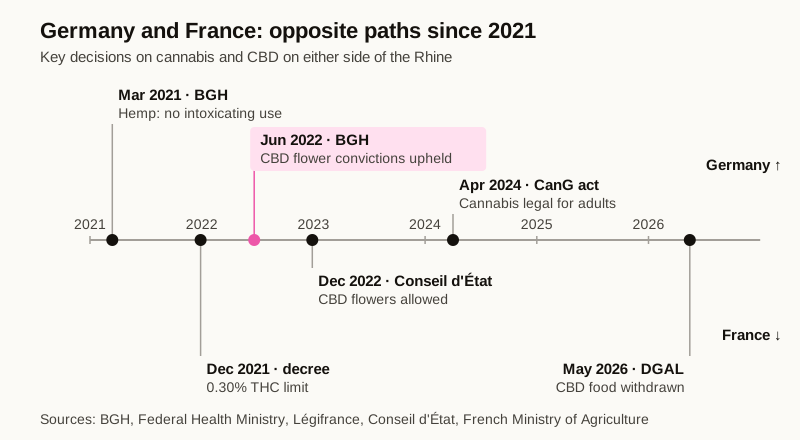
The Cannabis Act, known as CanG, came into force on 1 April 2024. It took cannabis out of Germany's narcotics law and split it between two texts: the KCanG for consumption and the MedCanG for medical use. Under section 3 of the KCanG, an adult may hold 25 g of cannabis in public, and up to 50 g of dried flowers and 3 live plants at home. Non-commercial growing associations have operated since 1 July 2024.
CBD itself is excluded from the definition of cannabis. But the hemp that carries it is still subject to a condition. Section 1 of the KCanG only treats as industrial hemp, free of these rules, hemp that comes from certified varieties or contains no more than 0.3% THC, and whose trade serves "exclusively commercial or scientific purposes" that rule out intoxicating use.
This clause already existed before 2024, and judges apply it strictly. In March 2021, the Federal Court of Justice (BGH) ruled that selling hemp to consumers was not banned in principle, provided any intoxicating use is ruled out. On 23 June 2022, it upheld the convictions of two Berlin resellers of flowers containing 0.2% THC, one of them sentenced to 3 years and 9 months in prison. Its reasoning: when heated, for example in baking, these flowers release extra THC, so intoxicating use cannot be ruled out. The Court also rejected the argument based on free movement of goods in the EU.
Despite calls to remove it, the clause is still in the text in September 2026. In practice, a CBD flower is more legally exposed in Berlin than in Paris.
France: no cannabis, but CBD flowers allowed
France took the opposite path. The decree of 30 December 2021 allows hemp varieties listed in the official catalogues and sets the maximum Δ⁹-THC level in extracts and products at 0.30%. It banned the sale of raw flowers and leaves, but the Conseil d'État struck down this ban on 29 December 2022, noting that CBD has no psychotropic effect. Compliant flowers and resins are therefore sold freely: they make up the CBD flowers and resins, hash and pollens categories of the catalogue. Our article on the decree and how the courts overturned it tells the story.
Cannabis, however, remains a narcotic. Its use is punishable by one year in prison and a 3 750 € fine; since 20 August 2026, the fixed fine that can replace prosecution is 500 €. The 0.30% limit and how it is measured are covered in our article on the legal THC level.
CBD food, banned on both sides of the Rhine
On this point, both countries apply the same text, Regulation (EU) 2015/2283 on novel foods. In Germany, the Federal Office of Consumer Protection and Food Safety (BVL) says it is aware of no case in which CBD in a food would be marketable: it is an unauthorised novel food.
In France, the Ministry of Agriculture stated on 20 May 2026 that foods containing CBD are illegal and must be withdrawn from the market, after a control plan launched on 15 May. Oils to swallow, gummies, drinks and chocolates with CBD have left the shelves, as our article on the withdrawal of CBD gummies explains. Only hemp seeds, their oil and leaves meant for infusion escape the rule.
Strasbourg, Kehl: what a French resident risks crossing the Rhine
The Pont de l'Europe separates two legal systems. Cannabis bought legally from a German association remains a narcotic in France. Bringing it back is importation, which article 222-36 of the Penal Code punishes with 10 years in prison and a 7 500 000 € fine. German associations are in any case reserved for adults whose home or habitual residence is in Germany.
In the other direction, a compliant French CBD flower has no guaranteed status in Germany, for the reasons above. And behind the wheel, a product's legality does not protect you: in France, the Court of Cassation ruled on 21 June 2023 that driving after drug use is an offence whatever the dose detected. Our guide to travelling with CBD covers the rules country by country, and our articles on Switzerland and Belgium complete the map of neighbours.
What the market figures say
Size comparisons between the two markets often circulate without a source. The verifiable figure for France comes from Xerfi, which estimates CBD revenue in France at 600 million euros in 2023. We found no reliable public source ranking European markets against each other; the claim that France is "Europe's second-largest market behind Germany" is not backed up.
The EU drugs agency listed in 2019 the products offered in each country. CBD flowers, resins, e-liquids and crystals were sold in France as well as in Germany, after a spread that began in Austria and Italy. The two markets then diverged under the influence of their judges.
Frequently asked questions
Is CBD legal in Germany?
CBD is not cannabis under German law. But the hemp that contains it is only free if its trade rules out any intoxicating use, and the Federal Court upheld convictions for selling flowers in 2022. CBD foods are banned, as in France.
Can a French resident buy cannabis in Germany?
No, not legally. There are no shops: cannabis is obtained by home growing or through an association reserved for residents. And bringing it back to France is importation of narcotics.
Why are CBD flowers legal in France but not clearly in Germany?
Because the judges did not rule the same way. The Conseil d'État held in 2022 that a general ban was not justified, since CBD has no psychotropic effect. The German Federal Court requires that any intoxicating use be ruled out, which it found impossible for flowers.
Can you still buy CBD to drink or eat in France?
No. Since May 2026, CBD foods and supplements have been withdrawn from sale for lack of EU authorisation. CBD flowers, resins and cosmetics remain on sale.
Do German cannabis rules apply in France?
No. Each country applies its own criminal law. Only the EU novel food regulation is shared, and it bans CBD food in both countries.
Written by the Phytogrammes team
Every article in this journal draws on primary sources (ANSM, EFSA, EUR-Lex, peer-reviewed publications) and on the lab's own practice: batch-by-batch HPLC analyses, measured cannabinoid profiles. Our approach.
Article published on . CBD is not a medicine.