Flying with CBD: France, Europe and outside the EU
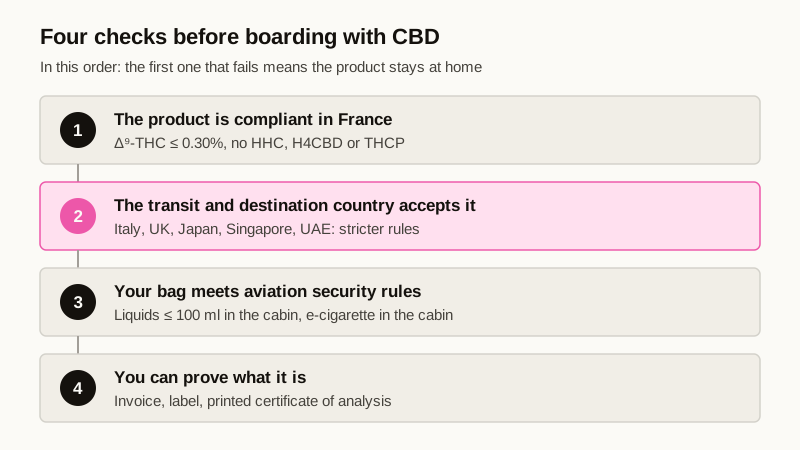
On a domestic flight in France, you can carry a compliant CBD product, meaning one whose finished product contains no more than 0.30% Δ⁹-THC, as long as cabin liquids follow the 100 ml rule. Abroad, the law of the transit and destination country decides, and it is often stricter: Italy has banned products made from hemp flowers since 2025, Japan sets THC limits in ppm, and Singapore and the UAE tolerate nothing.
Contents
> Key takeaways > > - In France, compliant CBD can be carried freely, by plane, train or car. > - In the cabin, oils, creams and e-liquids follow the 100 ml per container rule, in a one-litre bag. > - The law that applies is that of the country you are in, stopovers included. > - Italy, the UK, Japan, South Korea, Singapore, the UAE and Saudi Arabia are stricter than France, sometimes far stricter. > - Keep the invoice, the label and the batch certificate of analysis, on paper.
In France: what you can carry
A compliant CBD product can be held and carried freely in France, by plane, train or car. The rule is set by the decree of 30 December 2021, which caps Δ⁹-THC at 0.30% in varieties, extracts and products. The Conseil d'État struck down on 29 December 2022 the ban on selling raw flowers and leaves, so a compliant flower or resin travels just like an oil. Our article on the legal THC level explains this limit.
Two caveats. First, the product must not contain any cannabinoid classified as a narcotic: the ANSM listed HHC from 13 June 2023, then H4CBD, THCP and other derivatives from 3 June 2024. Second, CBD products meant to be swallowed, gummies, capsules or oils sold as supplements, have been off sale since May 2026, as our article on the withdrawal of CBD gummies explains.
Security screening looks for dangerous items, not CBD. A flower in a bag can still smell like cannabis and lengthen a check. An oil or a cosmetic raises fewer questions.
The 100 ml rule in the cabin
In the cabin, each liquid must fit in a container of 100 ml or less, and all of them in a single resealable transparent bag of one litre, about 20 × 20 cm. The rule covers liquids, gels, pastes and aerosols, so CBD oils, creams, soft balms and e-liquids. A 10 ml or 30 ml bottle goes through easily. Exceptions exist for prescribed medicines.
An e-cigarette, on the other hand, must travel in the cabin: service-public.fr lists it among items banned from the hold. In the hold, oils and creams have no volume limit; a sturdy, well-closed container avoids leaks.
Within the EU: one market, different laws
The absence of systematic border checks in the Schengen area does not make your product legal everywhere. You remain subject to the law of the country you are in, including during a stopover. Three neighbours show the gaps.
Italy has become the riskiest destination. Article 18 of decree-law 48/2025, converted by law 80/2025, bans importing, selling, transporting and consuming products made from hemp flowers, including extracts, resins and oils. The Constitutional Court is due to examine the text at its hearing of 21 October 2026. Until then, leave your flowers and hash in France; our article on CBD flowers in Italy traces the litigation.
Germany legalised cannabis for adults in April 2024. Its law excludes CBD from the definition of cannabis, but section 1 of the KCanG limits so-called industrial hemp to commercial or scientific uses that rule out any use for intoxication. Our comparison of CBD in Germany and France details these rules.
Switzerland, inside Schengen but outside the EU, only classifies hemp as a narcotic from 1% THC. A Swiss product between 0.30 and 1% is legal there but not in France: do not bring it back. See our article on Switzerland and France, and the one on Spain if you are heading south.
Outside the EU: check every country, stopovers included
Outside Europe, the gaps are wider and the penalties heavier. The table sums up what each country's official sources say, as checked on 22 September 2026.
| Country | What the rule says | Source |
|---|---|---|
| United Kingdom | "Exempt product" only if it meets three conditions, including no more than 1 mg of each controlled cannabinoid per container | Home Office |
| United States | Security officers do not search for drugs but refer any illegal substance to police; new federal hemp definition planned for late 2026 | TSA, Congress |
| Japan | CBD allowed under THC limits since 12 December 2024: 10 ppm for oils, 0.1 ppm for drinks, 1 ppm for other products | Ministry of Health |
| South Korea | No CBD oil or hemp product, even in transit, without written approval | US Embassy |
| Singapore | Cannabis and derivatives are Class A, an offence "even in trace amounts" | CNB |
| United Arab Emirates | CBD oil in cosmetics or vape refills confiscated, possible charges | UK government |
In the United States, the agriculture appropriations law signed on 12 November 2025 now counts THCA within the 0.3% limit and caps finished products at 0.4 mg of total THC per container. It was set to take effect on 12 November 2026. A delay is being discussed, so check the date before you leave. In Saudi Arabia there is zero tolerance for drugs, and official travel advice makes no exception for CBD.
If a country on your route bans CBD, the safest rule is to carry nothing. A seizure can end with the product destroyed or go as far as prosecution. If you are arrested, ask to contact the French consulate. To ship by parcel rather than carry in your luggage, see our article on customs and CBD parcels.
On arrival: do not drive after use
If you rent a car on arrival in France, a legal product can be enough to make a saliva test positive for THC. France's Court of Cassation ruled on 21 June 2023 that the offence of driving after drug use is established as soon as a test reveals it, whatever the dose. Since the law of 9 July 2025, article L235-1 of the Highway Code punishes it with 3 years in prison and a 9 000 € fine. Our guide to CBD and drug tests gives detection windows.
Travelling with a cannabinoid-based treatment
A prescribed treatment follows different rules from CBD sold in shops. For a medicine classified as a narcotic, such as medical cannabis containing THC, you need a certificate. Within the Schengen area it is issued by the regional health agency of the prescribing doctor. Outside Schengen, the ANSM issues a transport certificate, to be requested at least 10 days before departure, for no more than 28 days of treatment. Our overview of medical cannabis in France describes this framework.
Epidyolex, the only authorised cannabidiol medicine, is not a narcotic. Still take the prescription, ideally written with the name of the molecule, and ask the destination country's embassy: some countries also control CBD medicines.
Frequently asked questions
Can you take CBD through airport security?
Yes, for a flight within France, if the product is compliant and liquids follow the 100 ml rule. Security screening looks for dangerous items. For a flight abroad, what counts is the law of the destination and stopover countries.
Can you take CBD flowers on a plane?
In France, yes: a flower with no more than 0.30% Δ⁹-THC is legal. Avoid them for Italy, which has banned products made from the flower since 2025, and for non-EU countries that ban cannabis in all its forms. Their smell can also lengthen a check.
Is a certificate of analysis required to travel?
No rule requires it. It is still the most useful proof during a check, along with the invoice and the label. Our guide to reading a certificate of analysis lists the lines to check, and our laboratory page describes the measurement methods.
Can you bring back CBD bought in Switzerland?
Only if it meets the French limit of 0.30% Δ⁹-THC. Switzerland tolerates up to 1%, but French law applies as soon as you cross the border.
Is there an official list of countries that ban CBD?
No. There is no single list, and rules change fast, as in Italy in 2025 or Japan in 2024. Check the country's official page, or travel advice, before every trip.
Written by the Phytogrammes team
Every article in this journal draws on primary sources (ANSM, EFSA, EUR-Lex, peer-reviewed publications) and on the lab's own practice: batch-by-batch HPLC analyses, measured cannabinoid profiles. Our approach.
Article published on . CBD is not a medicine.