CBD flowers in Italy: the 2025 ban before the EU Court
In Italy, selling, transporting and importing hemp flowers has been banned since April 2025, under Article 18 of Decree-Law No. 48 of 11 April 2025. The ban is being challenged before three courts: the Court of Justice of the European Union (case C-716/25), the Italian Constitutional Court, which hears it on 21 October 2026, and the Court of Cassation. In France, nothing changes: flowers remain on open sale below 0.30% THC.
Contents
> Key takeaways > > - Article 18 of Decree-Law 48/2025, converted by Law No. 80 of 9 June 2025, bans hemp flowers and their extracts, resins and oils in Italy. > - On 11 November 2025, the Italian Council of State asked the CJEU whether this kind of ban is compatible with the common agricultural policy and free movement. > - Since 2019, the Italian Court of Cassation only punishes sales if the product has a real narcotic effect; a 2026 ruling applies that test to the 2025 decree. > - In France, the Council of State struck down the flower ban on 29 December 2022; taking flowers into Italy remains risky.
What Article 18 of the "security decree" provides
Decree-Law No. 48 of 11 April 2025, known as the "security decree", was converted with amendments by Law No. 80 of 9 June 2025. Its Article 18 removes from the scope of the hemp law any product made of inflorescences, even semi-processed, dried or shredded, along with the extracts, resins and oils derived from them. These products now fall under the consolidated drugs law, Presidential Decree No. 309 of 1990.
The text bans their processing, distribution, trade, transport, sending, delivery and import. That is the summary given by the Italian Council of State in its note of 1 December 2025. According to the same note, growing authorised varieties remains lawful for leaves and seeds.
Before 2025: a farming law and a 2019 ruling
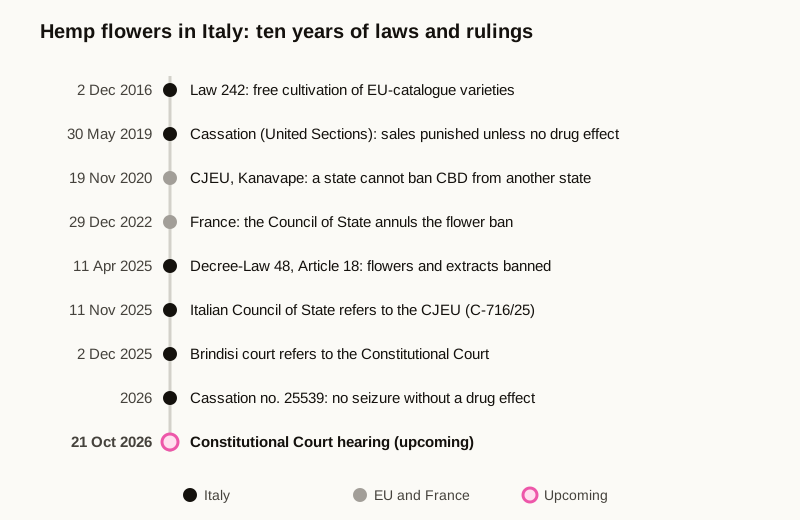
Law No. 242 of 2 December 2016 freed the cultivation of hemp varieties listed in the EU catalogue, with no prior authorisation. It sets a THC level of 0.2% in the crop, with a tolerance up to 0.6% that clears the farmer of liability. It said nothing about selling flowers, and "cannabis light" shops opened in that gap.
The United Sections of the Court of Cassation settled the question on 30 May 2019, in ruling No. 30475 published on 10 July 2019. According to the Council of State's summary, selling leaves, inflorescences, oil or resin to the public remains an offence under Article 73 of the drugs law, even below the thresholds of the 2016 law. One exception: products that are, in practice, devoid of any narcotic or psychotropic effect. The farming threshold therefore does not protect the seller; only the real effect of the product sold counts.
The referral to the CJEU: case C-716/25
The dispute began with an order of the Agriculture Ministry of 21 January 2022 on medicinal plants. It kept only hemp seeds under the free regime and sent leaves and flowers to the drugs regime. The Lazio regional administrative court annulled it; the ministries appealed.
By an order of 11 November 2025, No. 8813, the sixth section of the Council of State put two questions to the Court of Justice of the European Union:
- Does the common agricultural policy (Article 38 of the Treaty, Directive 2002/53/EC on the variety catalogue, the direct payments regulations) preclude a rule that bans using the leaves, flowers, oil and resin of authorised varieties, whatever their THC level?
- Do Articles 34 to 36 of the Treaty on the free movement of goods, together with the EU food and cosmetics regulations, preclude a ban on producing and selling these parts of the plant and their derivatives, including CBD?
The questions concern Italian law as it stood until 11 April 2025, as interpreted by the Court of Cassation. The answer from Luxembourg will still show how far a state can go against hemp listed in the EU catalogue. The case is registered as C-716/25, Società Agricola Jure; no judgment had been delivered when this article was last updated.
The precedent is well known. In the Kanavape judgment of 19 November 2020, the CJEU ruled that a member state cannot ban the sale of CBD lawfully produced in another member state and extracted from the whole plant, unless the ban is suitable for protecting public health and does not go beyond what is necessary. It also noted that CBD is not a narcotic drug under the 1961 UN convention. Our article on the Kanavape ruling details its effects in France.
Italian judges are already reining in Article 18
The Constitutional Court. On 2 December 2025, the preliminary investigations judge in Brindisi referred Article 18 to the Constitutional Court. According to the Court's case sheet, the case is entered in the register as No. 26 of 2026 and the hearing is set for 21 October 2026. The judge relies in particular on Article 77 of the Constitution, which reserves decree-laws for cases of necessity and urgency, and on Articles 34 and 36 of the Treaty.
The Court of Cassation. In 2026, the fourth criminal section applied the 2019 test to the 2025 decree. In ruling No. 25539, reported by the journal Fuoriluogo, it overturned a refusal to return products seized in Modena in December 2025. The prosecution's own expert report found them to have no narcotic effect. According to the Court, one cannot both find that effect absent and keep the goods as a narcotic.
Italy and France: two opposite approaches
| Point | France | Italy |
|---|---|---|
| THC threshold | 0.30% Δ⁹-THC in the plant and the finished product | 0.2% in the crop, tolerance up to 0.6% for the farmer |
| Sale of flowers | Allowed since the Council of State decision of 29 December 2022 | Banned by Article 18 since April 2025 |
| Criminal test | THC level of the product | Real narcotic effect of the product (Cassation, 2019 and 2026) |
| Pending proceedings | None on flowers | CJEU (C-716/25), Constitutional Court (21 October 2026) |
France had its own ban: the order of 30 December 2021 prohibited the sale of raw flowers, and the Council of State struck it down on 29 December 2022. Our article on the CBD flower ban tells that story, and the one on the legal THC level explains the 0.30% threshold.
What this means for you
In France, nothing: CBD flowers remain on open sale if their Δ⁹-THC does not exceed 0.30%. A CJEU ruling on Italy would not change that threshold.
When travelling, be careful. Article 18 covers the transport and import of flowers. Taking flowers bought in France into Italy exposes you to Italian law, whatever their THC level. See our guide to flying with CBD and the one on CBD parcels from abroad.
In neighbouring countries, each keeps its own rules: Switzerland tolerates 1% THC, while Germany and Spain apply their own frameworks.
Frequently asked questions
Are CBD flowers banned in Italy?
Yes, since April 2025. Article 18 of Decree-Law No. 48 bans the sale, transport and import of hemp inflorescences and their extracts. The Court of Cassation still requires a real narcotic effect for a conviction.
Has the CJEU ruled yet?
No. Case C-716/25, referred by the Italian Council of State on 11 November 2025, is pending. The 2020 Kanavape judgment sets the test: a ban must be justified by public health and proportionate.
Can I take CBD flowers to Italy?
It is not advisable. The 2025 decree bans the import and transport of hemp flowers. A THC level that complies with French law does not protect you in Italy.
Would an EU ruling change French law?
No. France already allows the sale of flowers below 0.30% THC. A CJEU ruling on Italy would mainly clarify what other states may ban.
Written by the Phytogrammes team
Every article in this journal draws on primary sources (ANSM, EFSA, EUR-Lex, peer-reviewed publications) and on the lab's own practice: batch-by-batch HPLC analyses, measured cannabinoid profiles. Our approach.
Article published on . CBD is not a medicine.