How to dry hash: the 65% threshold and the jar test
Only hash made with ice water (ice-o-lator, bubble hash) comes out wet and really needs drying: dry sift, pollen and rosin start from material that is already dry. Dry it crumbled in a thin layer, in a cool, dark, ventilated room, with no heat source. It is dry when, sealed in a jar with a hygrometer, the air in the jar stays below 65% relative humidity, the level above which mould can grow.
Contents
> Key takeaways > > - Only resins separated with ice water need real drying; other extracts are stored, not dried. > - The ASTM D8197 standard sets a water activity of 0.55 to 0.65 for dried flower: above that, there is a risk of mould. > - In a sealed jar, the humidity shown on the hygrometer once it settles gives that water activity: 65% equals 0.65. > - Heat speeds up the breakdown of THC into CBN and drives off terpenes: no oven, radiator or microwave.
Which extracts actually need drying?
"Drying" covers very different situations. Everything depends on how the resin was separated from the plant. An ice water method leaves a waterlogged paste; a dry method starts from flower that is already dried and adds no water.
| Extract | State when made | What to do |
|---|---|---|
| Ice-o-lator, bubble hash | Wet paste, separated with ice water | Full drying, then storage |
| Dry sift, static, pollen | Dry powder, sieved dry | No drying, dry storage |
| Rosin | Oil pressed with heat from dry material | No drying, cold storage |
| Pressed or cured hash | Block that is already dry | Curing in a closed container, no drying |
The most common mix-up concerns rosin. It is not "dried" for weeks: it is pressed from hash or flower that is already dry, and what is sometimes called its curing happens in the cold, in a closed container. Our article on storing rosin, wax and crumble covers this. The rest of this article is therefore about ice water hash, the only kind with a real water problem.
The target: water activity below 0.65
You cannot judge a product's moisture well by touch. Laboratories use water activity, written aw: the share of "free" water that microorganisms can use. The US Food and Drug Administration defines it as a ratio of vapour pressures: that of the product in balance with the surrounding air, divided by that of pure water. It runs from 0 (bone dry) to 1 (pure water).
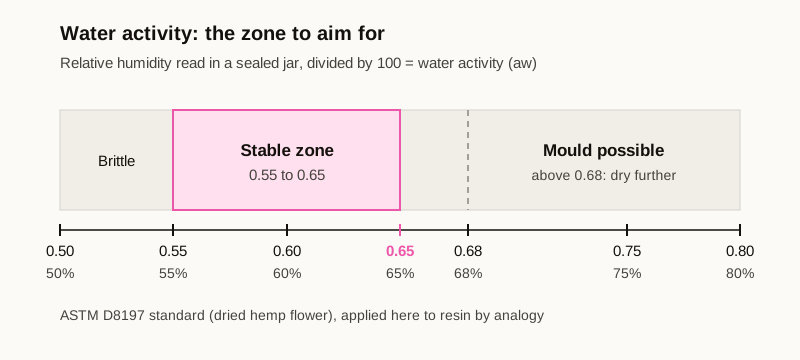
For hemp, the reference is the ASTM D8197 standard, written for dried flower. It sets a water activity between 0.55 and 0.65. Below 0.65, mould struggles to grow. Above 0.55, the flower does not crumble when handled. Beyond 0.68, the standard calls for further drying. We have not found an equivalent standard for hash: we apply these benchmarks by analogy, since resin is also plant material rich in trichomes.
Step-by-step method for ice water hash
- Press out the water. Squeeze the resin gently in the filter bag, then on paper towel, to remove the water that runs off.
- Crumble it. The finer the grains, the faster and more evenly the water evaporates. A compact ball dries on the surface and keeps a wet core.
- Spread it in a thin layer on baking paper or a glass plate, without piling it up.
- Put everything in a cool, dark room, with air that moves without blowing straight onto the resin. A fan aimed at it scatters the powder and dries the surface too fast.
- Stir and crumble again once or twice a day, until the grains stop sticking together.
- Do the jar test, described below, before any storage.
The time depends on thickness, grain size and the humidity of the room. It is counted in days, not hours. Rather than follow a calendar, rely on the jar test. Professionals often use a freeze dryer, which removes water under vacuum and at low temperature. On flowers, a 2024 study showed that freeze drying preserves acidic cannabinoids better than tray drying, but loses more of the volatile compounds that carry the aroma.
If you make your own resin, our guide to homemade hash describes both extraction methods, dry and with ice water.
Heat, time, moisture: what damages resin
Heat is the most common mistake, because it seems faster. It does two things. It drives off terpenes, which are volatile molecules. It also speeds up the transformation of cannabinoids. A stability study published in 2026 by the University of Mississippi followed flowers, extracts and isolates at room temperature, in the fridge and in the freezer: at room temperature, THC broke down into CBN, while CBD-only products stayed stable. The freezer at -20 °C preserved everything best.
Time works the same way. On 150 resins seized in Morocco and stored for up to eight years, researchers measured THC falling from 35% to under 3% after two years, with a rise in CBN. These were THC-rich resins, but the oxidation process is the same for the residual THC in a hemp resin.
Moisture, finally, encourages mould. An Israeli team compared controlled-atmosphere drying chambers with traditional drying of flowers: traditionally dried flowers were heavily infested with Alternaria alternata, with a lower presence of Botrytis cinerea. A wet, compact, poorly ventilated resin offers the same conditions to these fungi.
The jar test: knowing when it is dry
The principle follows from the definition of water activity. In a closed container, the product and the air end up in balance, and the relative humidity of the air, divided by 100, equals the product's water activity. The ASTM standard also reasons in terms of the air in the container.
- Put a sample of resin in a small glass jar, filled to about two thirds.
- Add a small digital hygrometer and close it.
- Wait at least 24 hours, out of the light and at a steady temperature.
- Read the value. Above 65%, put the resin back to dry. Between 55 and 65%, it can be stored. Below 55%, it is very dry: it keeps, but crumbles more.
Check the hygrometer before use, because cheap models can drift by several points. The salt test is enough: a spoonful of moistened table salt, sealed with the device for 24 hours, holds the air at about 75% relative humidity. And do the test at room temperature, because water activity varies with it. If the resin smells musty or shows white or greyish fuzz, do not use it: our article on mould shows how to recognise it.
Storing resin once it is dry
Once below 65%, store the resin in a closed glass jar, away from light. On flowers, the 2024 study cited above found that a glass jar kept aromas better than a plastic box or an open tray. For long storage, cold slows breakdown: fridge, or freezer for the most fragile ice water hashes, letting the jar come back to room temperature before opening it to avoid condensation.
A resin that ends up a little too hard or too soft after drying is not lost: our article on tempering hash explains how to soften it without heating it. The resins in our CBD hash range are sold already dry.
Legally, a hemp resin can only be sold in France if its Δ⁹-THC content does not exceed 0.30%, a threshold set by the order of 30 December 2021. The Conseil d'État annulled on 29 December 2022 the ban on raw flowers and leaves that the order contained. Our article on whether CBD hash is legal goes through these three texts.
Frequently asked questions
Do dry sift or pollen need drying?
No. They are sieved dry from flowers that are already dried and contain no added water. Just keep them dry, in a closed jar, away from light.
Can I speed up drying in the oven or microwave?
No. Heat drives off terpenes and speeds up the conversion of THC into CBN. It can also decarboxylate part of the acidic cannabinoids. Slow drying somewhere cool remains the safe method.
Is a dehumidifier useful?
Yes, in a damp room, as long as the air does not get too dry. Resin exposed to very dry air dries fast on the surface and can keep a wet core. Aim for a room at around 55 to 60% humidity and check with the jar.
How long does ice water hash take to dry?
Several days in general, longer for a thick layer or a damp room. The right indicator is not time but the jar test: a steady reading below 65% after 24 hours.
How can I tell if resin has gone mouldy?
A musty or cellar smell, white or grey fuzz, powdery spots that do not look like trichomes are warning signs. If in doubt, do not use the product.
Written by the Phytogrammes team
Every article in this journal draws on primary sources (ANSM, EFSA, EUR-Lex, peer-reviewed publications) and on the lab's own practice: batch-by-batch HPLC analyses, measured cannabinoid profiles. Our approach.
Article published on . CBD is not a medicine.