Strain hunter: the job of hunting cannabis landraces
A strain hunter travels to collect the seeds of landraces: local cannabis populations selected by generations of growers in one specific region. The goal is to preserve a genetic diversity that commercial hybridisation is erasing. The job is more botany than adventure, and the law governs every seed brought back.
Contents
> Key takeaways > > - A landrace is a population grown for generations in one region, without crossing with modern hybrids. > - A 2020 study based on about 1,100 herbarium specimens considers the landraces of Central and South Asia threatened with extinction through hybridisation. > - An analysis of 110 genomes places the domestication of cannabis in East Asia, in the early Neolithic. > - Collecting seeds abroad requires the consent of the country of origin, under the Nagoya Protocol adopted in 2010. > - In France, only varieties listed in the catalogue, with no more than 0.30% Δ⁹-THC, may be grown.
What a strain hunter does
A strain is a variety in the commercial sense, and a hunter goes looking for it. The term caught on with Strain Hunters, a documentary series produced by a Dutch seed company that filmed its own expeditions. The image of adventure it spread hides slower work.
In the field, the strain hunter meets local growers, records growing conditions and climate, observes the plants in flower and collects seeds. Back home, they sow them, select the most stable plants and keep part of the batch. Some then cross these lines with existing varieties. Others only try to keep them intact.
The job remains marginal. It is done by a small number of breeders, often linked to seed companies, and by researchers working for genetic resource collections.
Landrace: the hunter's target
A landrace is a traditional population specific to one region, shaped by growers' selection over centuries. It contrasts with the modern strain, the product of directed crosses. The distinction matters: a landrace is not a wild plant, it is a cultivated plant that stayed local.
The most cited classification comes from two botanists, John McPartland and Ernest Small. In a study published in 2020 in PhytoKeys, they examined about 1,100 herbarium specimens held in 15 herbaria. They distinguish two broad types of drug cannabis: the "Sativa" type, from South Asia (India), and the "Indica" type, from Central Asia (Afghanistan, Pakistan, Turkestan). Our article on indica and sativa explains why these words took on a very different commercial meaning.
Several famous varieties descend from landraces. Haze, for example, was put together from populations from Mexico, Colombia, South India and Thailand: our article on the Haze family traces its history.
Why these varieties are disappearing
The problem has a name: introgression, meaning foreign genes entering a local population. McPartland and Small write that the landraces of Central and South Asia are threatened with extinction through hybridisation. They give a precise example: by around 1980, Afghan landraces had been brought into southern Kashmir, and escaped plants were growing near the crops. Their conclusion is blunt: collecting and conserving these populations in their regions of origin is urgent, and banking their seeds is an immediate priority.
Genetics confirms the value of this reservoir. An international team, led in part from the University of Lausanne, sequenced the full genome of 110 cannabis plants from around the world, in a study published in 2021 in Science Advances. According to its results, cannabis was domesticated in East Asia in the early Neolithic. All current varieties, fibre and drug types alike, come from an ancient gene pool now represented by feral plants and landraces in China. Our article on the history of hemp in Europe takes over for the recent period.
Bringing seeds back: what the law says
Seeds hold a special place in international law. Article 1 of the Single Convention on Narcotic Drugs of 1961 defines cannabis as the flowering or fruiting tops of the plant, "excluding the seeds". That exclusion does not make transport free: each country sets its own rules on exporting seeds, which are often restrictive.
Biodiversity law adds another layer. The Nagoya Protocol, adopted on 29 October 2010, sets a simple principle: whoever uses a genetic resource must obtain the prior consent of the country where it is found, and negotiate terms of use with it, including benefit sharing. A landrace collected without that agreement is therefore a legal problem, even when the seed itself is not a narcotic.
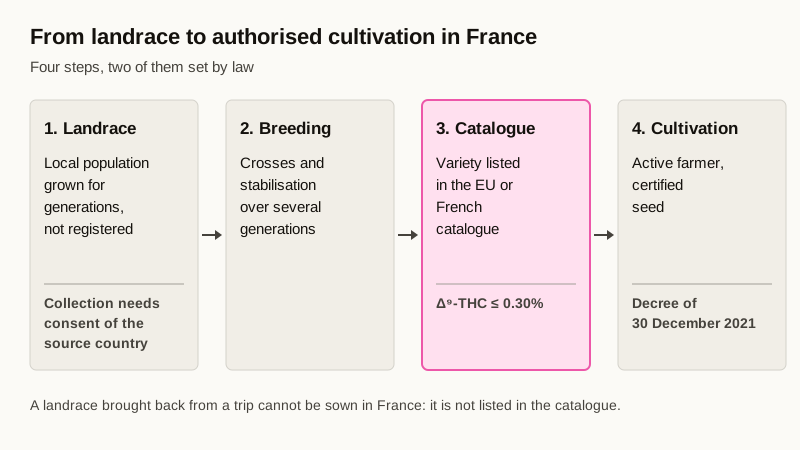
In France, sowing is a different act. The decree of 30 December 2021 only allows Cannabis sativa L. varieties listed in the EU common catalogue or the French official catalogue, with no more than 0.30% Δ⁹-THC. It reserves the cultivation of flowers and leaves for active farmers, using certified seed. A landrace brought back from a trip meets none of these conditions. Our article on CBD seeds sets out what an individual can buy, and what they cannot sow.
From landrace to the CBD hemp grown in France
The CBD hemp grown in France does not come directly from imported landraces. It relies on catalogue-listed varieties, selected for a stable composition and controlled THC. The European Commission counted 116 hemp varieties in the common catalogue in 2024. Our guide to the EU variety catalogue explains how to consult it.
The link with landraces is indirect. Breeding programmes draw on the available genetic diversity, and the collections kept in seed banks are part of it. The Lausanne study also found that selection for fibre or for psychoactive effect switched off some cannabinoid synthesis genes: each direction left part of the original heritage behind.
On a label, a variety name often keeps the trace of an origin. Durban is a city in South Africa, and Afghanistan is among the homelands of the Indica type. Our Durban Poison flower and our Afghan resin are nonetheless hemp products with no more than 0.30% Δ⁹-THC, not the original populations. The name tells a story; only an analysis tells you what a batch contains. Our guide to the certificate of analysis explains how to read one, and all our CBD flowers show their Δ⁹-THC ceiling.
Frequently asked questions
What is a strain hunter?
A breeder who travels to collect the seeds of landraces, local cannabis populations grown for generations in one region. They document them, preserve them and sometimes cross them with other varieties.
Can you legally bring back seeds found abroad?
Rarely without formalities. The 1961 Convention excludes seeds from the definition of cannabis, but each country sets its own export rules, and the Nagoya Protocol requires the consent of the country of origin to use a genetic resource. In France, a seed that is not in the catalogue cannot be sown.
Are landraces used in French CBD hemp?
Not directly. Hemp grown in France relies on catalogue-listed varieties below 0.30% Δ⁹-THC. Genes from landraces may enter breeding programmes further upstream.
What is the difference between a landrace and a commercial variety?
A landrace is a local population, shaped by generations of growers in a single environment. A commercial variety comes from crosses aimed at a precise goal: yield, stability, composition.
Why are landraces disappearing?
Because modern varieties are brought in near local crops and cross with them. A 2020 study considers the landraces of Central and South Asia threatened with extinction through this hybridisation, and calls for them to be kept in seed banks.
Written by the Phytogrammes team
Every article in this journal draws on primary sources (ANSM, EFSA, EUR-Lex, peer-reviewed publications) and on the lab's own practice: batch-by-batch HPLC analyses, measured cannabinoid profiles. Our approach.
Article published on . CBD is not a medicine.