Afghan hash: traditional production, history and the CBD version
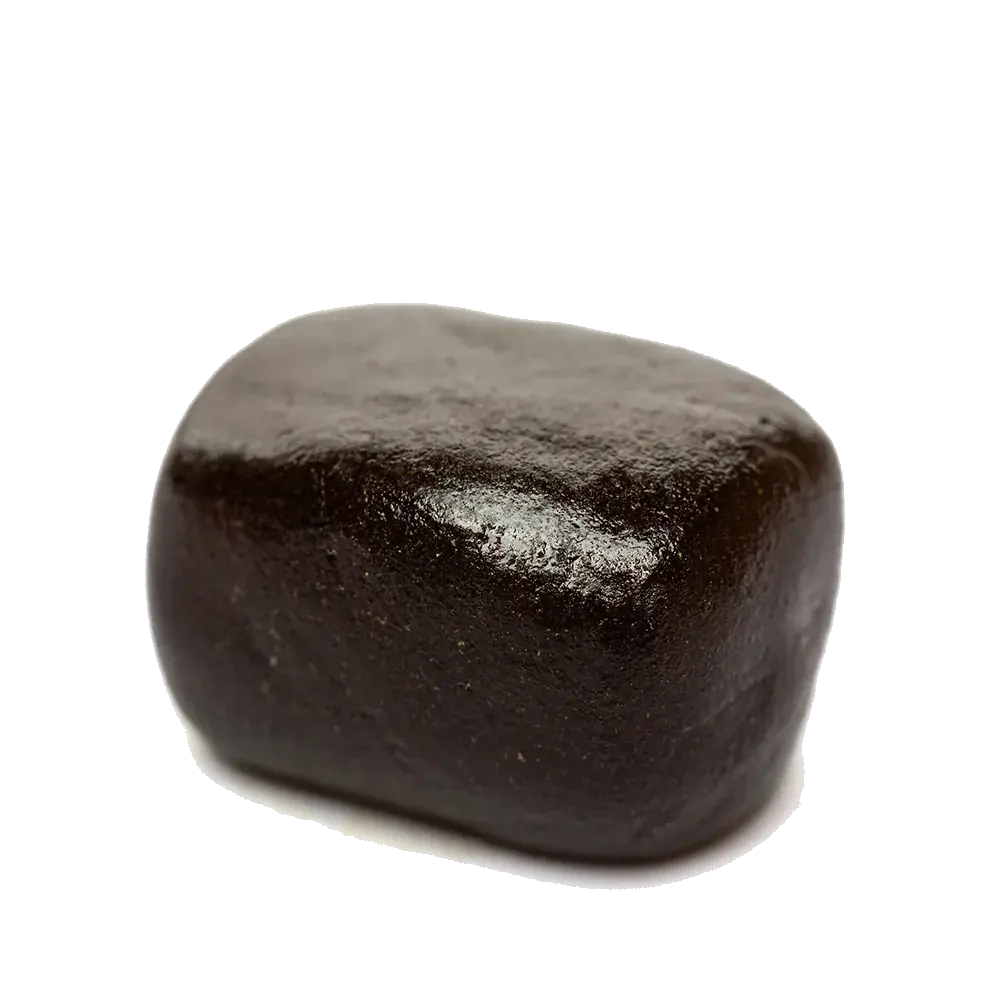
Traditional Afghan hash is made by beating and sieving dried cannabis plants, then kneading the resulting powder with heat. Because it comes from THC-rich cannabis, it is a narcotic in France. On a CBD resin, the word "Afghan" refers to a style of production and appearance, and says nothing about origin.
- 01How is traditional Afghan hash made?
- 02How does the powder become hash?
- 03Afghan hash and charas: what is the difference?
- 04Why does Afghanistan matter in the history of "indica"?
- 05Where does Afghan production stand since 2009?
- 06What does "Afghan" mean on a CBD hash sold in France?
- 07How do you read the analysis of an Afghan CBD hash?
- 08What are the risks of street Afghan hash?
- 09Frequently asked questions
The first systematic survey of Afghan cannabis covers the year 2009. Carried out by UNODC with the Afghan government, it put resin powder production at between 1,500 and 3,500 tonnes. At that level, Afghanistan was the world's largest producer of cannabis resin (UNODC, Afghanistan Cannabis Survey 2009, 2010).
This article is documentary: the illicit practices it describes serve to explain a vocabulary, and it gives no instructions.
Key takeaways
- Garda is the name for the powder taken from dried plants that are beaten, then sieved; its grade follows the order of the sievings.
- Kneaded with heat, by hand or by machine, this powder becomes hash.
- Western breeders only took an interest in the cannabis of Afghanistan, called "Indica" in everyday language, in the early 1970s.
- In France, an "Afghan" resin is legal only if it comes from authorised hemp and does not exceed 0.30% Δ⁹-THC.
How is traditional Afghan hash made?
According to the 2009 survey, Afghan cannabis is sown from April to June and harvested from October to January. The cut plants dry first in the field, then under cover, on the farm.
It takes at least two people. They beat the dry plants against a drum to detach the tops, set the stems aside and remove the seeds. The material is then passed over a cloth stretched on a sloping wooden frame.
The powder is shaken for about five minutes in a cloth bag, which knocks out the dust. The sieving is repeated three times, and a last small quantity is beaten by hand in a fabric pouch.
Locally, this product is called garda. The first pass, the gentlest, gives first garda: the richest in resin, and the most expensive. For UNODC, the following grades very probably contain a large share of plant matter.
| Grade | Average yield recorded in 2009 | What the survey says |
|---|---|---|
| First garda | 68 kg/ha | Highest proportion of resin, highest price |
| Second garda | 46 kg/ha | More plant matter |
| Third garda | 30 kg/ha | Lowest of the three usual grades |
| Total | 145 kg/ha | Average weighted by area |
Garda from the north, called Jooshi or Balkhi, has a good reputation. According to the survey, 25 kg of ordinary first garda yield only about 14 kg of it.
At 145 kg/ha, Afghanistan is far ahead of Morocco, where about 36 kg/ha had been measured in 2004 and 2005. UNODC points out, however, that the measurement methods differ, which limits the comparison. On the hemp market, this unpressed powder corresponds to what is called pollen, presented in the CBD pollen guide.
How does the powder become hash?
At this stage, garda is not yet hash. Most growers sell it as powder, and it is usually traders who process it. The survey describes three methods.
The traditional method uses Jooshi garda. One grower holds a handful of powder in the hollow of the hand and lights a match, while a second lets the powder fall like rain above the flame. After several passes over the heat, the material becomes supple, sticky and solid. It is pressed and rolled by hand into a greenish-brown product, Jooshi hash, also called Balkhi or "Mazar milk".
In the south, a small quantity of powder is pressed between the palms. A resin-rich first garda sticks together on its own; for lower grades, a little water is added. The mass is warmed over a small flame, rubbed again, and the process is repeated several times.
The third method uses a machine. These machines, which come from Pakistan, knead the powder with an auger, and the friction heats it. The dark brown paste is then rolled out in a wooden mould, which gives blocks made for storage and sale. According to accounts gathered by UNODC, only traders use these machines.
For UNODC, one kilo of garda gives one kilo of hash, even though the added water makes the lower grades heavier. Before processing, garda keeps for three to ten months in bags of leather or goatskin, the gharak. The survey measured no THC content, so the potency of the gardas is unknown.
Afghan hash and charas: what is the difference?
UNODC notes that in Afghanistan hash is commonly called "charas". In the Indian subcontinent, the word means something else: fresh tops, still on the plant, rubbed by hand.
Researchers Pierre-Arnaud Chouvy and Kenza Afsahi place this hand rubbing in India, Kashmir included, and in Nepal (Chouvy and Afsahi, International Journal of Drug Policy, 2014). Drawing on ethnobotanist Robert Clarke, they compare yields: a few hours are enough to obtain a kilo of sieved resin, whereas one person rubs 10 to 25 grams of resin a day.
The charas entry in the lexicon describes this gesture. Afghan hash, like that of the Rif, comes from dry sieving. What separates them is the shaping: in Morocco, the powder is pressed into a slab; in Afghanistan, garda is kneaded with heat. Moroccan hash and Rif sieving describes the Moroccan method, and Lebanese hash the tradition of the Bekaa, where the resin is also sieved, then pressed.
Why does Afghanistan matter in the history of "indica"?
According to a classification published in 2020, the so-called "Indica" type originates in Central Asia, namely Afghanistan, Pakistan and Turkestan (McPartland and Small, PhytoKeys, 2020). Its authors call it Cannabis sativa subsp. indica var. afghanica.
Their old herbarium specimens come from Afghanistan, north-western Pakistan, Turkestan and Iran. These plants were grown for sieved hash, sometimes also for the oil of their seeds. Western breeders only took an interest in them in the early 1970s.
They have since been crossed haphazardly with South Asian lines, and most of the differences have disappeared, according to the authors. The "strains" sold as indica are most often hybrids whose origin is not documented.
In the field, the 2009 survey records many local names, among them Mazari, Watani, Kandahari and several Shadani. Mazari, also called Balkhi, accounts for 58% of mentions. Growers also single out a plant with a pinkish-red stem, which is said to give better resin.
Afghan genetics appear in famous pedigrees, based on what breeders say. The history of the Skunk cultivar is one example; the distinction between indica and sativa looks back at this shift in vocabulary.
Where does Afghan production stand since 2009?
In 2009, cannabis covered 10,000 to 24,000 hectares, spread over 17 of the 34 provinces. Two thirds of those who grew it also produced opium poppy.
For recent years, the data concern seizures. Among the countries of origin cited for seized resin, UNODC ranks Afghanistan second (UNODC, World Drug Report 2021, 2021). With 18% of mentions from 2015 to 2019, the country comes after Morocco.
On 3 April 2022, the Taliban de facto authorities issued a decree banning the cultivation of poppy and of all types of narcotics. According to UNODC, the text also applies to use, transport, manufacture, trade, import and export (UNODC, Afghanistan Opium Survey 2023, 2023).
The measured effects concern poppy, whose area fell by 95% in 2023. In the report's timeline, a ban targeting cannabis dates from 8 March 2023, with no figure estimating that crop.
What does "Afghan" mean on a CBD hash sold in France?
Article 1 of the French order of 30 December 2021 authorises only varieties of Cannabis sativa L. listed in the EU common catalogue or the official French catalogue (Légifrance, consulted on 6 October 2026). Their Δ⁹-THC content must not exceed 0.30%, and this ceiling also applies to extracts and to products that contain them.
The word "Afghan" therefore indicates neither the variety nor the country of cultivation. On a French label, it designates a style: a resin dry-sieved then pressed, dense and dark, whose scent is often described as earthy. The comparison of frozen, piattella, 120u and static hash places this style alongside ice-water methods.
A dark colour says nothing about content, as explained in the article on the colour of a CBD resin. Nor does the name guarantee that no synthetic cannabinoid has been added, which is one of the three pitfalls of legal CBD hash.
How do you read the analysis of an Afghan CBD hash?
Take a real batch. The page for the Phytogrammes Afghan Hash CBG, consulted on 6 October 2026, shows five lines of a reference profile for batch PG-26-ED80. As of 18 October 2026, no laboratory certificate is published for this batch.
| Profile line | Reference value for batch PG-26-ED80 | Reading |
|---|---|---|
| CBG | 18.5% | Dominant cannabinoid, as the "CBG" in the product name announces |
| CBD | 4.0% | Second cannabinoid of the batch |
| CBC | 0.4% | Minor cannabinoid |
| CBN | 0.3% | Form derived from aged THC |
| Δ⁹-THC | 0.2% | Below the 0.30% threshold, with no published certificate to verify it |
First check the batch number: it must be the same on the bag and on the page. Here, the Δ⁹-THC of the reference profile is shown to one decimal place. Its exact value and its measurement uncertainty can only be read on a certificate of analysis, and the one for this batch is not published; the guide to reading a certificate of analysis explains what to look for in it.
A complete certificate would also cover heavy metals, pesticides and terpenes; none is published for this batch. As for the CBN line, it tells you about the ageing of the material: this cannabinoid comes from degraded THC, as detailed in the comparison between CBD and CBN.
Worked example Your bag says "Afghan" and carries the number PG-26-ED80. Look for this number on the product page: if it differs, the reference profile displayed does not match your product. If it is identical, the five lines remain reference values, with no laboratory certificate to confirm them. Certificate of analysis for this batch: Not published as of 18 October 2026.
The other products in the CBD resins, hash and pollen category read the same way: each batch has a reference profile, and no certificate is published as of 18 October 2026.
What are the risks of street Afghan hash?
Outside the CBD framework, Afghan hash is a narcotic, and its content is unknown at the time of purchase. In France, resins contained an average of 12.3% THC in 2011, against 29% in 2023 (OFDT, consulted on 6 October 2026).
Its appearance says nothing about this content, nor about any cutting, as the case of jaune mousseux shows. The signs often cited for spotting cut hashish do not replace an analysis. If you feel unwell after using it, call 15, the French emergency medical number.
Frequently asked questions
No. Because it comes from THC-rich cannabis, it is a narcotic, however it was made. Only a resin taken from a hemp variety listed in the catalogue, with at most 0.30% Δ⁹-THC, can be sold legally.
In Afghanistan, garda is the powder obtained by beating, then sieving, dried plants. First, second and third garda are told apart by the order of the sievings. Once kneaded and heated, it becomes hash.
In Afghanistan, "charas" is the everyday word for hash itself. In the Indian subcontinent, the word refers to a resin rubbed by hand from fresh plants, whereas Afghan hash comes from sieving dried plants.
Nothing in the name says so. In France, the plant must belong to a variety listed in the EU or French catalogue, and "Afghan" then designates a style of sieved, pressed, dark resin. It is the traceability of the batch that tells you about its origin.
The word "Afghan" designates a process and announces no cannabinoid. The hemp variety used sets the dominant cannabinoid; here, the full product name, Afghan Hash CBG, announces CBG. The reference profile of batch PG-26-ED80 points the same way: 18.5% CBG against 4.0% CBD, with no published certificate.
Sources and dates
All linked sources were consulted on 6 October 2026. The dates below refer to publications or records.
- UNODC and the Afghan government, cannabis survey 2009: published in April 2010.
- Chouvy and Afsahi, International Journal of Drug Policy, vol. 25: published in 2014.
- McPartland and Small, PhytoKeys, vol. 144: published in 2020.
- UNODC, World Drug Report 2021, booklet 3: mentions from 2015 to 2019.
- UNODC, opium survey 2023: published in November 2023.
- French order of 30 December 2021, Article 1: version in force since 29 December 2022.
- OFDT, "Cannabis" summary: average contents for 2011 and 2023.
- Afghan Hash CBG page, batch PG-26-ED80: recorded on 6 October 2026.
Written by the Phytogrammes team
Each journal article draws on cited primary sources: ANSM, EFSA, EUR-Lex and peer-reviewed publications. Product profiles are distinguished from documented laboratory results. Our approach.
Article published on . CBD is not a medicine.