Jaune mousseux: what the name says, what seizures show
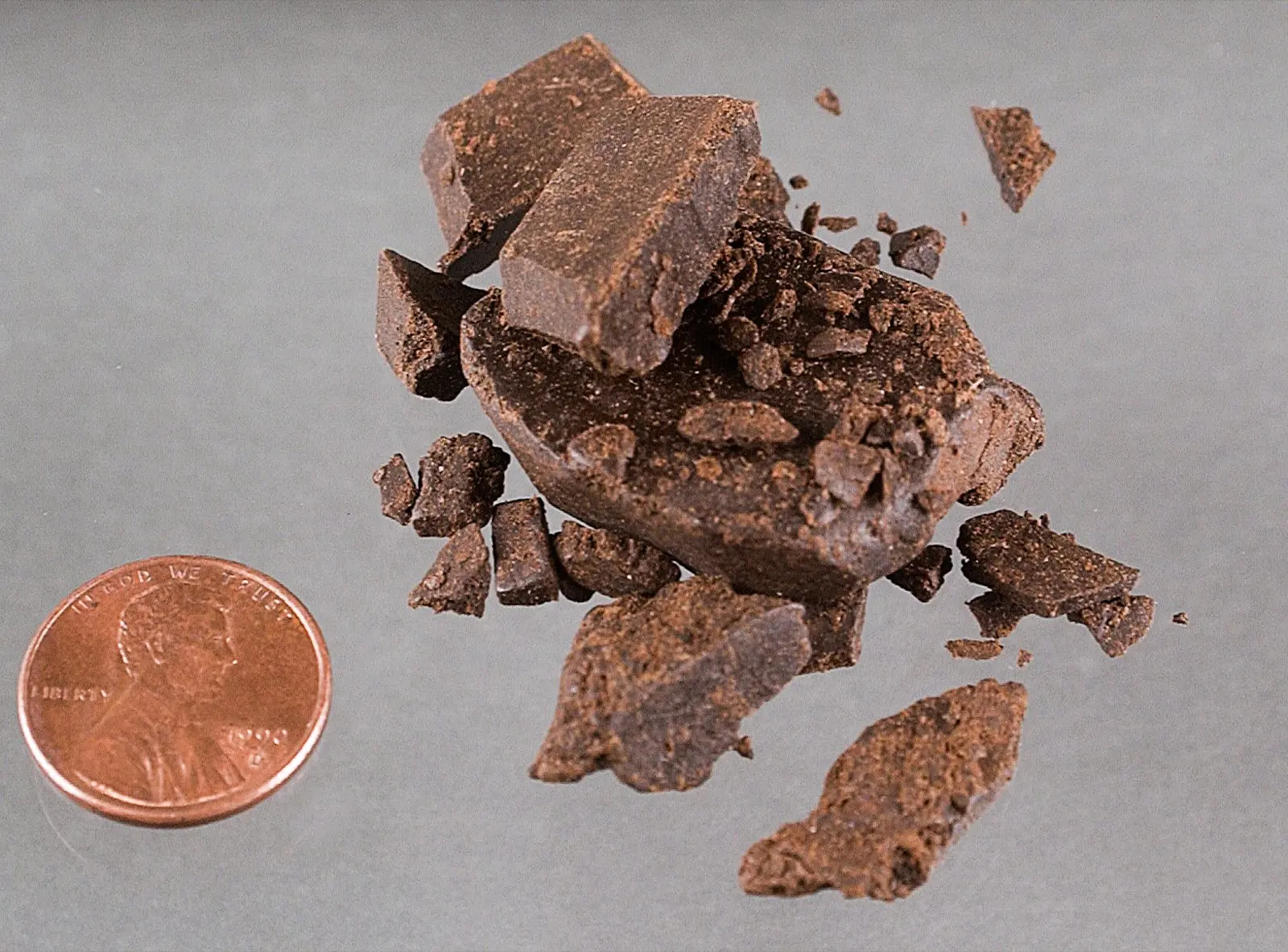
"Jaune mousseux" (literally "frothy yellow"), or just "jaune", is a French street name for a light-coloured, soft-textured THC hash sold as quality Moroccan hashish. It is a controlled drug, illegal in France, sold without any testing: neither its colour nor its texture tells you how strong it is. Resin seized in France averaged 29% THC in 2023, against 12.3% in 2011.
Contents
> Key takeaways > > - "Jaune" describes the colour and "mousseux" the texture: they are sales arguments, not test results. > - The average THC content of resin sold in France more than doubled between 2011 and 2023, according to the OFDT. > - Herb and resin sold as ordinary cannabis have been found sprayed with synthetic cannabinoids, with no visible sign. > - Use is punishable by one year in prison and a €3,750 fine; the fixed penalty has been €500 since 20 August 2026. > - CBD hash comes from hemp under 0.30% Δ⁹-THC: the same craft, a different legal status.
Definition: what "jaune" and "mousseux" mean
Both words describe what the buyer sees and feels. "Jaune" means a pale shade, from beige to blond, that the market links with a fine sift of fresh trichomes. "Mousseux" means a soft, airy paste that crumbles between the fingers and swells or bubbles when heated. In the unofficial ranking of street hash, these two signs are used to sell a product at a higher price.
The colour of a resin depends on the sift, but also on the variety, oxidation, age and pressing, as our article on resin colour explains. None of these signs works as a test: without analysis, neither the shade nor the reaction to a flame tells you the THC content or whether a cutting agent is present. Modern names such as frozen, piatella or 120u follow the same logic: our comparison of hash names shows that a name describes a method, never a strength.
The Moroccan origin that sellers claim cannot be checked either. The traditional Rif sifting, described in our article on Moroccan hash, serves as a brand image for products whose real origin nobody knows.
What resin sold in France contains
Public data describe the market as a whole, not a trade name. According to the French Monitoring Centre for Drugs and Drug Addiction (OFDT), the average THC content of resin rose from 12.3% in 2011 to 29% in 2023. For herb, it rose from 10.4% to 14.0% over the same period. The usual street price of resin stays around €8 a gram.
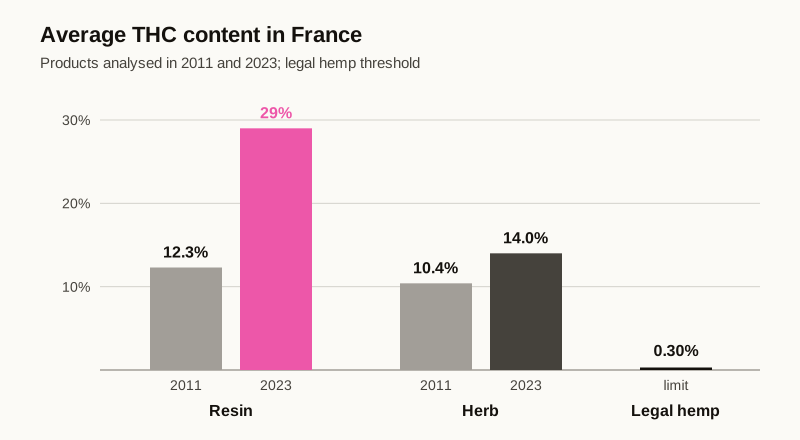
An average of 29% hides wide gaps from one sample to the next. For someone used to a weaker resin, the same amount can deliver twice as much THC.
The second risk cannot be seen. In February 2021, the OFDT's SINTES system published a note on adulterated herb and resin: products with very little THC, sprayed with synthetic cannabinoids and sold as ordinary cannabis. These molecules act at very low doses that are hard to control. Our article on the "pète ton crâne" products describes them, and the one on cut hashish explains why the eye is not enough.
What the law says about jaune mousseux
Jaune mousseux is a THC cannabis resin, and therefore a controlled drug. Article L3421-1 of the Public Health Code punishes use with one year in prison and a €3,750 fine. Since 20 August 2026, prosecution can be closed with a fixed penalty of €500, reduced to €400 for quick payment and raised to €1,000 for late payment. Buying, holding and selling carry heavier penalties.
CBD hash falls under a different framework. It is made from hemp varieties listed in the catalogue, and the order of 30 December 2021 caps Δ⁹-THC at 0.30% in the product. Our article on the legal THC limit explains where the figure comes from and how it is measured.
| Criterion | Jaune mousseux | CBD hash |
|---|---|---|
| Raw material | THC cannabis, unknown origin | Hemp of a listed variety |
| Δ⁹-THC | Not measured; 29% on average for resin seized in 2023 | 0.30% at most |
| Status | Controlled drug | Sale authorised |
| Composition | Unknown to the buyer | Measurable in a laboratory |
Harm reduction pointers
Phytogrammes sells no controlled product, and this section is not a guide to use. For someone who uses street hash anyway, four facts matter.
- Appearance does not give the strength. A pale, soft resin can be far weaker, or far stronger, than the 29% average.
- Double the strength means double the dose. For the same amount, the unwanted effects of high THC doses, anxiety, palpitations, feeling faint, become more likely.
- A synthetic cannabinoid cannot be seen. Only a laboratory analysis identifies it.
- If someone feels unwell, call 15 (the French emergency medical number) and describe what was taken: health workers are bound by medical confidentiality. For a non-urgent question, Drogues Info Service answers free of charge on 0 800 23 13 13, 7 days a week.
Driving after using THC is an offence, whatever the amount: our guide to saliva testing gives the known detection windows.
CBD hash: the same craft, a different status
The demand that jaune mousseux reveals is for craft resins, finely sifted and rich in aroma. Legal hemp uses the same techniques: dry sifting, ice-water separation, hot pressing. The vocabulary is defined in our hashish lexicon entry, and the catalogue's resins are gathered in the CBD hash, resin and pollen category.
The difference lies in what can be checked. On the analysis of a batch of CBD hash, three lines are enough: Δ⁹-THC under 0.30%, THCA, and the absence of HHC, H4CBD or THCP when the laboratory tested for them. Our guide to reading a certificate of analysis takes them one by one.
Frequently asked questions
What is "jaune" or "mousseux"?
Two French street names for a pale, soft THC hashish that swells when heated. They are seller descriptions, not technical categories: no analysis comes with these products.
Is jaune mousseux legal in France?
No. It is a THC cannabis resin, classified as a controlled drug. Use is punishable by one year in prison and a €3,750 fine, or a €500 fixed penalty since 20 August 2026. Only hemp products under 0.30% Δ⁹-THC are authorised.
Is jaune mousseux stronger than ordinary hash?
Nobody can say without an analysis. Resin seized in France averaged 29% THC in 2023, with wide gaps from one sample to the next. Colour and texture do not place a piece anywhere within that range.
How can you know what street hash contains?
Only a laboratory analysis can tell. The OFDT's SINTES system analyses samples collected from users: that is how resins sprayed with synthetic cannabinoids were spotted in France.
Is there a legal equivalent of jaune mousseux?
Finely sifted, hand-pressed CBD hashes reproduce the texture and aromas people look for, made from hemp under 0.30% Δ⁹-THC. They do not produce the effect of THC, and their composition can be checked by a laboratory analysis.
Written by the Phytogrammes team
Every article in this journal draws on primary sources (ANSM, EFSA, EUR-Lex, peer-reviewed publications) and on the lab's own practice: batch-by-batch HPLC analyses, measured cannabinoid profiles. Our approach.
Article published on . CBD is not a medicine.