CBD rosin: a solventless extract, pressed with heat
Rosin is a hemp extract made by mechanical compression: heat and pressure make the resin flow out of the trichomes, with no solvent at all. That is what separates it from BHO, extracted with butane, and from ethanol extracts. Its limit is the heat: it releases the resin, but it also converts and destroys part of the cannabinoids.
Contents
> Key takeaways > > - Rosin names a process, not a strain: a press, two heated plates, no solvent. > - It is pressed from flower, dry sift or ice water hash. > - Measured in 2016: THCA in an extract decarboxylates in about 30 minutes at 110 °C and 6 minutes at 145 °C, and CBDA twice as slowly. > - The same study shows that heat destroys part of the CBDA and CBD. > - With no solvent, rosin has no "residual solvents" line to justify; its analysis must show no more than 0.30% Δ⁹-THC.
Definition: heat and pressure, nothing else
A review published in 2025 in Frontiers in Toxicology defines rosin as a solventless extract obtained by mechanical compression, using heat and pressure. It sets it against butane hash oil, or BHO, produced by hydrocarbon extraction. The same review notes that terpenes are the second largest class of compounds in concentrates, after cannabinoids.
The principle fits in a sentence. The starting material goes into a filter bag between two heated plates and is squeezed. The softened resin passes through the filter and is collected on baking paper. What stays in the filter, fibres and debris, is thrown away.
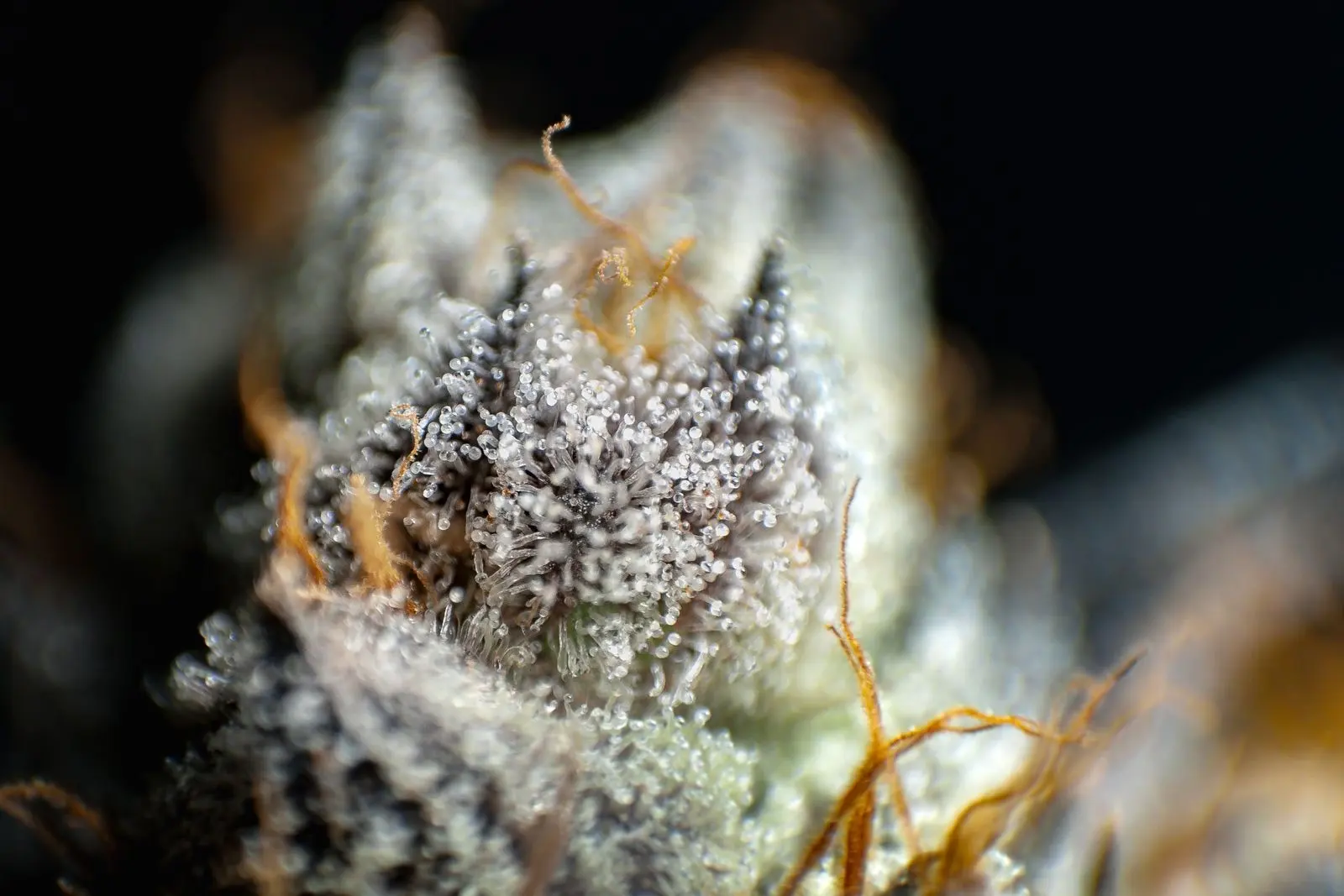
That resin comes from the trichomes. A study published in 2020 in Scientific Reports notes that cannabinoids and terpenes are produced and stored in the secretory cells of these glands, which are densest at the top of female flowers. Our article on trichomes describes these structures.
Flower, sift or hash: three starting materials
Rosin does not replace hash: it often comes from it. Three materials can be pressed.
- Dried flower. The most direct route, with no sieving step.
- Dry sift. The trichomes were first separated dry on sieves. The press works on an already concentrated powder.
- Ice water hash. The ice-o-lator method separates trichomes in cold water. The finest grades, called full melt, melt almost completely with heat.
Pressing a material that has already been sieved leaves less plant debris in the extract, at the cost of an extra step upstream. Our article on homemade CBD hash describes both separation methods.
The word "live" tells you about the plant, not the process. In market usage, "live resin" is a solvent extract made from freshly frozen plants, and "live rosin" is its pressed counterpart, made from fresh-plant hash. No scientific publication defines these terms. Our guide to live resin explains how they are used.
Temperature, the central trade-off
The press settings that circulate, in degrees and bars, nearly all come from equipment makers. We do not repeat them. The chemistry of heat, however, has been measured.
A study published in 2016 in Cannabis and Cannabinoid Research heated extracts of Cannabis sativa flowers at five temperatures, from 80 to 145 °C, for up to 60 minutes. THCA converted to THC in about 30 minutes at 110 °C, 9 minutes at 130 °C and 6 minutes at 145 °C. CBDA and CBGA reacted about half as fast as THCA.
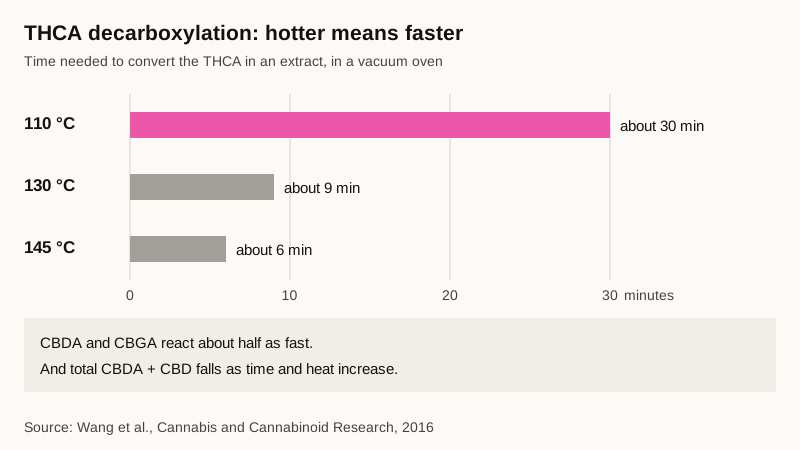
The most useful result for rosin lies elsewhere. The authors observed that the combined concentration of CBDA and CBD fell as time and temperature rose. In other words, heat does not just turn the acid form into the neutral form: it destroys part of it. CBGA lost even more. For THCA, conversion stayed almost complete.
The rule that follows is simple: press as cool and as briefly as possible while the resin still flows. That is what makes the process demanding. Our article on decarboxylation covers the chemistry in detail.
Terpenes, the most fragile fraction
Terpenes give rosin its smell. They are also the molecules that go first. In a study published in 2020 in Frontiers in Plant Science, terpenoids in stored flowers had lost more than 50% in four months, while cannabinoids lost 26% on average in a year.
Two consequences for rosin. The starting material must be recent and well stored, or the extract will smell flat. And the extract itself must be kept cold and away from air, as our article on storing rosin and crumble explains. For hot use, our guide to CBD dabbing covers equipment and temperatures.
Residual solvents: what the process avoids
An extract made with a solvent has to prove that none is left. As far as we know, there is no French or European limit specific to hemp extracts. The available reference framework is pharmaceutical: the ICH Q3C guideline on residual solvents.
| Process | Separation agent | Possible residual solvent | ICH Q3C benchmark |
|---|---|---|---|
| Rosin | Heat and pressure | No | Not applicable |
| Dry sift, static sift | Sieves, cold | No | Not applicable |
| Ice-o-lator | Water and ice | No | Not applicable |
| Ethanol extract | Ethanol | Yes | Class 3: 5,000 ppm |
| Hexane extract | Hexane | Yes | Class 2: 290 ppm |
| BHO | Butane, propane | Yes | Not in the tables |
Butane and propane do not appear in the ICH Q3C tables: other rules, specific to cannabis in some countries, cover them. For a solvent extract, the "residual solvents" section of the certificate of analysis is therefore essential. Our article can CBD hash contain solvents? shows how to read it. For rosin, that line does not apply, but the rest of the analysis still matters: cannabinoids, heavy metals, pesticides.
Reading the analysis of a CBD rosin
French law does not treat rosin differently from other extracts. The decree of 30 December 2021 caps the Δ⁹-THC content of hemp extracts and of products containing them at 0.30%. In theory, pressing concentrates all cannabinoids, THC included: an extract made from compliant material is not automatically compliant. Only the batch analysis tells you.
On the certificate, look at four lines: the batch number, Δ⁹-THC, the CBDA and CBD pair, and terpenes when they are measured. The ratio of CBDA to CBD reflects the heat received: the stronger it was, the more the neutral form dominates. Our guide to the certificate of analysis goes through each section.
In the catalogue, the Rosift product, presented as a CBG/CBD hash rosin, shows 18.4% CBG, 3.9% CBD and 0.1% Δ⁹-THC on batch PG-26-EF5C (product page checked on 23 September 2026). Other solventless resins are grouped in the resins, hash and pollens category.
Frequently asked questions
Does CBD rosin contain solvents?
No. Rosin is defined as an extract obtained through heat and pressure, without solvent. No extraction solvent residue can therefore be present. Other checks, such as heavy metals and pesticides, remain useful.
What is the difference between rosin and hash?
Hash is a resin of trichomes separated dry or in ice water, then gathered together. Rosin is what flows out when you press flower, sift or hash with heat. Hash can therefore become rosin.
What is the difference between rosin and live rosin?
"Live" means the starting material was frozen fresh, without drying. In market usage, live rosin is pressed from fresh-plant hash. No scientific definition governs the term.
Why does press temperature matter so much?
Because heat makes the resin flow, but it also converts CBDA into CBD and destroys part of it. The 2016 study observed that combined CBDA and CBD fell as temperature and time rose. Pressing hotter makes extraction easier and the extract poorer.
Is CBD rosin legal in France?
Yes, if it comes from authorised hemp and its Δ⁹-THC does not exceed 0.30%, like any hemp extract. Only the batch analysis can confirm it.
Written by the Phytogrammes team
Every article in this journal draws on primary sources (ANSM, EFSA, EUR-Lex, peer-reviewed publications) and on the lab's own practice: batch-by-batch HPLC analyses, measured cannabinoid profiles. Our approach.
Article published on . CBD is not a medicine.