Live resin CBD: what freezing the plant really changes
Live resin is a concentrate extracted with a solvent (butane, propane or CO2) from hemp frozen right after harvest, with no drying or curing. The aim is to keep the monoterpenes, the most volatile terpenes, which drying reduces in some varieties. We found no published study comparing live resin with a standard extract made from the same plant: the aroma advantage remains an industry claim.
Contents
> Key takeaways > > - Live resin: solvent plus fresh frozen plant. Live rosin: no solvent and no drying, the resin is heat-pressed. > - In one CBD variety air-dried for a week, monoterpenes fell from 58.7% to 46.5% of the volatile oil. > - In two other varieties dried at 15 °C, total terpene content actually went up. > - Storage matters more than method: dried flowers lost more than half of their terpenes in four months. > - Butane and propane have no limit in the ICH Q3C guideline: only the batch analysis tells you what is left.
Definition: a solvent extract of fresh plant material
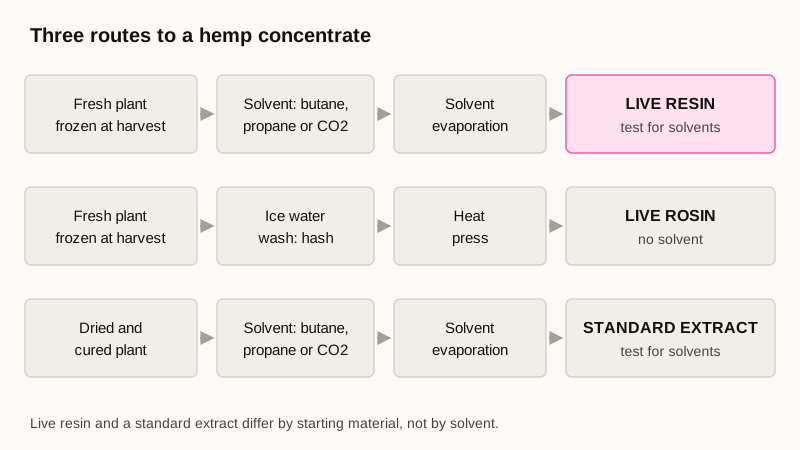
The word "live" describes the starting material, not a method. The plant is cut and frozen at once, and that frozen material goes to extraction. Two products carry the word, and they are not made the same way.
| Product | Starting material | Process | Possible residual solvent |
|---|---|---|---|
| Live resin | Fresh frozen plant | Solvent: butane, propane or CO2 | Yes, needs testing |
| Standard extract (wax, shatter, crumble) | Dried and cured plant | Same solvents | Yes, needs testing |
| Live rosin | Ice water hash made from frozen plant | Heat and pressure | No, by design |
| Rosin | Dried flower or hash | Heat and pressure | No, by design |
The review by Lazarjani and co-authors, published in 2021 in the Journal of Cannabis Research, describes gas extraction: butane or propane, liquefied by cold or pressure, flows through the plant and is then evaporated. The authors point to two risks. Pressurising flammable gases is dangerous, and the gases used are often industrial grade, with impurities that end up in the extract. The solvent itself can remain as a residue. For CO2, they give the critical point: 31.06 °C and 73.83 bar, above which it becomes "supercritical" and dissolves cannabinoids. Our article on supercritical CO2 extraction covers that process.
Live rosin starts from a hash made by washing the plant in ice water, the ice-o-lator method, which is then pressed between two heated plates. The same review notes a limit of pressing: very high pressure cannot be combined with low temperature, which limits terpene retention. Our article on rosin describes the press, and the one on wax concentrates covers the textures of solvent extracts.
The term is still trade vocabulary. Searching PubMed, the US National Library of Medicine database, for the phrase "live resin" returns no study of this product (search of 23 September 2026). So nobody has measured, in a peer-reviewed paper, what freezing adds to the finished product.
What drying does to terpenes: the data disagree
The case for live resin rests on one idea: drying drives terpenes off. Published measurements give a more nuanced answer, which depends on the variety and on how the plant is dried.
One figure is everywhere, "31% of terpenes lost in a week", credited to a 1996 study. The abstract of that study by Ross and ElSohly gives no percentage. It says drying did not change the qualitative make-up of the volatile oil, and that people familiar with the smell still recognised it. So we do not repeat that figure.
The closest data come from Wanas and co-authors, in 2020 in Natural Product Communications. The team split mature buds of three varieties into two batches: one distilled fresh, the other after a week of air-drying at room temperature. In the CBD variety, monoterpenes fell from 58.7% to 46.5% of the volatile oil, and myrcene, the dominant terpene, from 27.5% to 17.1%. The THC variety also dropped, from 33.7% to 25.5%. The intermediate variety barely moved.
Two cautions. These are relative shares of the volatile oil, not milligrams lost per gram of plant: the monoterpene share also falls because other compounds rise. And the paper contradicts itself: its abstract reports no notable change for the CBD variety, while its tables show the drop.
A study by Birenboim and co-authors, published in 2024 in Plants, dried two varieties at 15 °C, over six to fifteen days depending on the method. In the THC-rich variety, total terpene content rose by 25 to 30% during drying, because the plant loses water and everything becomes more concentrated. Myrcene fell by 3 to 20% in that variety, and by 16 to 30% in the other. The authors confirm that monoterpenes are more sensitive than the heavier sesquiterpenes.
Put together, the data say this: slow, cool drying reduces the most volatile monoterpenes, sometimes clearly, without emptying the plant. Freezing skips that step. It does not prevent the losses that come afterwards. Our article on drying and curing flowers describes those steps, and the one on the role of terpenes covers their chemistry.
Storage matters more than the method
The most useful finding for a buyer is about what happens next. Milay and co-authors, in 2020 in Frontiers in Plant Science, stored dried and cured flowers at −80 °C, −30 °C, 4 °C and 25 °C for a year. On average, terpenoid concentration fell by more than 50% after four months, at every temperature. The terpenoid decline was in fact generally steepest at −80 °C. Cannabinoids lost 26% over twelve months, and changed most at 25 °C. Ground flowers lost their terpenes faster than whole buds.
The authors note something unexpected: monoterpenes and sesquiterpenes followed similar trends despite very different volatilities. The study covers flowers, not concentrates. We found no equivalent published measurement for an extract.
The practical point: whatever aromatic edge live resin has, it plays out in the first months. If concentrates behave like flowers, an extract kept for a few months has lost much of what justified its price, however the plant was handled. Cool storage mainly protects the cannabinoids; the study shows no benefit of deep cold for terpenes. Closed container, away from light: our guide to storing rosin, wax and crumble sets out the rules.
Residual solvents: the line to look for on the analysis
Live resin extracted with butane or propane should be tested for residual solvents. The reference point is the ICH Q3C guideline, which the European Pharmacopoeia adopts. It sorts solvents into three groups:
| ICH Q3C class | Examples | Limit |
|---|---|---|
| 1: to be avoided | Benzene | 2 ppm |
| 2: to be limited | Hexane, methanol | 290 ppm, 3,000 ppm |
| 3: low toxic potential | Ethanol, pentane, heptane, acetone | 5,000 ppm, or 0.5% |
Butane and propane, the two gases most used for this kind of extract, appear in none of these tables. So there is no pharmacopoeia limit to hold them to. And these standards govern medicines: a hemp extract sold in France is not legally bound by them. They remain the reference a serious laboratory uses to put a result in context.
On the certificate of analysis, look for a "residual solvents" line that names butane and propane, with the laboratory's limit of quantification and a batch number matching the product's. A certificate that only tests cannabinoids says nothing about solvents. Our article on solvents in hash and our guide to reading a certificate of analysis go through each line; the laboratory page describes the methods.
The French rules: 0.30% applies to the extract itself
Whatever the method, section III of article 1 of the order of 30 December 2021 caps Δ⁹-THC at 0.30% in hemp extracts and in the products that contain them. The cap applies to the live resin itself, not only to the plant it came from. A concentrate packs the cannabinoids of a lot of plant material into a few grams: THC concentrates along with CBD, and a batch analysis is the only way to check the threshold.
A concentrate sold as "CBD" can also contain an added semi-synthetic cannabinoid. HHC, H4CBD and THCP are classified as narcotics in France; our article on the H4CBD ban gives the timeline. Concentrates are vaporised rather than smoked: our dab guide gives the temperatures. The catalogue's resins are listed under CBD resins and hash.
Frequently asked questions
What is live resin?
It is a concentrate extracted with a solvent (butane, propane or CO2) from hemp frozen just after harvest, instead of being dried and cured. The aim is to keep the most volatile terpenes.
What is the difference between live resin and live rosin?
Live resin is extracted with a solvent. Live rosin is made without one: the frozen plant is washed in ice water to make a hash, which is then heat-pressed. The first needs a residual solvent test, the second produces no residue.
Does live resin contain more terpenes than a standard extract?
Nobody has measured it variety for variety in a published study. Drying lowers the monoterpene share in some varieties, from 58.7% to 46.5% of the volatile oil in a 2020 study, but not in all of them.
How should live resin be stored?
Cool, away from light, in a closed container, and without waiting too long. In a 2020 study on dried flowers, terpenes fell by more than half in four months at every temperature tested, even at −80 °C.
Is live resin CBD legal in France?
Yes, if it comes from authorised hemp and the extract itself contains no more than 0.30% Δ⁹-THC, with no HHC, H4CBD or THCP. Only a batch analysis can confirm it.
Written by the Phytogrammes team
Every article in this journal draws on primary sources (ANSM, EFSA, EUR-Lex, peer-reviewed publications) and on the lab's own practice: batch-by-batch HPLC analyses, measured cannabinoid profiles. Our approach.
Article published on . CBD is not a medicine.