Best CBD: 7 checks you can verify before buying
There is no "best CBD" in the absolute: there are products whose claims can be verified and products whose claims cannot. Seven criteria are enough to sort them: the batch analysis, the gap between stated and measured levels, THC, the absence of synthetic molecules, the variety, a legal format and the price per gram. All of them can be checked in a few minutes, before you pay.
Contents
> Key takeaways > > - Of 223 products sold as CBD and tested in France, only 19% had a CBD level matching the label within 20%. > - 12.6% exceeded the legal threshold of 0.3% Δ⁹-THC. > - The document that counts is the analysis of the batch you buy, not of the variety. > - Since May 2026, CBD to swallow can no longer be sold in France as food. > - Compare prices per gram, at the pack size you actually buy.
Why a ranking is not enough
"Top 10" rankings do not say how their positions are set. The reader can neither repeat the test nor check the score. Yet the market has a documented problem, and it concerns what the product actually contains.
In 2023 the addiction-monitoring centres of Paris, Lyon and Montpellier had 223 products sold as CBD analysed, bought in shops, online and in pharmacies. Their report, funded by MILDECA, the French interministerial drugs agency, is harsh. Only 19% of samples had a CBD content matching the label, within a 20% margin. When there was a gap, the real level was lower in 69% of cases. And 46% of samples carried no composition at all.
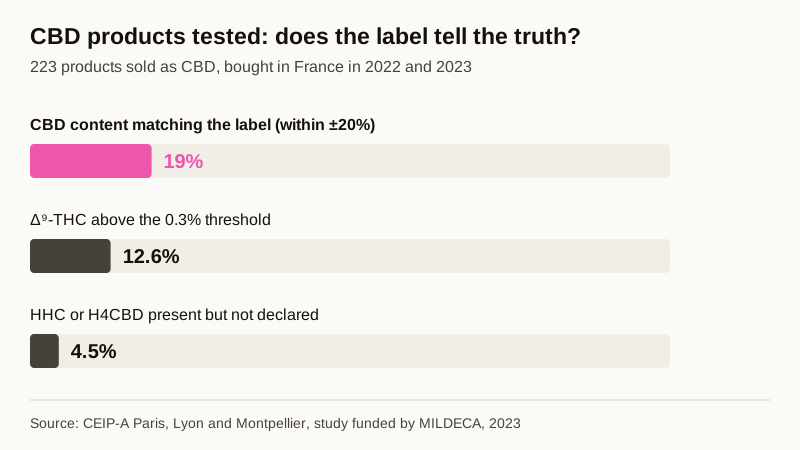
The same report found that 12.6% of products exceeded 0.3% Δ⁹-THC, and that 4.5% contained HHC or H4CBD without declaring it. The ANSM and ANSES issued a joint warning in June 2025, after several hundred poisonings recorded since 2024. A checklist answers this problem better than a league table: it does not say who is best, it says how to check what a product claims.
The 7 criteria you can verify
1. The batch analysis, not the variety's
The certificate of analysis must cover the batch you are buying: the same batch number as the pouch, a date, the laboratory's name. A generic analysis of the variety, or one that is two years old, proves nothing about your product. A "lab tested" mention with no document to consult remains a sales pitch.
The method matters too. Liquid chromatography (HPLC) measures acid forms such as THCA without converting them with heat. Our laboratory page describes the measurement methods, and our guide to the certificate of analysis goes through each line. To judge the lab itself, see how to check its accreditation.
2. The gap between stated and measured levels
A product says "CBD 10%": the certificate must show a measured figure, with decimals. The 2023 study counted a product as compliant if the real level was within 20% of the claim, so between 8 and 12% for a "10%". That is a good benchmark. A round figure, identical from batch to batch, should raise a flag: a plant varies from one harvest to the next.
3. Δ⁹-THC below 0.30%, with THCA next to it
The order of 30 December 2021 caps Δ⁹-THC at 0.30% in hemp, its extracts and the products that contain them. Also look at the THCA line: this acid form turns into THC when heated. In the 2023 study, adding THC and THCA together, one sample in five exceeded 0.3%. Our article on the legal THC level explains the threshold in detail.
4. No synthetic cannabinoids
The ANSM classified H4CBD, THCP and other derivatives as narcotics from 3 June 2024, after HHC in 2023. A serious certificate states whether the lab tested for them. A product sold as "stronger" with no figures to back it deserves a second look: both health agencies warn that such products can be the most dangerous. Our article on synthetic cannabinoids explains how to spot them.
5. A named variety, a stated origin
A compliant flower comes from a hemp variety listed in the EU common catalogue of varieties. A serious seller can tell you which variety the batch comes from and in which country it was grown. "Exclusive genetics" is not a variety name. Our guide to reading the EU catalogue shows how to search it.
6. A format the law allows
The best product on paper is worth nothing if it cannot be sold legally. On 20 May 2026 the French Ministry of Agriculture declared foods containing CBD illegal, food supplements included, under the novel food regulation. Checks began on 15 May 2026, according to the Provence-Alpes-Côte d'Azur chamber of agriculture. CBD gummies, capsules, oils to swallow and drinks are all affected.
What remains are flowers and resins, which are not foods, and cosmetics for use on the skin. Our overview of the 2026 rules explains the split, and our article on labelling covers what each format's label should say.
7. Price per gram, at the pack size you actually buy
Displayed prices are hard to compare: different pack sizes, promotions, volume discounts. The only comparable figure is the price per gram at the size you buy. Divided by the measured level, it also shows what you pay per gram of CBD. Our article on CBD prices in 2026 gives the observed ranges.
Applying the checklist: a worked example
Take two fictitious flowers. Flower A costs €24 for 3 g and claims 12% CBD; its batch certificate shows 9.1%. Flower B costs €65 for 10 g, claims 10% and measures 9.6%.
| Flower A | Flower B | |
|---|---|---|
| Price per gram | €8.00 | €6.50 |
| Stated / measured level | 12% / 9.1% | 10% / 9.6% |
| Gap from the claim | 24%, outside the margin | 4%, within the margin |
| Price per gram of measured CBD | €88 | €68 |
Flower A looked the richest. Once the certificate is read, it is the most expensive and the least faithful to its label. The sum takes two minutes. It assumes the certificate exists, carries the right batch number and shows Δ⁹-THC below 0.30%.
The same checklist works for a resin. To compare real batches, see our CBD flowers category and our resins, hash and pollens category.
Warning signs that should make you walk away
- A health claim. A product presented as curing a disease becomes a medicine under Article L5111-1 of the French Public Health Code. The only authorised CBD medicine is Epidyolex, available on prescription.
- No batch number on the pack: no traceability, and no link to an analysis.
- A seller with no identity: no company name, no address. Our article on the legal notices of a CBD website lists what must appear.
- CBD to swallow sold as food after May 2026.
Customer reviews add to this check without replacing it. Our article on how reliable CBD reviews are helps sort the ones that matter.
Giving CBD as a gift: who to leave out
Even a compliant product is not advised for minors or for pregnant or breastfeeding women. The same goes for people on medication: the ANSM and ANSES point out that CBD taken with some medicines can reduce their effectiveness or increase their side effects. The same agencies advise drivers against it, because of residual THC. For a gift, a CBD cosmetic remains the simplest choice.
Frequently asked questions
Which CBD should a beginner choose?
The one whose evidence is readable: a batch analysis, a measured level close to the claim, a named variety, Δ⁹-THC below 0.30%. The format then depends on use, within what the law allows in 2026.
Does a high price guarantee quality?
No. Price reflects costs and commercial choices. The gap between label and certificate measures quality; the price per gram is for comparing, not judging.
Is a product without a certificate of analysis necessarily bad?
Not necessarily, but nothing lets you check it. In 2023, four products in five tested in France did not contain the stated level within 20%: without a batch analysis, you are buying a promise.
Is organic CBD better?
The organic label covers farming, pesticides in particular. It says nothing about the CBD level or THC. It complements the batch analysis without replacing it.
Can you still buy CBD oil to swallow?
Not as food or a food supplement. The Ministry of Agriculture declared these products illegal on 20 May 2026. An oil sold as a cosmetic falls under a different regime, for use on the skin.
Written by the Phytogrammes team
Every article in this journal draws on primary sources (ANSM, EFSA, EUR-Lex, peer-reviewed publications) and on the lab's own practice: batch-by-batch HPLC analyses, measured cannabinoid profiles. Our approach.
Article published on . CBD is not a medicine.